Calendula Oil Safety: How Much to Use and Who Waits
People often ask us for the dose of calendula oil, and the honest answer is that a skin oil does not have one. There is no milligram figure to hit. What you can get right is how much you put on, how often, how long you keep going, and when to stop. Those habits matter more than any number, and they are easy to learn.

Calendula Oil
Our own small-batch calendula oil, in sizes from 0.5 oz to bulk.
From $13.99
Shop Calendula Oil →EU herbal monograph dosing schedule for traditional use
The nearest thing to a published schedule comes from the European herbal committee, and it was written for licensed traditional medicines, not for a cosmetic oil like ours. Its monograph describes applying a thin layer of a semi-solid preparation to the affected area two to four times a day, and says that if symptoms last longer than a week, a doctor or qualified health care practitioner should be consulted (European Union herbal monograph on Calendula officinalis L., flos).
We read that as a useful frame rather than a recipe. Notice what it emphasizes: a thin layer, a modest number of applications, and a short window before you check in with someone. Nothing in it suggests that more oil, or a thicker coat, does more. As a suggestion of ours, not a measured figure, start with just a few drops warmed between your palms; a larger amount mostly ends up on your sleeves.
What does a safe everyday calendula oil routine look like?
We keep things simple. Use a small amount on clean, intact skin, keep it away from your eyes, and build up gradually. The Cosmetic Ingredient Review panel looked at calendula-derived cosmetic ingredients and found them safe as used in cosmetics, not irritating, sensitizing or photosensitizing in the animal and clinical tests it reviewed, though they may be mild irritants to the eyes (Final report of the Cosmetic Ingredient Review Expert Panel amended safety assessment of Calendula officinalis-derived cosmetic ingredients). Reasoning from that, a bottle that is kept well away from the eye area is a sensible default.
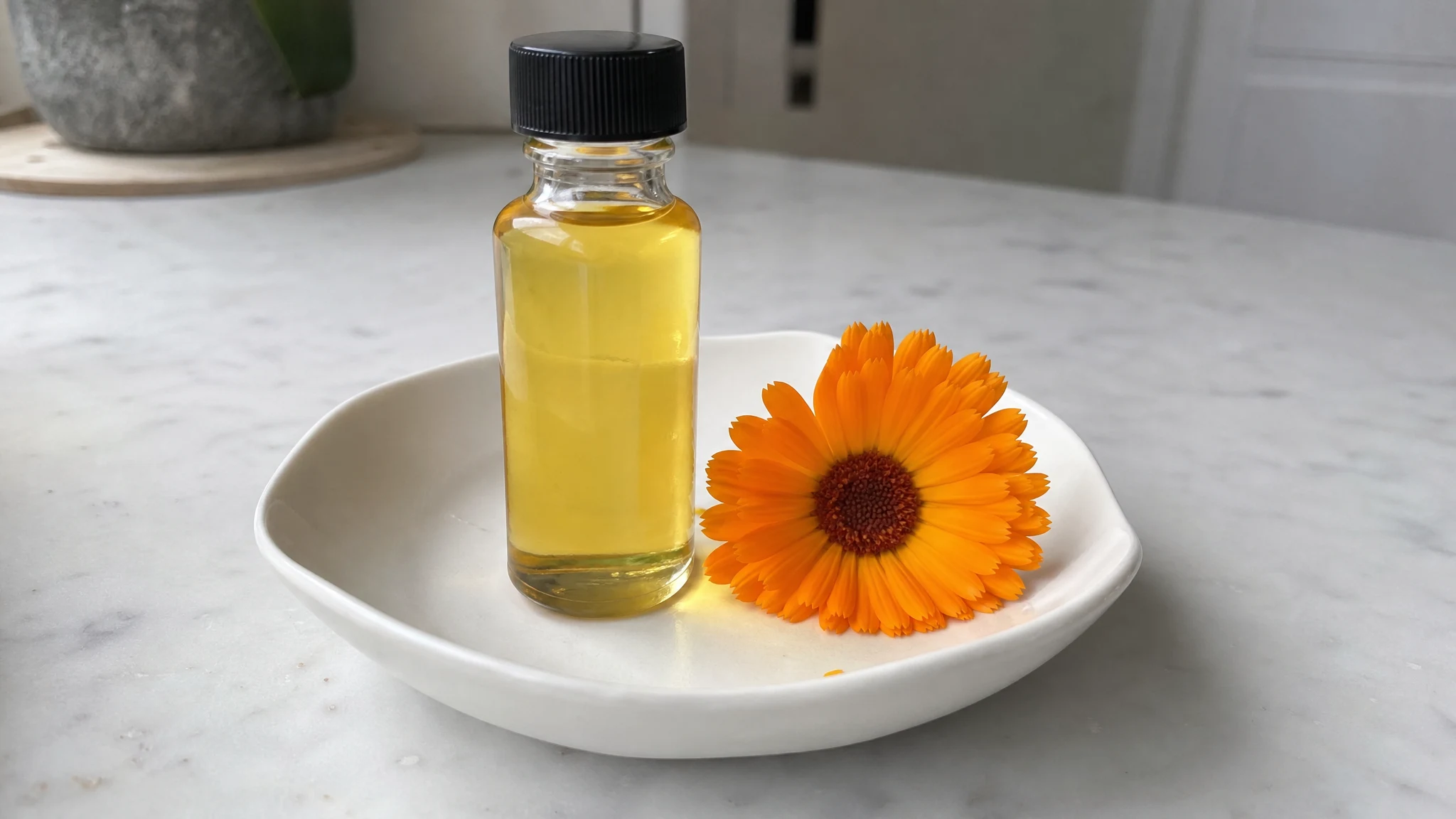
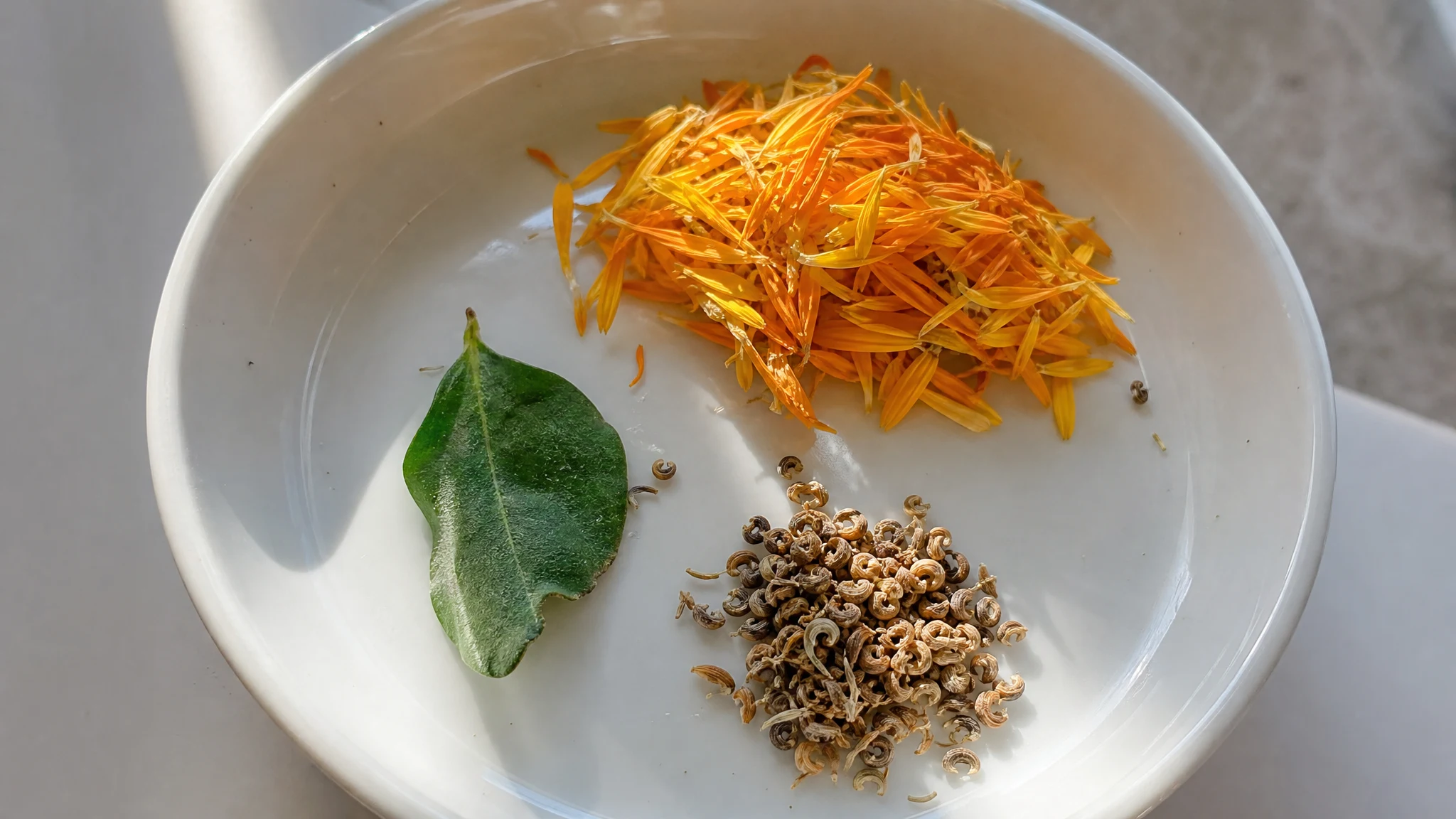
Our oil is a whole-flower infusion carried in oil with nothing else added, no preservatives, tocopherol or stabilizers, so there is no fragrance or extra ingredient to wonder about. Which carrier oil it is made in is on the batch paperwork; email the lot number from your bottle to [email protected] and we will send it along. That detail is worth knowing if you have a nut, seed or other allergy.
Why is a patch test the key calendula habit?
Calendula is in the daisy family, along with ragweed, chamomile and chrysanthemums, and the EU monograph lists allergy to plants in that family as a contraindication. It also notes skin sensitization has been reported, with the frequency unknown. A patch test costs you a week and very little oil. Dermatologists do this with a repeated open application test: a survey of American Contact Dermatitis Society members found the leave-on product most often goes on twice a day, on the forearm, for one or two weeks, with no standard method agreed (Clinical Utilization of Repeated Open Application Test Among American Contact Dermatitis Society Members). Our patch test guide shows how to do it at home, and our ragweed article explains why the plant family matters.
Redness, itching, bumps or burning are your cue to stop. If something does not settle, that is a question for a professional, not for more oil.
Starting calendula oil in one area, once daily
The best way to learn how your skin feels about an oil is to go slowly. Use it in one place, once a day, for the first few days. Notice how the skin looks and feels in the morning. If it is comfortable, you can add a second application, or move to another area, one change at a time. It is a quiet, unglamorous approach, and it works with any new product, ours included.
Daisy allergy, pregnancy and young children: who should wait
- Anyone with an allergy to daisy-family plants. We would skip our oil.
- Anyone who is pregnant or breastfeeding. The EU monograph says safety has not been established, so please ask your midwife or OB/GYN. We go through the details in our pregnancy article.
- Parents of children under six, where the monograph says skin use has not been established. Our article on babies has the questions to take to a pediatrician.
- Anyone with a wound that is open, weeping or not closing, or with a diagnosed skin condition. A clinician should see those first.
How thin is a thin layer of oil?
"A thin layer" is easier to describe than to picture, so here is how we would show it. Put two or three drops in your palm, rub your hands together, and then smooth them over the area. The skin should look lightly glossy, not wet. If oil drips, or you can see beads sitting on top, you used too much, and a tissue will take the extra.
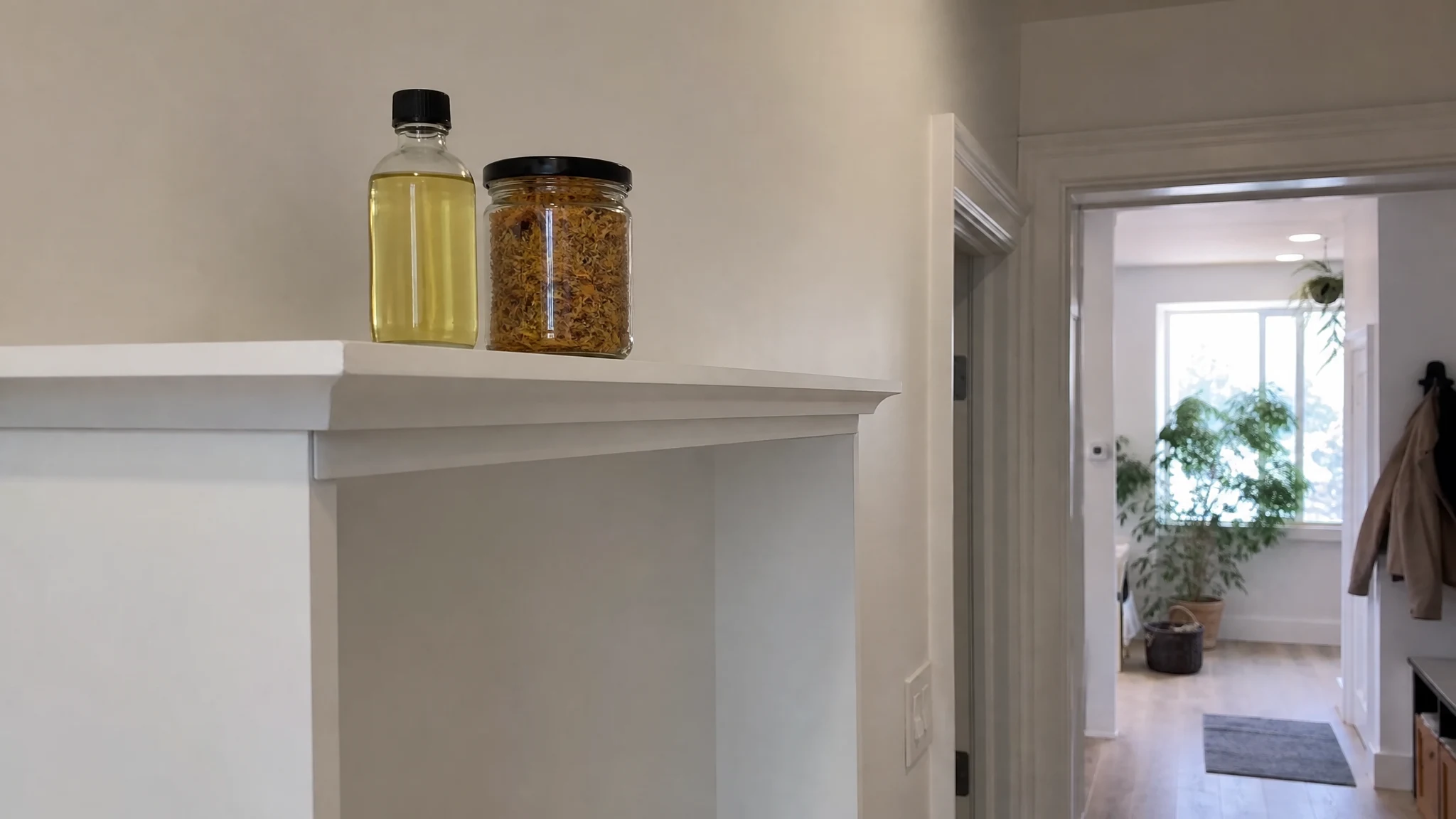
Give it a few minutes before you dress. The oil is golden-orange, so it is kind to your clothes to let it sink in first. Keep the cap on tight when you finish, and wash your hands, so that a bit of oil does not find its way to your eyes later.
Why calendula oil guidance avoids doses and schedules
Our oil is a cosmetic, sold for external use on healthy skin, and we give no instructions for swallowing it. Talking about doses, schedules and target conditions belongs to medicine, which is a different category with different rules. What we can offer is a plain-spoken approach: a thin layer, a patch test, a short check-in window, and attention to how your skin responds.
If you ever want to know exactly what went into your bottle, send us the lot number and we will share what the batch paperwork says. We would rather you ask than guess.
Calendula Oil
Nature's Golden Botanical, bottled: small-batch calendula oil in sizes from 0.5 oz to bulk.
From $13.99
Shop Calendula Oil →Sources & Further Reading
- European Union herbal monograph on Calendula officinalis L., flos (EMA/HMPC/437450/2017)
- Final report of the Cosmetic Ingredient Review Expert Panel amended safety assessment of Calendula officinalis-derived cosmetic ingredients (Andersen et al., 2010)
- Clinical Utilization of Repeated Open Application Test Among American Contact Dermatitis Society Members (Brown et al., 2015)