Homemade Calendula Lip Balm: Why the Wax Matters
A lip balm has two jobs, and they are done by two different ingredients. The oil gives it softness and glide, and the wax gives it staying power. If you are making your own with calendula oil, the fun part is the oil, but the part that decides how well the balm works is the wax.

Calendula Oil
Our own small-batch calendula oil, in sizes from 0.5 oz to bulk.
From $13.99
Shop Calendula Oil →Ointments, waxes and oils for chapped lips
The American Academy of Dermatology has a page of tips for dry, chapped lips, and one line on it shapes how we think about homemade balms: ointment seals in water longer than waxes or oils. For lips that are very dry and cracked, it suggests a thick ointment such as white petroleum jelly. That is useful to know before you pour a single tin. A liquid oil on its own sits on the lips for a short while and then wears off, while an oil set with beeswax lasts longer. So when we think about calendula oil in a balm, we think of it as the soft, pleasant part of a recipe that needs a good proportion of wax.
Calendula has a long tradition in skin care, and we love it for that. The research on calendula is mostly about other kinds of skin, so we think of a calendula balm as a lovely everyday balm, not a first aid kit for lips that are already split. For those days, keep a plain petroleum jelly on hand and use it first.
Beeswax to infused oil starting ratio for lip balm
One widely used starting ratio comes from Mountain Rose Herbs, whose basic body salve uses 1 ounce of beeswax to 4 ounces of infused oil. That is a salve meant for skin in general, and lip balms are usually made firmer so they hold their shape in a tube or tin. So the arithmetic suggestion is to raise the wax share a little, make a small batch, let it set, and adjust: more wax for a firmer balm, more oil for a softer one. Warm the wax gently, stir in the oil, pour, and let it cool.
Because there is no water in an oil-and-wax balm, it is among the simplest homemade products to keep. Water-based things like hydrosols or aloe are a different story and need proper preservation, so we would keep a first balm to oil and wax only. Our salve article goes into the beeswax method in more detail.
Which tins and tubes suit homemade lip balm?
Part of the pleasure of a homemade balm is the container. Small metal tins, little screw-top jars and push-up tubes are all easy to find at a craft shop, and each one changes how the balm behaves. A shallow tin is quick to fill and easy to dip a fingertip into. A tube keeps your fingers out of it, which is tidier in a pocket. Whichever you choose, wash it well and let it dry completely before you pour, because a single drop of water left inside is exactly what we want to keep out of an oil-and-wax balm.
Pour while the mixture is still liquid but not scalding, and let the tins sit undisturbed on a flat surface. Resist the urge to move them as they cool. A balm that sets in peace has a smooth, even top.
Which ingredients irritate chapped lips?
The same dermatology page lists ingredients that can bother lips when they are chapped: camphor, eucalyptus, menthol, fragrance, lanolin, and flavorings such as cinnamon, citrus, mint and peppermint. That list covers many favorite lip balm additions. If you want a minty or citrusy balm, wait until your lips are comfortable, and if a balm ever stings, stop using it. For a calendula balm, simple really is better: oil, wax, nothing else. The oil we make has nothing else in it either, just calendula extract brought into a carrier oil, with no preservatives, tocopherol or stabilizers.
The page also says licking your lips makes them drier, since the moisture evaporates, and that a balm in your pocket is a better habit than a wet lip. If your lips have not improved after two to three weeks of careful self-care, it recommends seeing a board-certified dermatologist.
Does calendula balm protect lips from sun?
Lips burn too, and the AAD suggests a non-irritating lip balm with SPF 30 or higher before going outdoors. A calendula balm is a different kind of product. We do not claim any sun protection for our oil, so if you are outside for any length of time, use a lip balm that is made and labeled for the sun, and keep your calendula balm for the rest of the day.
Calendula balm color and scent when opened
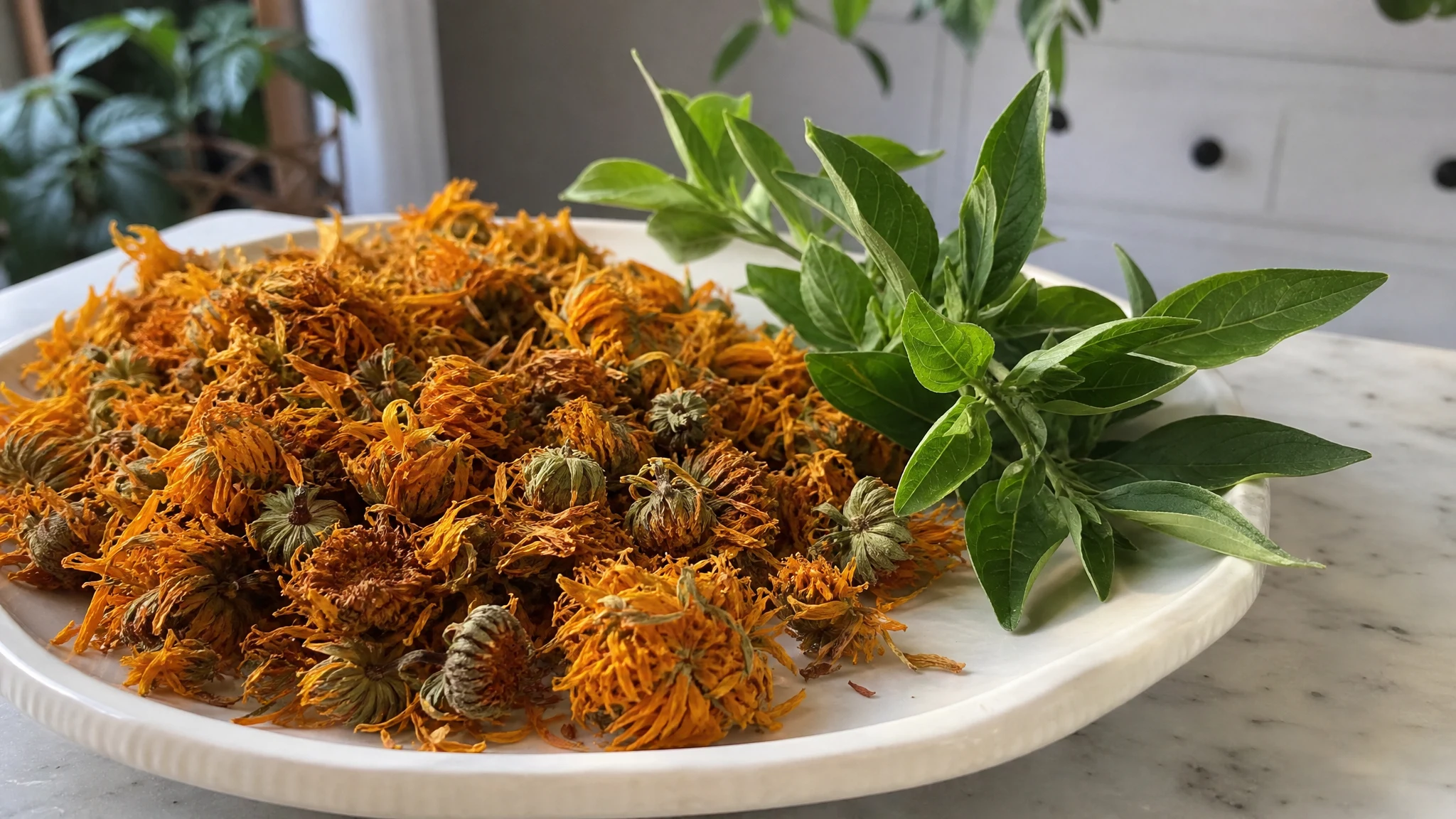
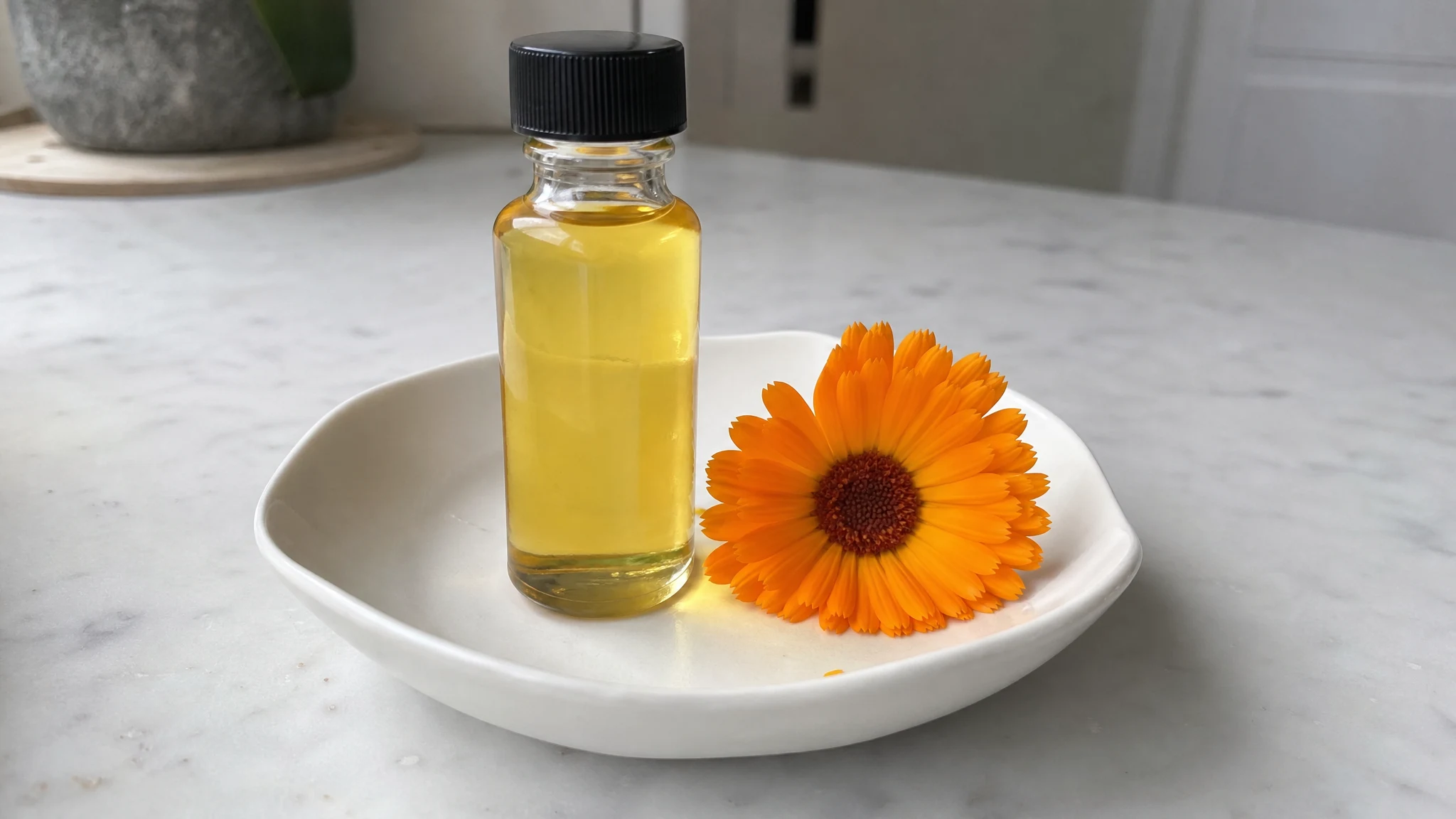
A balm made with calendula oil carries a faint golden color, and when you lift the lid you may catch a soft, warm, lightly herbal aroma from the flowers. It will not smell like a flavored balm from a drugstore, and we think that is part of the charm. Run a fingertip across the surface and notice how firm it feels. If it drags, the balm has too much wax for your taste; if it smears like thick oil, it needs a little more. Write the proportions on a label or in a notebook each time you make a batch, so the version you love is one you can make again.
A small batch also makes a thoughtful, inexpensive gift. Tuck one in a pocket, put a date on the lid, and you have something that came from your own kitchen.
Patch testing calendula oil before lip use
Lips are a place where whatever you put on is partly swallowed or licked off, so it is worth knowing your skin gets along with calendula. It belongs to the daisy family, Asteraceae, and the EU herbal monograph lists a known allergy to plants in that family as a reason not to use it. In one Austrian series of 443 people being patch-tested, 9 reacted to marigold. Try the oil on your inner forearm for a few days first, and skip it if you react. Our patch test guide shows a simple way to do it. The monograph also says safety during pregnancy and breastfeeding has not been established, so ask your OB/GYN or midwife if that applies to you, and it does not recommend skin use for children under 6.
If you want to know which carrier oil is in our bottle, for a nut allergy or for how the finished balm will feel, email us the lot number through the contact page and we will send you the batch paperwork. The sun question is its own subject, and our SPF article goes through it, and the storage guide shows how to keep a finished balm in good shape.
Make a small tin, carry it with you, and let your own lips tell you whether you have the proportions right.
Calendula Oil
Nature's Golden Botanical, bottled: small-batch calendula oil in sizes from 0.5 oz to bulk.
From $13.99
Shop Calendula Oil →Sources & Further Reading
- American Academy of Dermatology, "7 dermatologists' tips for healing dry, chapped lips." aad.org
- Mountain Rose Herbs, "How to Make Herbal Salves." blog.mountainroseherbs.com
- European Medicines Agency, "European Union herbal monograph on Calendula officinalis L., flos" (EMA/HMPC/437450/2017). ema.europa.eu
- Reider N et al., 2001. "The seamy side of natural medicines: contact sensitization to arnica (Arnica montana L.) and marigold (Calendula officinalis L.)." Contact Dermatitis. PubMed 11722485