Dry Winter Skin and Calendula Oil: A Layering Guide
By midwinter, most of us know the feeling: hands that tighten after washing, shins that flake, a face that stings in the wind. Calendula oil can play a part in the answer, and its role is a specific one. An oil has no water of its own, so it works as a seal rather than a drink. Understanding that one idea makes the whole winter routine easier to build.

Calendula Oil
Our own small-batch calendula oil, in sizes from 0.5 oz to bulk.
From $13.99
Shop Calendula Oil →How does winter change skin hydration?
Dryness in winter is something researchers can measure. In a study that followed 72 healthy women in Kunming, China through the four seasons, skin hydration on the cheek was lowest in winter while the rate of water loss through the skin peaked then (Seasonal variations of epidermal biophysical properties in Kunming, China: A self-controlled cohort study). It is one city and one group of young women, so the size of the effect is local, but the direction makes sense to anyone who has lived through a cold, dry month: water leaves faster than it is replaced.
That gives us a job description. Winter skin benefits from habits that keep water in, and from a layer on top that slows its escape. An oil is well suited to the second part and cannot do the first on its own.
Dermatologist first steps for dry winter skin
The American Academy of Dermatology's advice starts with water, not oil. Keep baths and showers to five to ten minutes in warm rather than hot water, pat skin dry, use a gentle fragrance-free cleanser, and apply a cream or ointment while skin is still damp, then again whenever it feels dry. It also suggests a humidifier and gloves for cold or wet work (Dermatologists' top tips for relieving dry skin). Calendula oil is not on that page, and we would not claim a place for it that the evidence has not given. We see it as a pleasant extra on top of a routine like this one, not a replacement for it.
Why does the carrier oil matter in infused oil?
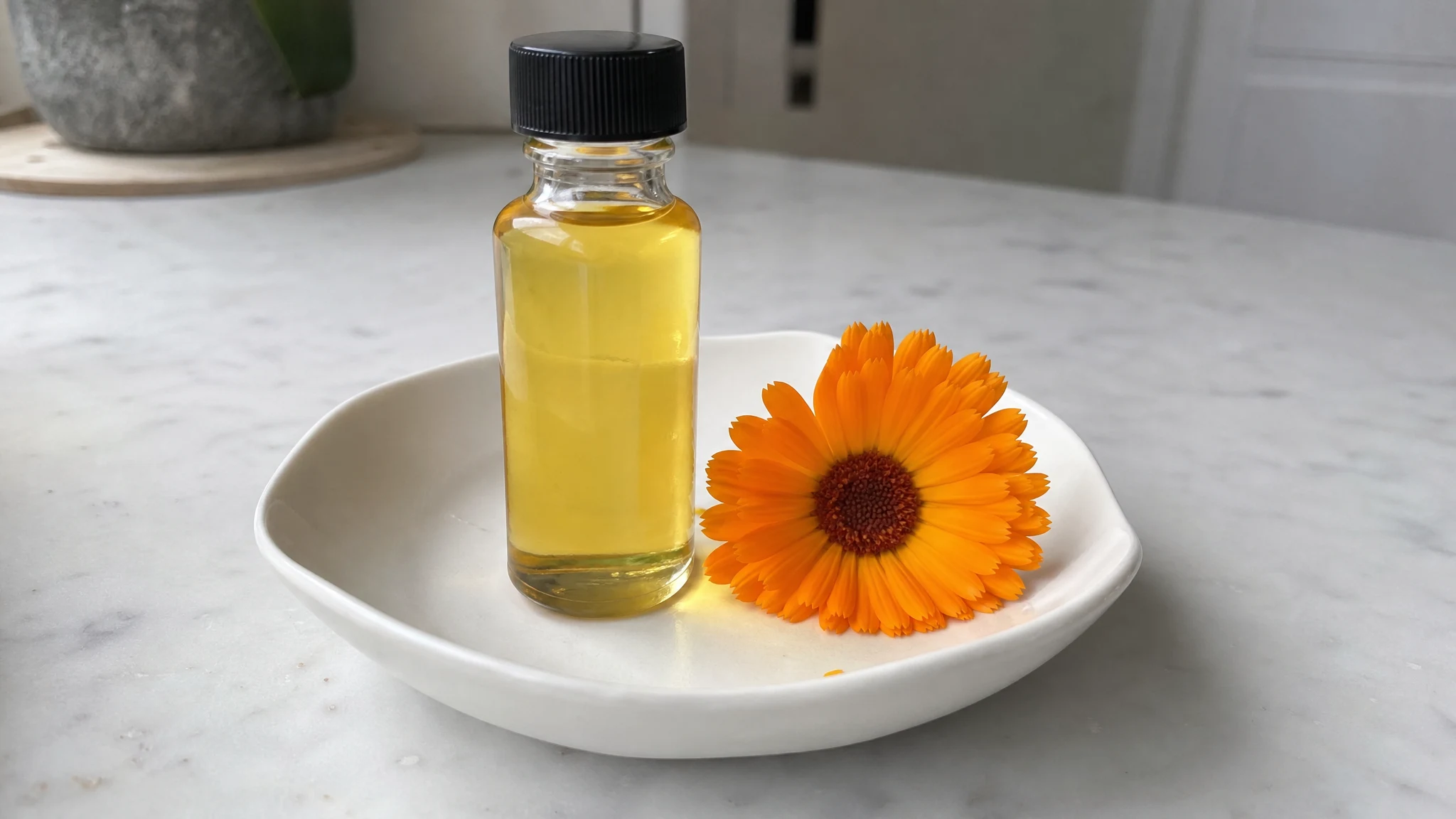
An infused oil is mostly its carrier by volume, so the carrier decides a lot about how the oil feels and behaves. Ours is made in two steps: calendula is extracted on its own, then brought into a carrier oil. The carrier is on the batch paperwork, and if you email the lot number from your bottle to [email protected] we will tell you.
It is worth asking, because oils are not interchangeable on the skin barrier. In a forearm study of 19 adults, olive oil applied twice daily for four weeks reduced skin barrier integrity and caused mild redness, while sunflower seed oil preserved integrity and improved hydration (Effect of olive and sunflower seed oil on the adult skin barrier: implications for neonatal skin care). That is a small study of two oils and says nothing about ours. What it does show is that "any plant oil is fine on dry skin" is not a safe assumption, so it pays to know what is in your bottle.
Layering order for calendula oil on dry skin
- Start with the water habits: shorter, warm showers and a gentle pat dry.
- Moisturize while skin is still damp, with the cream or ointment you already like.
- If you want to, add a thin layer of oil on top, or only where skin stays tight, such as hands, elbows and shins. As a suggestion of ours rather than a measured amount, a few drops go a long way, and a greasy film on your sleeves tells you that you used too much.
- Keep the bottle closed and somewhere cool and out of the sun. We add no preservatives or stabilizers, so storage is your part of the bargain, and our storage guide has the details.
Best spots for calendula oil: hands, elbows, shins
If you only want to try the oil in one place, choose your hands at the end of the day. Dry them well after washing, press a few drops over the backs of the hands and around the nails, and rub them in until the surface no longer feels wet. If you like, slip on a pair of old cotton gloves for the evening. You will notice by morning whether your hands feel softer, and if the answer is no, you have lost nothing but a few drops.
Our recommendation is to keep the bottle where you will actually use it, in a drawer by the bed or a cabinet near the sink, and away from radiators and sunny windowsills. A bottle that sits in sight and in a cool spot is far more likely to get used.
Who should skip calendula or ask first?
Calendula is in the daisy family, and the EU herbal monograph lists allergy to that family as a contraindication, noting that skin sensitization has been reported (European Union herbal monograph on Calendula officinalis L., flos). In one Austrian clinic series of 443 patients with suspected contact dermatitis, nine reacted to marigold (The seamy side of natural medicines: contact sensitization to arnica (Arnica montana L.) and marigold (Calendula officinalis L.)). Those were clinic patients, so it does not describe the general public, but it is a good reason for a forearm patch test, which our patch test guide walks through.
Skin that is red, weeping, cracked or intensely itchy deserves a dermatologist's eyes before another product. The monograph also advises against skin use under six and says safety in pregnancy and breastfeeding has not been established, so check with a pediatrician or midwife in those cases.
Moisturizer first, calendula oil as finishing layer
For dry winter skin, we would put water habits and a good moisturizer first, and treat calendula oil as an optional finishing layer for the spots that need it. If a single-ingredient infused oil appeals to you, that is what ours is: a whole-flower infusion from organically grown calendula, with nothing added. You may also like our comparison of calendula oil and shea butter. And if dryness will not budge, a dermatology appointment is a better next step than a different oil.
Calendula Oil
Nature's Golden Botanical, bottled: small-batch calendula oil in sizes from 0.5 oz to bulk.
From $13.99
Shop Calendula Oil →Sources & Further Reading
- Seasonal variations of epidermal biophysical properties in Kunming, China: A self-controlled cohort study (Yang et al., 2020)
- Dermatologists' top tips for relieving dry skin (American Academy of Dermatology)
- Effect of olive and sunflower seed oil on the adult skin barrier: implications for neonatal skin care (Danby et al., 2013)
- The seamy side of natural medicines: contact sensitization to arnica (Arnica montana L.) and marigold (Calendula officinalis L.) (Reider et al., 2001)
- European Union herbal monograph on Calendula officinalis L., flos (EMA/HMPC/437450/2017)