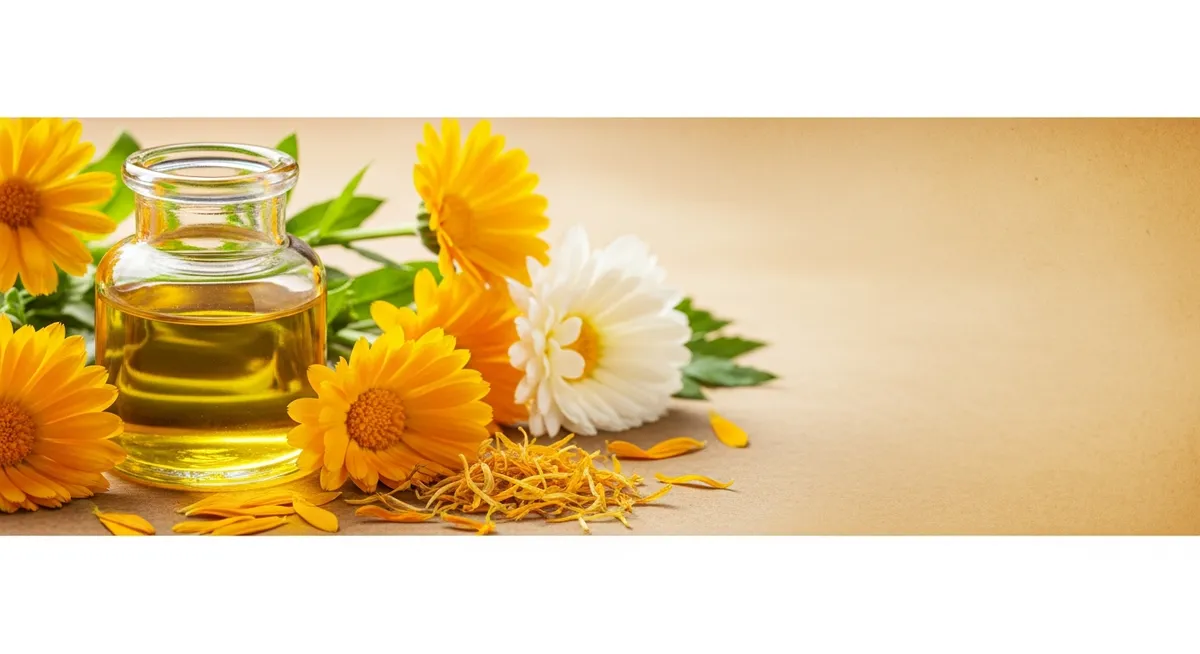
Spring Garden Guide: Growing Calendula for Oil Making
Growing calendula for oil is easy to start and easy to do poorly at the end, because the plant is forgiving but the flowers are only useful if they are picked at the right stage and dried properly. We do not grow our own flowers; we buy dried flowers from family farms in Egypt, Hungary, the Balkans and Turkey and make the oil in-house. So what I can say firsthand is about what a good dried flower looks like when it arrives. The growing advice below comes from extension services and growers, and I name each one.

Calendula Oil
Our own small-batch calendula oil, in sizes from 0.5 oz to bulk.
From $13.99
Shop Calendula Oil →Decide when to sow by your winter, not the calendar
Calendula is a cool-season annual. Utah State University Extension says it prefers temperatures below 85 F, often stops blooming in extreme heat, and survives down to 25 F; seeds go in the ground in spring about 1/4 inch deep once the soil reaches about 60 F, germinate in 1-2 weeks, and are thinned to 8-12 inches apart (Braithwaite and Drost, USU Extension, 2020). In mild-winter zones (USDA 9b to 11) the UF/IFAS sheet says calendula is generally planted in the fall for winter and spring color (Graves et al., UF/IFAS FPS87). So: cold winter, sow in spring; mild winter, think fall.
The sources do not agree on exact timing, and that is worth knowing. Johnny's Selected Seeds says to direct seed after danger of frost, or start indoors 4-5 weeks before planting out (Johnny's Selected Seeds). Strictly Medicinal Seeds says the seed "is loaded with germination inhibitors," so sow as soon as the ground can be worked, because late sowing in warm, dry conditions may give no germination (Strictly Medicinal Seeds). Reasoning from those two, early sowing into cool, moist soil is the safer bet, and a second sowing a few weeks later covers a failed first one. Johnny's suggests sowing in two or three batches 2-3 weeks apart to extend the bloom.
Pick the right seed, with a little skepticism
Most calendula varieties are ornamental selections. USU lists 'Resina' and 'Erfurter Orangefarbige' as high-resin types, and 'Pacific Beauty' as heat-tolerant. Seed sellers market 'Alpha' (Johnny's) and 'Resina' (Fruition Seeds) for herbal use. Treat the language on those pages carefully: Fruition's "off the charts" resin claim and Johnny's wording about healing ointments are seller copy, not a measured analysis, and neither page cites one. A Montana State University trial in 1998 and 1999 found 'Resina' and 'Erfurter Orangefarbige' yielded about the same dry flower weight (Montana State University, Western Agricultural Research Center). If a variety is sold as "more medicinal," the useful questions are whether it is organic seed and what the days to harvest are, not the adjectives. Our seed buying guide goes through sources.
Site, water and feeding
- Light and soil. Full sun to part shade in fertile, well-drained soil; pH 6-7 is preferred but the plant tolerates a wide range (USU). UF/IFAS adds that part shade can reduce bloom frequency.
- Water. USU says to water routinely but not to overwater, and that calendula can survive low water; it suggests 1 to 1 1/2 inches a week in mid-summer.
- Feeding. USU advises monthly soluble fertilizer for constant bloom. Reasoning from our own standard (our flowers are grown without synthetic fertilizers or pesticides), if you plan to infuse what you grow, think about what has been on the plant before you pick it. The extension sheets do not address residue, so that is our reasoning, not theirs.
- Pots. UF/IFAS says calendula is well suited to containers; our container growing post covers it.
Pests and diseases, without reaching for a spray
USU lists whiteflies and aphids as easily controlled by a hard stream of water or insecticidal soap, and powdery mildew as associated with cool, wet weather and managed by air circulation, controlled irrigation and removing infested parts. UF/IFAS adds snails and cucumber mosaic virus. The Montana trial lost plants to aster yellows (11-27% in various plots). Reasoning from that, spacing and airflow are your first defense, and a water jet beats a spray you would later have to think about when making oil.
Harvest: the stage is the decision
This is where the sources disagree in a useful way. USU says to pick the complete flower at full bloom, harvest repeatedly through the season, and expect re-bloom in about 2 weeks. Johnny's cut-flower harvest is at roughly half-open, but that is for bouquets, and it says petals are edible when fully open. For oil, the full-bloom advice fits better, so I would pick flowers that are fully open. Deadheading encourages re-bloom (USU and the Royal Horticultural Society).
Yield expectations help you plan a jar of oil. USU states a 60-foot row will produce about 1 pound of dried flower heads. The Montana trial reported much higher figures per acre in its table and a much lower average in its discussion without explaining the gap, so we would not plan from it.
Dry them before they go near oil
This step matters most, and we apply it ourselves at scale: our flowers are dried naturally by traditional methods, with no industrial heat or forced air, and we infuse petals separated by hand from sound, whole dried flower heads, not broken florets. At home, USU says to dry blooms in a well-ventilated place out of sunlight (a food dryer also works), which takes 1 to 5 days, and to store them in a moisture-tight container in a cool, dark place. Oregon State Extension's general herb guidance is a dehydrator at 95-115 F, or air drying, until material crumbles easily between your fingers (Oregon State University Extension). That is for leaf herbs, and thick flower heads take longer, so judge by the crumble test, not the clock.
The reason to be strict is safety. The University of Maine Extension calls dried herbs "the safest way" to make infused oils, and says fresh material most likely carries C. botulinum spores (University of Maine Cooperative Extension, Bulletin 4385). CDC advises refrigerating homemade oils made with garlic or herbs and discarding them after 4 days (CDC, Preventing Botulism). Those sources are about culinary oils, so applying them to a cosmetic oil is an inference, but I would not take the chance. Some blog recipes say to "wilt" fresh flowers for 12 hours; that does not make them dry, and we would not follow it. Our drying post and the home infusion guide go step by step.
What a home crop will and will not give you
A garden gives you a few jars of oil from your own plants, and that can be a pleasant project. It does not give you a tested product: you will not have independent lab assays, a lot number or a certificate of analysis. We have batch documentation because every batch of ours is tested by independent third-party labs, and you can request it by emailing the lot number to [email protected]. If you need consistent oil, for a formulation or for anyone you will give it to, that difference matters more than the flowers.
Calendula is in the daisy family, so gardeners handling plants and flowers with bare hands should know that the EU herbal monograph lists hypersensitivity to Asteraceae plants as a contraindication and notes skin sensitization has been reported (EMA/HMPC, 2018). Wear gloves if your skin reacts to plants, and see a dermatologist if a rash appears after handling them.
Calendula also self-seeds readily and USU says it may become weedy, so decide where it can spread. If you want to save seed, Cedar Circle Farm says to leave some flowers to dry on the plant and collect seed once it releases easily (Cedar Circle Farm). If you would rather skip the garden season entirely, the sourcing page explains where our flowers come from, and the shop page lists the oil. The gardener's complete handbook and fall harvest post cover the rest of the year.
Calendula Oil
Nature's Golden Botanical, bottled: small-batch calendula oil in sizes from 0.5 oz to bulk.
From $13.99
Shop Calendula Oil →Sources & Further Reading
- Braithwaite L, Drost D, 2020. How to Grow Calendula in Your Garden. Utah State University Extension. extension.usu.edu/calendula-in-the-garden
- Graves K et al. Calendula officinalis: Calendula, Pot Marigold (FPS87). UF/IFAS Extension. ask.ifas.ufl.edu/FP087
- Johnny's Selected Seeds. Calendula key growing information. johnnyseeds.com/calendula-key-growing-information
- Johnny's Selected Seeds. Alpha Organic Calendula Seed. johnnyseeds.com/alpha-organic-calendula
- Fruition Seeds. Organic Resina Calendula. fruitionseeds.com/f46
- Royal Horticultural Society. Calendula officinalis plant profile. rhs.org.uk/plants/62350
- Strictly Medicinal Seeds. Calendula, Mixed Colors (organic). strictlymedicinalseeds.com/?p=15153
- Montana State University, Western Agricultural Research Center. Calendula trial, 1998 and 1999. agresearch.montana.edu/calendula
- Oregon State University Extension. Drying herbs. extension.oregonstate.edu/drying-herbs
- University of Maine Cooperative Extension. Safe Homemade Flavored and Infused Oils, Bulletin 4385. extension.umaine.edu/4385e
- CDC. Preventing Botulism. cdc.gov/botulism/prevention
- Cedar Circle Farm. Calendula Seed Saving. cedarcirclefarm.org/calendula-seed-saving
- EMA/HMPC, 2018. European Union herbal monograph on Calendula officinalis L., flos (Revision 1), EMA/HMPC/437450/2017. ema.europa.eu/EMA/HMPC/437450/2017