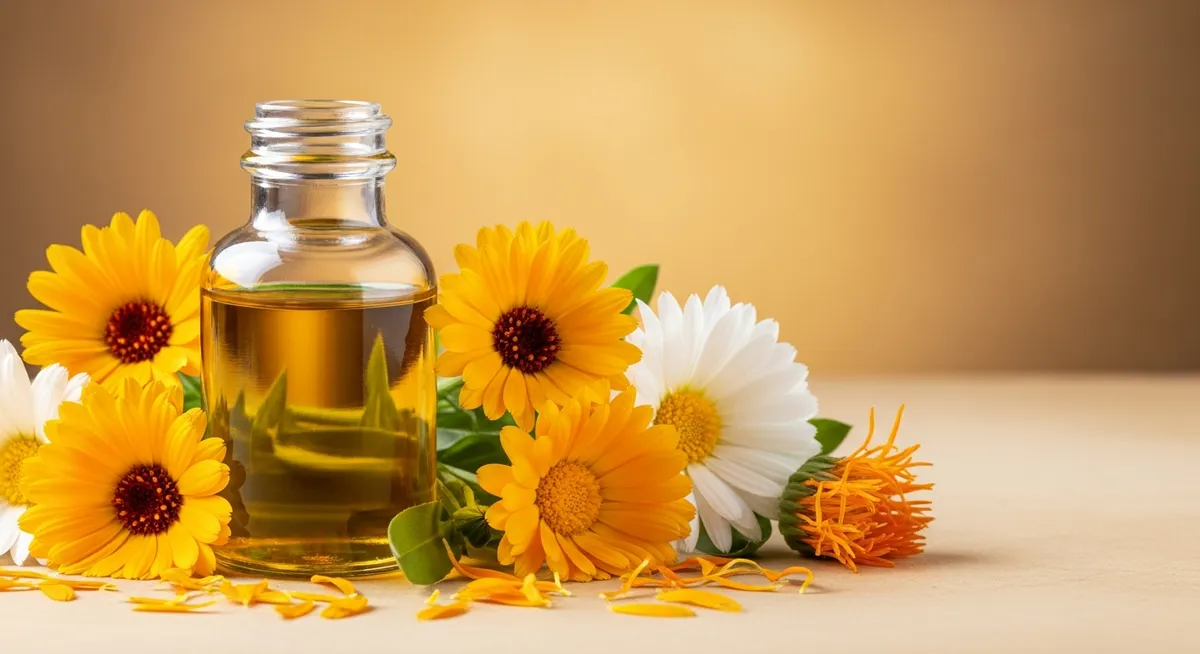
Where to Buy Calendula Seeds for Oil-Making: What to Check
The first thing to check on a seed packet labeled "marigold" is the Latin name, because the wrong plant is the most expensive mistake in this whole project. The calendula used for oil is Calendula officinalis. French and African marigolds are Tagetes, a different genus. Everything else about where to buy seed is secondary to getting that one word right.

Calendula Oil
Our own small-batch calendula oil, in sizes from 0.5 oz to bulk.
From $13.99
Shop Calendula Oil →Check one: is it the right plant?
Pot marigold (Calendula officinalis) and the bedding marigolds (Tagetes) share a common name and little else. Pet Poison Helpline rates Tagetes as mildly irritating to dogs and cats and calendula as non-toxic when eaten, and describes them as different plants (Pet Poison Helpline, Marigold). The naming trap runs through the trade as well: a 2026 review notes that the "marigold" lutein sold commercially is normally Tagetes erecta, not calendula (Kurniawan et al., Foods, 2026). For a gardener it means: buy by Latin name, never by "marigold," and do not infuse Tagetes flowers in oil and call it calendula oil.
Check two: what are you actually trying to make?
This decides whether seed is worth buying at all.
- A few jars for yourself, as a garden project: seed is a sensible start, and you control how the plants are grown.
- A consistent oil you will give away or put in a formulation: a home crop will not have independent assays or a lot record. We make our own oil from dried flowers bought from family farms in Egypt, Hungary, the Balkans and Turkey, test every batch through independent third-party labs, and give batch documentation on request (email the lot number to [email protected]). That is the difference between a garden project and a repeatable ingredient, and a seed packet cannot supply it.
- You just want calendula in a bottle: skip the seed. The oil on the shop page is already infused, and the guide to making it at home shows what you are signing up for.
Check three: organic, resin and what the seller can back up
Three specialist sellers have pages we could read, and each sells organic calendula. This is a list of what the pages say, not an endorsement, and stock changes.
| Seller and seed | What its own page says |
|---|---|
| Johnny's Selected Seeds, 'Alpha' | USDA Certified Organic seed; "high resin content for medicinal use"; about 50-55 days to harvest; spacing 6-12 inches |
| Fruition Seeds, 'Resina' | Organic; 55-65 days to harvest; about 24 inches tall; direct sow 1/2 inch deep, about 1 foot spacing after thinning; self-sows |
| Strictly Medicinal Seeds, mixed colors | "Certified Organically Grown"; heirloom single and double yellow and orange flowers; matures in 40-50 days; about 18 inches; seed has germination inhibitors |
Read the "resin" language with care. Fruition's page says all calendula varieties have the resins but that 'Resina' is "off the charts"; Johnny's describes 'Alpha' as medicinal. Neither page cites a measurement. Utah State University Extension lists 'Resina' and 'Erfurter Orangefarbige' as high-resin types and calls most cultivars mostly ornamental selections (Braithwaite and Drost, USU Extension, 2020), and a Montana State field trial found those two yielded about the same dry flower weight (Montana State University). So a seller's "medicinal" label is a marketing choice, and the sourced facts are organic status, days to maturity, height and spacing.
Organic seed is a statement about how the seed was produced. Note that USDA and FDA treat the word "organic" differently on a finished cosmetic: FDA says it does not define "organic" for cosmetics, and USDA's organic rules apply only if the product itself is certified (FDA, Organic Cosmetics). For our own oil, we say the flowers are organically grown and we do not claim a certification. That distinction is worth looking for on any packet or bottle.
Check four: timing, because seed is perishable in a different way
Strictly Medicinal Seeds says the seed is loaded with germination inhibitors, so sow as soon as the ground can be worked and expect poor germination if sown late in warm, dry conditions. Johnny's says to sow after danger of frost, or start indoors 4-5 weeks before planting out, and Fruition suggests sowing 2-3 weeks before or after the last frost. These do not fully agree, so buy early in the year, order slightly more than you need, and sow in two batches. Utah State says calendula should go in when the soil reaches about 60 F and germinates in 1-2 weeks. Our spring growing guide and gardener's handbook pick up from there, and the pot-growing post is for balconies.
How I would read the packet or product page
Work down it in this order, and stop at the first failure. One: the Latin name says Calendula officinalis. Two: the page says whether the seed is organic and whether that is a certification or a description (the three pages above use "Certified Organic" or "Certified Organically Grown"; one says "organic" without the word certified, so read each). Three: days to harvest, height and spacing are stated, since these are the only numbers you can plan a bed around. Four: it tells you how to sow, including depth. The three sellers give 1/4 inch (Johnny's, as does USU) and 1/2 inch (Fruition), so seed depth is not a settled number; the safe reading is shallow and firmed, not buried deep. Five: you know what you will do with the flowers. If the answer is "infuse them," plan the drying space before the seed arrives: Utah State says blooms dry in 1 to 5 days in a well-ventilated place out of sunlight, and the flowers come in repeatedly through the season.
What I would skip
- Unlabeled mixed packs with no Latin name. You cannot tell the genus.
- Pre-treated or coated seed if you intend to infuse the flowers in oil. We found no source that addresses what coatings leave on petals, so this is a precaution, not a finding.
Seed saving is an option once you have a plant you like: Cedar Circle Farm says to leave some flowers on the plant to dry and collect seed when it releases easily (Cedar Circle Farm). We could not verify an isolation distance or a viability period, so we do not state one.
A handling note before you buy
Calendula is in the daisy family. The EU herbal monograph lists hypersensitivity to Asteraceae plants as a contraindication and notes skin sensitization has been reported, frequency not known (EMA/HMPC, 2018). If you react to chamomile, ragweed or chrysanthemums, handle the plants in gloves and ask an allergist before you grow a patch of them. Our ragweed cross-reactivity post has the detail.
If after reading this you would rather not garden, that is a reasonable result. The oil is on the shop page, and the sourcing page says where the flowers behind it come from.
Calendula Oil
Nature's Golden Botanical, bottled: small-batch calendula oil in sizes from 0.5 oz to bulk.
From $13.99
Shop Calendula Oil →Sources & Further Reading
- Pet Poison Helpline. Marigold. petpoisonhelpline.com/marigold
- Kurniawan SB et al., 2026. Advances in sustainable lutein production: sources, technologies, and functional applications. Foods 15(10):1717. pmc.ncbi.nlm.nih.gov/PMC13206640
- Johnny's Selected Seeds. Alpha Organic Calendula Seed. johnnyseeds.com/alpha-organic-calendula
- Fruition Seeds. Organic Resina Calendula. fruitionseeds.com/f46
- Strictly Medicinal Seeds. Calendula, Mixed Colors (organic). strictlymedicinalseeds.com/?p=15153
- Braithwaite L, Drost D, 2020. How to Grow Calendula in Your Garden. Utah State University Extension. extension.usu.edu/calendula-in-the-garden
- Montana State University, Western Agricultural Research Center. Calendula trial, 1998 and 1999. agresearch.montana.edu/calendula
- U.S. FDA. Organic Cosmetics. fda.gov/organic-cosmetics
- Cedar Circle Farm. Calendula Seed Saving. cedarcirclefarm.org/calendula-seed-saving
- EMA/HMPC, 2018. European Union herbal monograph on Calendula officinalis L., flos (Revision 1), EMA/HMPC/437450/2017. ema.europa.eu/EMA/HMPC/437450/2017