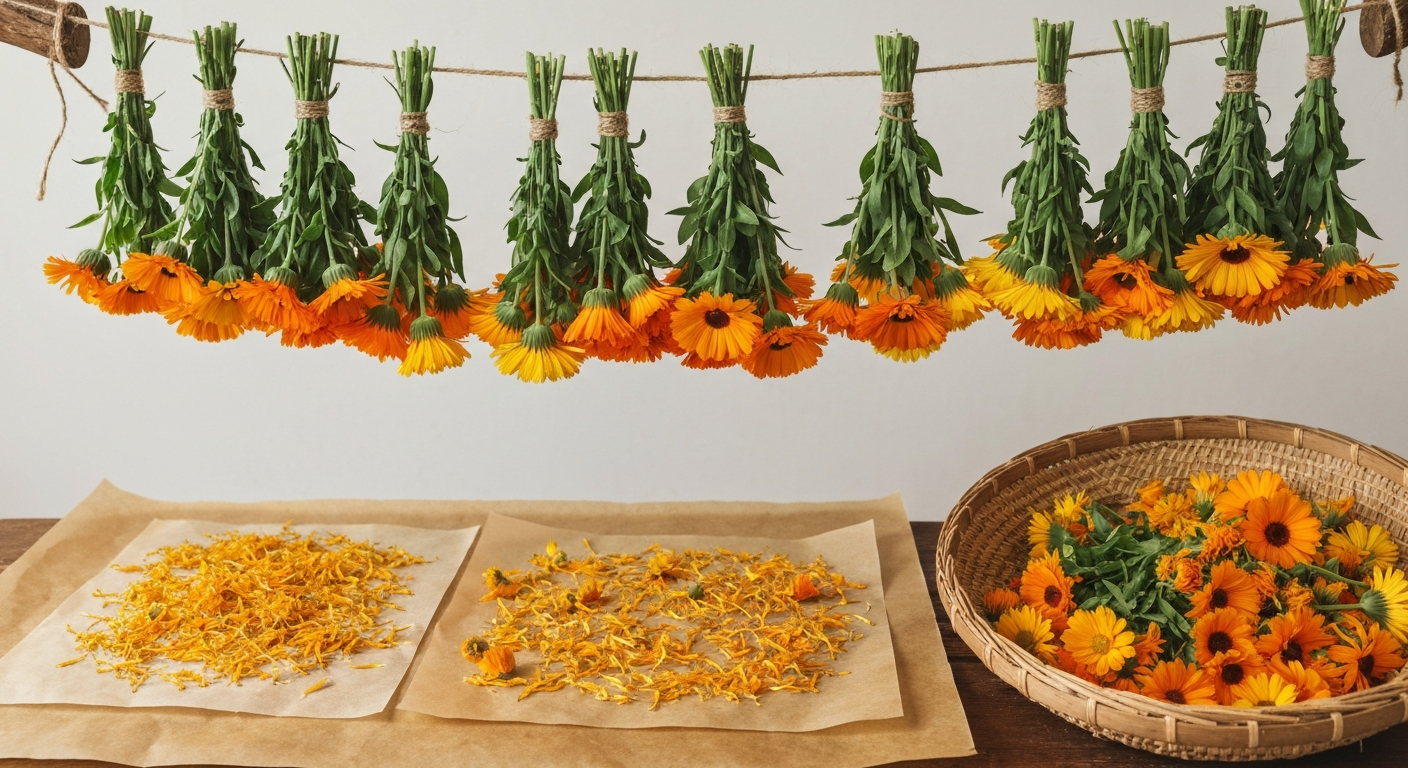
How to Dry Calendula Flowers for Oil Infusion
Drying is not a preliminary chore before making calendula oil. It is the step that decides whether the oil is safe to keep, and our own process depends on it. The flowers we use are dried naturally by traditional methods, with no industrial heat or forced air, and we buy them already dried. This is what published sources say about doing it yourself, and where they run out.

Calendula Oil
Our own small-batch calendula oil, in sizes from 0.5 oz to bulk.
From $13.99
Shop Calendula Oil →Why the flowers must be dry, not wilted
Water in an oil infusion is the problem. University of Maine extension says dried herbs are the safest way to make infused oils, and that fresh plant material most likely carries C. botulinum spores (University of Maine Cooperative Extension, Bulletin 4385). The CDC advises refrigerating homemade oils made with garlic or herbs and discarding them after 4 days (CDC, Preventing Botulism). Both documents concern food oils, so for a cosmetic oil this is an extrapolation, but it is the cautious one.
Some popular recipes, such as one from Mountain Rose Herbs, say fresh flowers can be wilted for 12 hours to remove most of the moisture and then infused. We would not follow that advice. Wilting is not drying, and neither the extension bulletin nor the CDC page treats it as equivalent. Separately, moisture in dried herbs supports mould growth, which is why quality specifications cap yeasts and moulds, for example at 1,000 CFU/g in one commercial calendula macerate sheet (Golgemma/Biolandes, FB026, 2025).
Step 1: pick fully open flowers, and pick often
Utah State University Extension says to pick the complete flower at full bloom, and that blooms can be harvested multiple times in a season, with re-bloom in about 2 weeks (Braithwaite and Drost, USU Extension, 2020). One seed company, writing about cut flowers, suggests roughly half-open; that is a cut-flower stage, not a drying stage. Our own standard is flowers dried whole and then separated by hand into petals from sound heads, which is a reason to pick at full bloom and avoid damaged heads. See growing and harvesting calendula for oil for the garden side.
The European Pharmacopoeia describes calendula flower as whole or cut, dried, fully opened flowers detached from the receptacle, of cultivated double-flowered varieties, as quoted in the EU monograph and assessment report (EMA/HMPC, 2008). We read that definition only as quoted by EMA, not from the Pharmacopoeia itself. Pick when the flower is dry on the outside, not wet with dew or after rain; that rule is common advice but we did not find an extension source that states it, so take it as reasoning, since surface water is more water to remove.
Step 2: choose a drying method
Air drying. Utah State's sheet says to dry blooms in a well-ventilated area, away from sunlight, and that flowers should dry in 1 to 5 days (USU Extension, 2020). Spread the heads in a single layer on a screen or paper-lined tray so air reaches both sides. Oregon State University Extension, writing about culinary herbs, says sun drying is not recommended because it affects colour and flavour. Colour is the whole point of a calendula infusion, so we agree with keeping the flowers out of direct sun, although that source is about leaves, not calendula flowers.
Dehydrator. Utah State says a food dryer can work effectively. Oregon State's herb guidance is a dehydrator preheated to 95-115 F, up to 125 F in humid areas, for about 1 to 4 hours for leafy herbs. Reasoning from that, thick calendula heads will take longer than leaf herbs (Utah State's air-drying figure is days, not hours), so check them, do not time them. No extension source we found gives a flower-specific dryer temperature, and we do not either. We do not use dehydrator heat; our flowers are dried by traditional natural methods.
Step 3: the dryness test
Oregon State's test for herbs is that they are dry when they crumble easily between your fingers and the stems snap (OSU Extension). Applied to calendula, the reasoning is that the petals should feel papery and brittle, and the thick receptacle at the base of the head is the last part to dry, so check there. If the base is still soft or cool and pliable, it is not ready. No source we found gives a numeric moisture limit for dried calendula; the European Pharmacopoeia has a loss-on-drying figure that we could not read. So the finger test is a practical check, not a specification. When in doubt, dry longer.
Which part to keep is also a decision. In one four-variety study, orange cultivars held several times more total carotenoids than yellow ones (276 versus 48 mg/100 g fresh in the extremes), and in one orange cultivar petals held 103.8 mg/100 g against 8 mg/100 g in the tubular centre (Pintea et al., Acta Biologica Szegediensis, 2003). That is why we infuse petals separated by hand from whole-dried heads and not broken pieces. Whether it is worth separating them at home is your call; a pinch of whole dried heads works, with less colour per gram.
Step 4: store it dry until you need it
Utah State says to store blooms in a moisture-tight container in a cool, dark place. Oregon State says airtight, cool, dark and dry, best used within six months to a year. The second is for culinary herbs. As a practical check (our reasoning, not a sourced test), put a handful in a jar, shut it, and look at it after a day: any condensation on the glass suggests the flowers were not dry, so take them back out. If you see mould, discard the lot.
What can go wrong
- Dried too fast and too hot. Heat degrades carotenoids in oils in laboratory tests (Achir et al., 2010), though that study was run at 120-180 C in oil, not on flowers. We cannot quote a loss figure for drying flowers, so the advice to keep it low rests on the Oregon State range.
- Dried too slowly in a humid room. This is reasoning, not a sourced finding: slow drying gives mould more time. Use a dehydrator at the low end if your room is damp.
- Allergic people handling the flowers. Calendula is in the daisy family. The EU monograph lists hypersensitivity to Asteraceae as a contraindication and notes skin sensitization has been reported (EMA/HMPC, 2018). If daisy-family plants or ragweed bother you, ask an allergist before handling, let alone using the oil.
Once the flowers are dry, the next step is the infusion itself: how to make calendula oil at home gives the ratios. If you would rather skip drying altogether, our calendula oil starts from flowers dried the way described on where it comes from, and each bottle is lot-numbered, with batch documentation on request.
Calendula Oil
Nature's Golden Botanical, bottled: small-batch calendula oil in sizes from 0.5 oz to bulk.
From $13.99
Shop Calendula Oil →Sources & Further Reading
- University of Maine Cooperative Extension, n.d. Safe Homemade Flavored and Infused Oils (Bulletin 4385). extension.umaine.edu/publications/4385e
- CDC, 2026. Preventing Botulism. cdc.gov/botulism/prevention
- Golgemma/Biolandes, 2025. Technical data sheet FB026, Calendula Org Macerate/Oil. biolandes.com
- Braithwaite L, Drost D, 2020. How to Grow Calendula in Your Garden. Utah State University Extension. extension.usu.edu
- EMA/HMPC, 2008. Assessment report on Calendula officinalis L., flos (superseded version). ema.europa.eu/herbal-report
- Mountain Rose Herbs. Calendula Uses + Infused Olive Oil Recipe. blog.mountainroseherbs.com
- Oregon State University Extension. Drying herbs. extension.oregonstate.edu
- Pintea et al., 2003. HPLC analysis of carotenoids in four varieties of Calendula officinalis L. flowers. Acta Biologica Szegediensis. abs.bibl.u-szeged.hu
- Achir et al., 2010. Kinetic study of beta-carotene and lutein degradation in oils during heat treatment. Eur J Lipid Sci Technol. doi.org/10.1002/ejlt.200900165
- EMA/HMPC, 2018. European Union herbal monograph on Calendula officinalis L., flos. ema.europa.eu