How to Make Calendula Oil at Home: Complete Infusion Guide
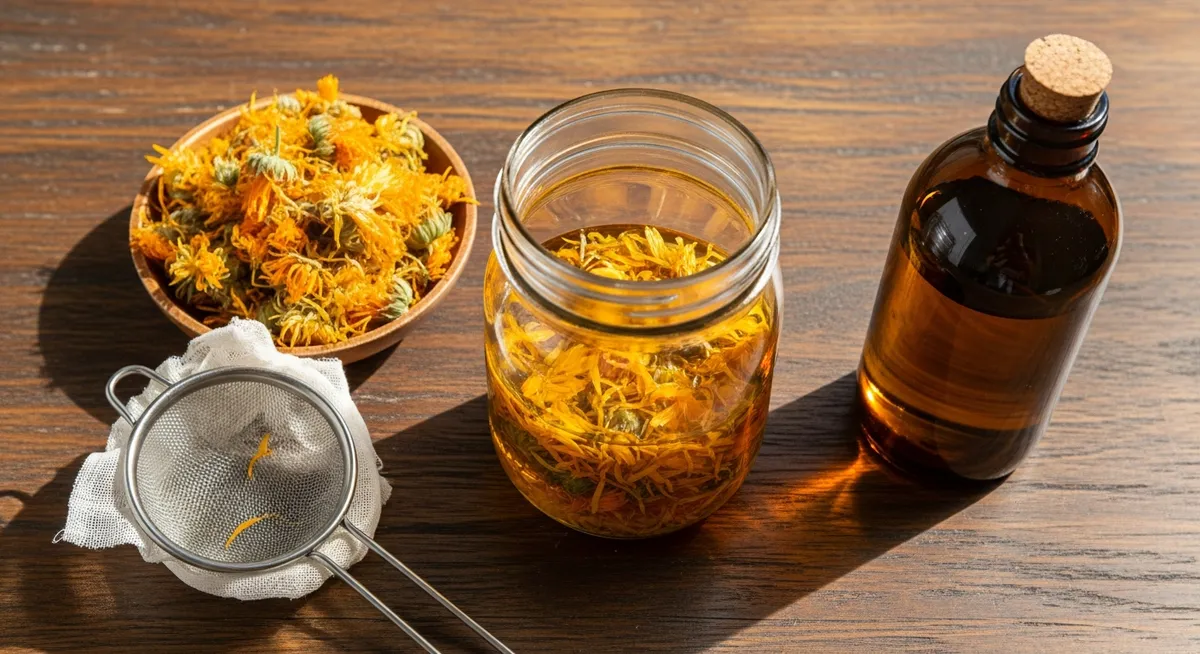
You can make a usable calendula oil in a kitchen with dried flowers, a plain oil and a jar, and the quantities below come from published sources rather than guesswork. The one rule we would not bend is to use dried flowers, not fresh ones. We make our own oil from dried flowers for the same reason: water in an oil infusion is where things go wrong.

Calendula Oil
Our own small-batch calendula oil, in sizes from 0.5 oz to bulk.
From $13.99
Shop Calendula Oil →Decide first: dried flowers, and which ratio
Extension guidance is blunt on this point. The University of Maine bulletin on homemade infused oils says using dried herbs is the safest way to make infused oils and that fresh plant material most likely carries C. botulinum spores (University of Maine Cooperative Extension, Bulletin 4385). The CDC advises refrigerating homemade oils made with garlic or herbs and throwing them out after 4 days (CDC, Preventing Botulism). Both are written about food oils and neither mentions calendula specifically, so applying them to a cosmetic oil is an inference, but it is the cautious one and it costs you nothing: buy dried flowers or dry your own first (how to dry calendula flowers for oil infusion).
For the ratio, there are two sourced anchors, both by weight of flower to weight of oil:
- 1:10. The EU herbal monograph defines the oil preparation as a 1:10 extract in a fatty vegetable oil, "e.g. olive oil" (EMA/HMPC, 2018). That is 20 g of dried flowers for 200 g of oil.
- 1:5. In a 2005 lab comparison, the highest carotene content, 57.5 mg/kg expressed as beta-carotene, came from a 72-hour room-temperature maceration in olive oil at 1:5 by weight (Novkovic et al., Hemijska industrija, 2005). That is 40 g of flowers for 200 g of oil. It was an abstract-level result from one lab, so treat it as a direction (more flower gives a deeper-coloured oil), not a guarantee.
The jar-fill method most home recipes use is volume-based: a jar two-thirds full of dried flowers, oil poured over to cover by at least an inch (Mountain Rose Herbs). Reasoning from the weights above, that is a much heavier flower load than 1:10, because dried petals are light and bulky. It works, but you use a lot of flower and recover less oil from the packed jar. Weigh instead, if you have a kitchen scale.
Choose the oil on purpose
The oil you pick becomes most of what is in the bottle. A calendula-infused oil is petals soaked in a carrier, so its fatty acid make-up is mainly the carrier's. A 2025 study did find that macerating herbs in some cold-pressed oils shifted fatty-acid proportions, so the profile is close to, not guaranteed identical to, the carrier (Laskos et al., Scientific Reports, 2025). Two things follow.
- Stability tracks unsaturation. Linoleic acid oxidises about 100 times faster than stearic and about 10 times faster than oleic in a standard comparison of pure fatty acids; light, heat, oxygen and trace metals all speed it up (Gharby et al., Food Chemistry X, 2025). That table is for pure acids at 100 C, so read it as a ranking. Reasoning from it, an oleic-rich oil such as olive is the safer base for an oil you will keep for months than a linoleic-rich one such as grapeseed.
- Skip peanut oil. The EU assessment report names peanut oil as not recommended because of a higher probability of adverse reactions (EMA/HMPC assessment report, 2008 (superseded)).
If you want to know what carrier is in a bottle of ours, the batch paperwork lists it. Email the lot number to [email protected].
Two ways to steep, and what the evidence does and does not say
Solar or room-temperature jar. Combine flowers and oil in a clean, dry glass jar, make sure the flowers are submerged, cap it, keep it on a warm windowsill, shake daily, and strain after 4 to 6 weeks (Mountain Rose Herbs). Strain through cheesecloth or a coffee filter and let the oil settle before bottling. This is the slow, low-risk route. One caution from the same chemistry: light speeds oxidation of oils, so a bright windowsill trades speed of colour for the oil's keeping quality. Giving the jar warmth but not direct sun is a defensible compromise, and that is reasoning, not a tested result.
Warm double boiler. Soap-making educators describe low-to-medium heat in a double boiler for at least 4 hours and up to 2 days, with the oil just covering the petals and the stove off when unattended (Soap Queen, Bramble Berry). The source gives no temperature, and we could not verify a temperature figure for slow-cooker or oven methods, so we do not give one. The fact we can support is directional: carotenoids in oil degrade faster as temperature rises, in a study run far hotter (120-180 C) than any infusion (Achir et al., Eur J Lipid Sci Technol, 2010). Keep it as cool as you can stand to wait.
Check the finished oil before you trust it
- Smell and look. Floral, slightly bitter and orange is the expected profile for a commercial macerate (Golgemma/Biolandes data sheet FB026, 2025). If the smell is sharply different from that, or you are unsure, discard the batch; we cannot give a sourced smell test for rancidity.
- Water. Cloudiness, droplets at the bottom of the jar or any mould means moisture got in. Discard the batch. Moisture in dried herbs supports mould growth, which is why quality sheets set microbial limits, for example 1,000 CFU/g for yeasts and moulds in that same macerate specification.
- Keeping time. Sources disagree and cover different materials: University of Maine says use homemade infused oils within three months; Soap Queen says 6 months to a year depending on the carrier. A commercial macerate data sheet states 36 months, but that is a manufacturer's claim for a sealed product with 0.2% added tocopherol. Without testing, take the short end and label the date.
A home batch has no batch testing behind it. Ours does: every batch goes to independent third-party labs for physical and chemical assays and contaminant screening, with documentation on request. That is the practical gap between a jar on your windowsill and a bottle with paperwork, and it is the reason to buy rather than make if you need an oil you can document.
Who should not use it, homemade or bought
Calendula is in the daisy family. The EU monograph lists hypersensitivity to Asteraceae as a contraindication, notes skin sensitization has been reported with unknown frequency, and says safety in pregnancy and breastfeeding has not been established (EMA/HMPC, 2018). In one Austrian clinic study of 443 dermatitis patients, 9 (about 2%) reacted to a marigold patch-test preparation (Reider et al., Contact Dermatitis, 2001); that is a referred-patient population, not the public. Test a small area first and stop at any rash. See how to do a patch test. For infants, pregnancy or any persistent skin problem, ask a pediatrician, an OB/GYN or midwife, or a dermatologist.
If you would rather skip the jar, our calendula oil is made in-house from dried flowers with nothing added, and where it comes from explains the process. If you make your own, the comparison of infusion methods goes deeper on the trade-offs.
Calendula Oil
Nature's Golden Botanical, bottled: small-batch calendula oil in sizes from 0.5 oz to bulk.
From $13.99
Shop Calendula Oil →Sources & Further Reading
- University of Maine Cooperative Extension, n.d. Safe Homemade Flavored and Infused Oils (Bulletin 4385). extension.umaine.edu/publications/4385e
- CDC, 2026. Preventing Botulism. cdc.gov/botulism/prevention
- EMA/HMPC, 2018. European Union herbal monograph on Calendula officinalis L., flos (EMA/HMPC/437450/2017). ema.europa.eu
- EMA/HMPC, 2008. Assessment report on Calendula officinalis L., flos (superseded version). ema.europa.eu/herbal-report
- Novkovic et al., 2005. Determination of total lipids and characterization of marigold flower extracts. Hemijska industrija. doi.org/10.2298/HEMIND0510254N
- Mountain Rose Herbs. Calendula Uses + Infused Olive Oil Recipe. blog.mountainroseherbs.com
- Soap Queen (Bramble Berry). Infusing Oil. soapqueen.com
- Gharby et al., 2025. Vegetable oil oxidation: mechanisms, impacts on quality, and approaches to enhance shelf life. Food Chemistry X. PMC12146556
- Laskos et al., 2025. Herbal maceration modulates fatty acid profile of cold-pressed oils. Scientific Reports. PMC12586497
- Golgemma/Biolandes, 2025. Technical data sheet FB026, Calendula Org Macerate/Oil. biolandes.com
- Achir et al., 2010. Kinetic study of beta-carotene and lutein degradation in oils during heat treatment. Eur J Lipid Sci Technol. doi.org/10.1002/ejlt.200900165
- Reider et al., 2001. The seamy side of natural medicines: contact sensitization to arnica and marigold. Contact Dermatitis. PMID 11722485