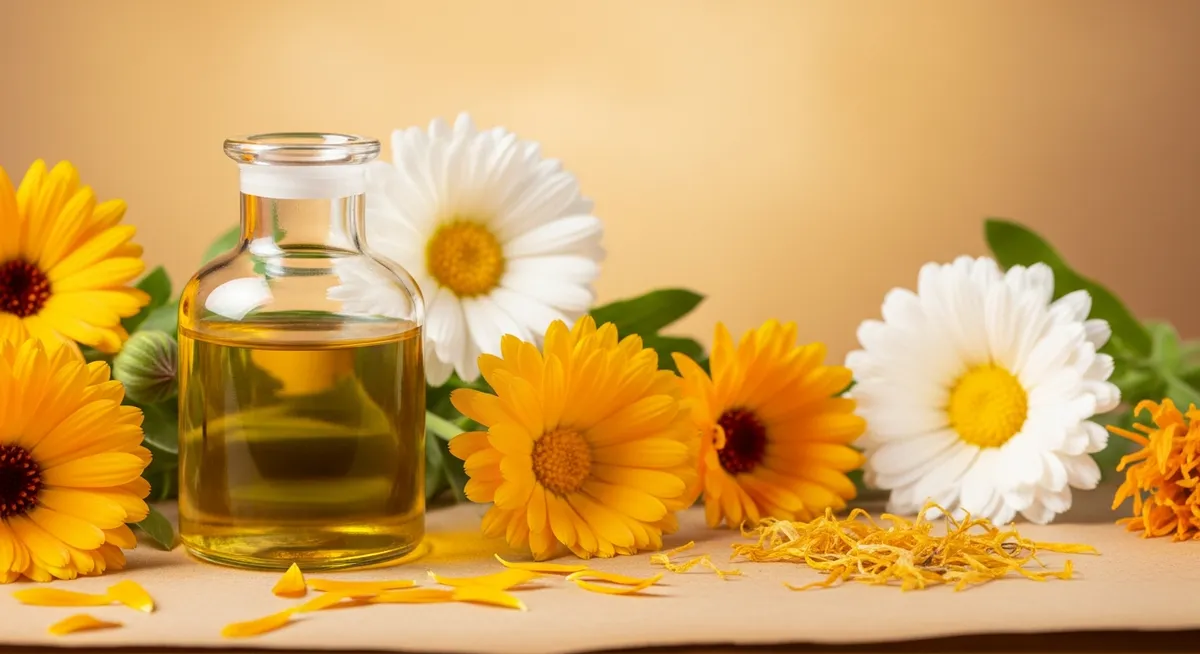
Growing & Harvesting Calendula for Oil: Gardener's Complete Handbook
Growing calendula for oil is mostly a harvesting problem, not a gardening one: the plant is easy, but the oil depends on picking fully open flowers again and again and drying them properly. We do not grow our own. We buy dried flowers from family farms in Egypt, Hungary, the Balkans and Turkey and do the infusion in-house, so what follows is what extension services and field trials say, not a farm diary.

Calendula Oil
Our own small-batch calendula oil, in sizes from 0.5 oz to bulk.
From $13.99
Shop Calendula Oil →Start with how much oil you want, then work back
Utah State University Extension says a 60-foot row of calendula yields about 1 pound of dried flower heads (Braithwaite and Drost, USU Extension, 2020). One pound is about 454 g. The EU herbal monograph defines the oil preparation at 1:10 flower to oil by weight (EMA/HMPC, 2018), and a 2005 lab study found the richest carotene content at 1:5 by weight (Novkovic et al., Hemijska industrija, 2005). Reasoning from those figures: a 60-foot row would supply flowers for roughly 2.3 kg of oil at 1:5 or 4.5 kg at 1:10. A single pot gives a small jar; a short garden row gives a year of home use. See growing calendula in pots for the small end.
These are extension and lab figures from one climate and one lab. Your yield will differ, so use them to size a plot, not to promise a harvest.
Growing it: the short version
Calendula is an annual in the daisy family (Asteraceae), native to Europe and the Mediterranean per UF/IFAS (Graves et al., UF/IFAS, FPS87). Utah State's sheet gives sowing 1/4 inch deep once soil reaches 60 F, thinning to 8-12 inches, full sun to part shade, fertile, well-drained soil of pH 6-7, and 1 to 1 1/2 inches of water a week in mid-summer. It prefers temperatures under 85 F, often stops blooming in extreme heat, and survives to 25 F. In mild-winter zones (9b-11) UF/IFAS says it is a fall-to-spring crop.
Seed sellers add that a first bloom comes roughly 50-65 days after sowing ('Alpha' is listed at 50-55 days by Johnny's Selected Seeds; 'Resina' at 55-65 by Fruition Seeds). They also recommend two or three sowings 2-3 weeks apart to extend the harvest season. Those are seller figures, not trials.
Choosing a variety for oil: what is and is not backed up
The European Pharmacopoeia defines calendula flower as whole or cut, dried, fully opened flowers of cultivated double-flowered varieties (as quoted by EMA/HMPC, 2008; we could not read the Pharmacopoeia itself). So double-flowered, fully open heads are the reference material. Beyond that:
- Colour. In a four-variety HPLC study, total carotenoids ranged from 48.2 mg/100 g fresh flowers in a yellow-orange type to 276 mg/100 g in a dark orange double one (Pintea et al., Acta Biologica Szegediensis, 2003). Petals carried most of it: 103.8 mg/100 g in petals against 8 in the tubular centre in one cultivar. If you want a deeply coloured oil, flower colour and petal share both matter.
- Resin. USU lists 'Resina' and 'Erfurter Orangefarbige' as high-resin types. Sellers market 'Alpha' as high-resin "for medicinal use" and describe 'Resina' as "off the charts" in resins. We found no resin assay for any of them, so this is marketing, not data.
- Yield. A Montana State field trial in 1998 and 1999 compared 'Resina' and 'Erfurter Orangefarbige', direct-seeded and hand-plucked 13 times in 1998 and 10 in 1999, and reported that the cultivars "did not differ in total yield" (Montana State WARC). The page's table lists dry yields of roughly 990 to 1,485 lb/acre, but its own text elsewhere says average harvest was only about 110 lb/acre; it does not explain the conflict, so we would not plan around either number. Aster yellows, a plant disease, hit both varieties.
Harvest: the routine that matters
USU says to pick the complete flower at full bloom, that blooms can be harvested many times in a season, and that plants re-bloom about two weeks after picking. Deadheading encourages re-bloom (USU, UF/IFAS and the RHS). The Montana trial's 10-13 harvests give a sense of the frequency a field needs. One seed company suggests roughly half-open flowers for cut flowers, but that is not the drying stage. Pick, then dry the same day: air drying in a well-ventilated place out of sunlight, 1 to 5 days per USU. The details, and why we will not infuse fresh flowers, are in how to dry calendula flowers for oil infusion.
When we make the oil, we infuse petals separated by hand from sound, whole-dried flower heads, not broken florets, and the flowers are dried naturally with no industrial heat or forced air. If a season goes badly and the flowers do not meet standard, we sell out rather than lower the bar. That is the discipline a home grower can copy: reject damaged heads rather than hoping they will not matter.
Pests and what to leave alone
USU lists aphids and whiteflies (a hard water stream or insecticidal soap) and powdery mildew in cool, wet weather (airflow, careful watering, remove infested parts). UF/IFAS adds snails, and cucumber mosaic virus as a disease. Since the flowers go into an oil that goes on skin, reasoning suggests keeping spray residue off the heads you plan to harvest; we have no source on what residues carry into an infusion, so we say nothing more.
A caution on safety: the Utah sheet calls calendula non-toxic and safe for any use, which is too broad. The EU monograph lists hypersensitivity to Asteraceae as a contraindication and notes skin sensitization has been reported (EMA/HMPC, 2018). Plants in this family, ragweed included, share allergy risk; people with those allergies should ask an allergist before handling the flowers or using the oil.
Where commercial flowers come from
A 2023 review says calendula is abundant in Central Europe and the Mediterranean, also found in Cyprus, Turkey and Iran, and cultivated on a larger scale in India and China (Shahane et al., Pharmaceuticals, 2023). Sourcing varies by brand; one US brand lists origin as the USA, Morocco, France, Moldova, Egypt and Albania (Herb Pharm). Ours is organically grown, with no synthetic pesticides or fertilizers, in four regions; we describe it as organically grown rather than certified.
If your garden gives you a few jars, how to make calendula oil at home picks up from here. If you want an oil with batch documentation behind it, ours is described on where it comes from.
Calendula Oil
Nature's Golden Botanical, bottled: small-batch calendula oil in sizes from 0.5 oz to bulk.
From $13.99
Shop Calendula Oil →Sources & Further Reading
- Braithwaite L, Drost D, 2020. How to Grow Calendula in Your Garden. Utah State University Extension. extension.usu.edu
- Graves K et al., 2026 rev. Calendula officinalis: Calendula, Pot Marigold (FPS87). UF/IFAS Extension. ask.ifas.ufl.edu/FP087
- Royal Horticultural Society. Calendula officinalis plant profile. rhs.org.uk/plants/62350
- EMA/HMPC, 2018. European Union herbal monograph on Calendula officinalis L., flos. ema.europa.eu
- EMA/HMPC, 2008. Assessment report on Calendula officinalis L., flos (superseded version). ema.europa.eu/herbal-report
- Novkovic et al., 2005. Determination of total lipids and characterization of marigold flower extracts. Hemijska industrija. doi.org/10.2298/HEMIND0510254N
- Pintea et al., 2003. HPLC analysis of carotenoids in four varieties of Calendula officinalis L. flowers. Acta Biologica Szegediensis. abs.bibl.u-szeged.hu
- Johnny's Selected Seeds. Alpha Organic Calendula Seed. johnnyseeds.com
- Fruition Seeds. Organic Resina Calendula. fruitionseeds.com
- Montana State University, Western Agricultural Research Center. Calendula trial, 1998 and 1999. agresearch.montana.edu
- Shahane K et al., 2023. An Updated Review on the Multifaceted Therapeutic Potential of Calendula officinalis L. Pharmaceuticals. PMC10142266
- Herb Pharm. Calendula Oil External Use. herb-pharm.com