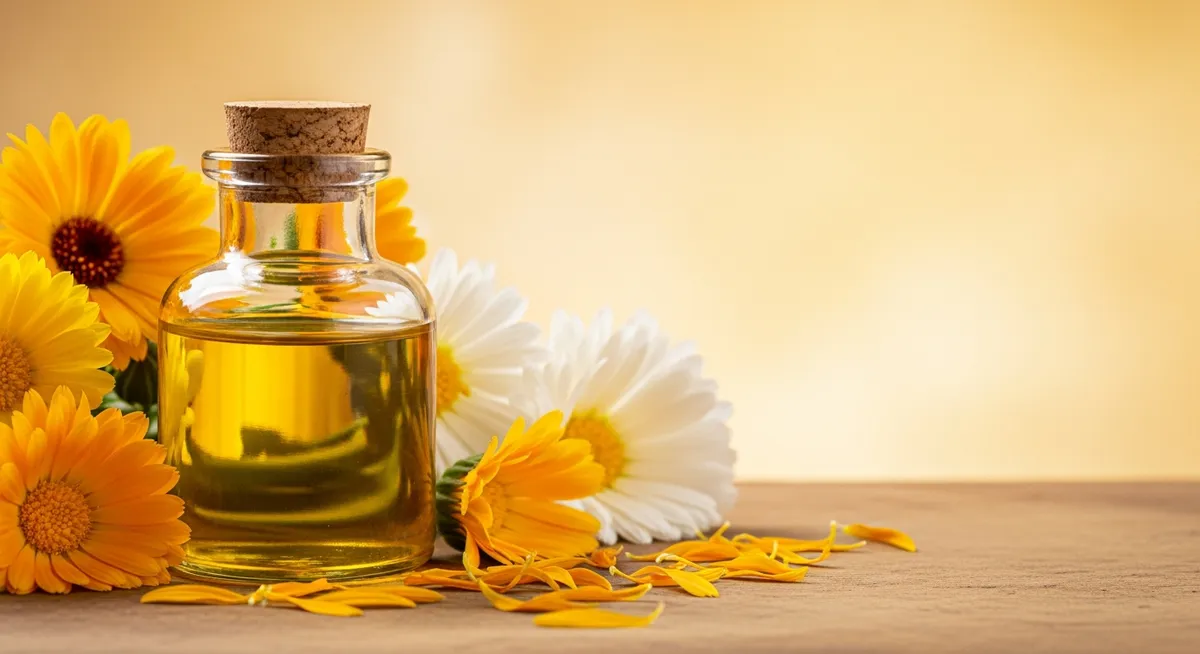
Fall Harvest: Making Your Annual Batch of Calendula Oil
The idea of one "annual batch" made in October is tidier than how calendula actually works. It is a cool-season annual that blooms repeatedly and can be picked many times, so the practical rhythm is harvest, dry, store, then infuse when you have enough dried flower. We make our oil from dried flowers, not fresh, and the single most important rule we would pass on is the same: infuse only flowers that are completely dry.

Calendula Oil
Our own small-batch calendula oil, in sizes from 0.5 oz to bulk.
From $13.99
Shop Calendula Oil →Where fall fits, and where it does not
Many fall-harvest guides say calendula reaches its "peak potency" just before the first frost. We found no source for that, so we are not repeating it. What the extension sources do say: Utah State Extension describes calendula as preferring cooler temperatures (below 85 F), often stopping bloom in extreme heat, surviving down to about 25 F, and re-blooming about two weeks after flowers are harvested (Braithwaite and Drost, Utah State University Extension, 2020). UF/IFAS calls it a cool-season annual and says that in USDA zones 9b-11 it is generally planted in the fall for winter and spring color (Graves et al., UF/IFAS, FPS87, revised 2026).
So where you live decides the calendar. In a cold climate, October is the tail of the season, and you are picking whatever the plants still produce. In a mild-winter zone, fall is when you plant. If you want a batch of oil in autumn, the real work was the picking you did all summer.
Step 1: pick, and dry hard
Utah State says to pick the complete flower at full bloom and that blooms can be harvested multiple times in a season. It says to dry them in a well-ventilated area away from sunlight, that a food dryer can also work, that flowers should dry in 1 to 5 days, and to store in a moisture-tight container in a cool, dark place. The same sheet estimates a 60-foot row yields about 1 pound of dried flower heads (Braithwaite and Drost). Johnny's Selected Seeds suggests sowing in batches 2-3 weeks apart to extend bloom (Johnny's Selected Seeds, grower library). Both are one-source figures, so plan on a small batch for a first attempt.
Our own process matches the principle, not the scale. We buy dried flowers from family farms in Egypt, Hungary, the Balkans and Turkey, grown organically without synthetic pesticides or fertilizers. The flowers are dried naturally by traditional methods with no industrial heat or forced air, and we infuse petals separated by hand from sound, whole dried flower heads, not broken florets.
How dry is dry? We found no calendula-specific moisture target. Oregon State Extension's general herb guidance is that herbs are dry when they "crumble easily between your fingers," and it advises low dehydrator temperatures (95-115 F) and airtight storage away from light, but that page covers culinary leaf herbs (Oregon State University Extension, Drying herbs). Thick flower heads dry more slowly, so if the center of a head still feels soft or cool, keep drying.
Step 2: why dry matters (the safety reasoning)
The University of Maine Cooperative Extension states that using dried herbs is the safest way to make infused oils, because fresh plant material most likely carries C. botulinum spores and dried herbs lack the moisture bacteria need to grow in the oil (University of Maine Extension, Bulletin 4385). CDC advises refrigerating homemade oils made with garlic or herbs and throwing them away after 4 days, and notes you cannot see, smell or taste the toxin (CDC, Preventing Botulism). Both are about culinary oils and neither addresses calendula, so applying them to a skin oil is an extrapolation. We think it is a prudent one.
This is where we disagree with a popular recipe. Mountain Rose Herbs' calendula page suggests that if you use fresh flowers you wilt them for 12 hours first (Mountain Rose Herbs, Calendula Uses + Infused Olive Oil Recipe). A 12-hour wilt does not make a flower dry. Reasoning from the extension sources above, we would infuse dried flowers only. Also note the quality side: moisture in dried herbs supports mould growth, which is why supplier specifications set microbial limits (1,000 CFU/g for total aerobic count and for yeasts and moulds in one macerate sheet; Golgemma/Biolandes FB026, 2025).
Step 3: infuse, and what is not settled
Published methods vary, and we will lay out the disagreement rather than choose one for you:
- Solar: a jar two-thirds full of dried flowers, covered with olive oil by at least an inch, shaken daily on a warm sunny windowsill, strained after 4 to 6 weeks (Mountain Rose Herbs).
- Warm double boiler: low to medium heat for at least 4 hours and up to 2 days, strained through cheesecloth or a coffee filter (Soap Queen, Infusing Oil). No temperature is given, and we found no verified temperature for slow-cooker or oven methods.
- Regulatory ratio: the EU herbal monograph defines the traditional oil preparation as a 1:10 extract in a fatty vegetable oil, olive oil as the example (EMA/HMPC, 2018).
- A lab comparison: in a 2005 comparison of oil extracts, the highest carotene content (57.5 mg/kg as beta-carotene) came from a 72-hour room-temperature maceration in olive oil at 1:5 by weight (Novkovic et al., Hemijska industrija, 2005). That measured pigment, not skin outcomes, and it is a single abstract-level source, but it suggests longer is not automatically better for color.
On heat, a lab study found carotenoids in oil degrade faster as temperature rises, but it was run at 120-180 C and does not describe gentle warming (Achir et al., Eur J Lipid Sci Technol, 2010). Our own oil is made by a two-stage process, calendula extracted on its own and then brought into a carrier oil, and we do not give process parameters on this page. For a home batch, "low heat or none" is our reasoning, not a tested rule.
Step 4: strain, bottle, label, check
- Strain well and keep water out. Water left in a finished oil is a spoilage risk; that is our inference, not a figure from a source we read.
- Label with the date. Our bottles are dated and lot-numbered so you can tell how old the oil is. Suppliers quote 36 months for a sealed commercial macerate with 0.2% added tocopherol, stored at 15-25 C away from air and light (Golgemma/Biolandes). A home batch has no such data. Soap Queen says use infused oils within 6 months to a year depending on the carrier, and the University of Maine says no more than three months for homemade infused culinary oils. We would use a home batch within a few months, as judgment.
- Dark glass, cool, closed. Light, heat, oxygen and trace metals speed oxidation (Gharby et al., Food Chemistry X, 2025). Our oil carries no added antioxidant, so the same applies to ours.
- Smell and look before every use. If it smells off or looks cloudy or has gone dark, discard it.
When making your own is not the better plan
A garden batch depends on your weather, your drying space and your carrier oil; it will not come with batch testing. A Montana State field trial (1998-99) hit aster yellows in both of its calendula cultivars (11-27% of plants) and logged 10 to 13 hand-picked harvests per season, so poor years happen even in research plots (Montana State University WARC calendula trial). If a season goes badly for us and the flowers do not meet standard, we sell out rather than lower the bar. If you want finished oil, ours has independent third-party batch testing documented on request (email the lot number to [email protected]).
Calendula is in the daisy (Asteraceae) family; the EU monograph lists hypersensitivity to it as a contraindication. Patch test first, and skip it if you are allergic to ragweed or chrysanthemums. See our allergy FAQ. For growing in more depth, see our gardener's handbook; for what to do with the finished oil, infusing in coconut oil and storage and shelf life.
Calendula Oil
Nature's Golden Botanical, bottled: small-batch calendula oil in sizes from 0.5 oz to bulk.
From $13.99
Shop Calendula Oil →Sources & Further Reading
- Braithwaite L, Drost D, 2020. How to Grow Calendula in Your Garden. Utah State University Extension. extension.usu.edu
- Graves K et al. Calendula officinalis: Calendula, Pot Marigold (FPS87). UF/IFAS Extension. ask.ifas.ufl.edu/FP087
- Johnny's Selected Seeds. Calendula key growing information. johnnyseeds.com
- Oregon State University Extension. Drying herbs. extension.oregonstate.edu
- University of Maine Cooperative Extension. Safe Homemade Flavored and Infused Oils, Bulletin 4385. extension.umaine.edu/4385e
- CDC. Preventing Botulism. cdc.gov/botulism
- Mountain Rose Herbs. Calendula Uses + Infused Olive Oil Recipe. blog.mountainroseherbs.com
- Golgemma/Biolandes, 2025. Technical data sheet, Calendula Org Macerate FB026. biolandes.com/FB026
- Soap Queen (Bramble Berry). Infusing Oil. soapqueen.com
- EMA/HMPC, 2018. EU herbal monograph on Calendula officinalis L., flos. ema.europa.eu/EMA/HMPC/437450/2017
- Novkovic et al., 2005. Determination of total lipids and characterization of marigold flower extracts. Hemijska industrija. doi/10.2298/HEMIND0510254N
- Achir N et al., 2010. Kinetic study of beta-carotene and lutein degradation in oils during heat treatment. Eur J Lipid Sci Technol 112:349-361. doi/10.1002/ejlt.200900165
- Gharby S et al., 2025. Vegetable oil oxidation. Food Chemistry X 28:102541. PMC12146556
- Montana State University, Western Agricultural Research Center. Calendula trial 1998-1999. agresearch.montana.edu