Calendula vs Chamomile: How Each Plant Is Documented
Calendula and chamomile are cousins, and anyone who has stood in front of a shelf of botanical products knows how often they get lumped together as gentle, golden, soothing flowers. They are both pretty and both popular. What is more useful to know is how each plant is documented, because that is where they differ.

Calendula Oil
Our own small-batch calendula oil, in sizes from 0.5 oz to bulk.
From $13.99
Shop Calendula Oil →Calendula officinalis and chamomile: shared daisy-family cautions
Both belong to the Asteraceae (Compositae) family, the daisy family. The European herbal monograph for calendula flowers lists hypersensitivity to that family as a contraindication, does not recommend skin use for children under 6, and says that safety in pregnancy and breastfeeding has not been established. If you are allergic to chamomile, ragweed, chrysanthemums or daisies, check with an allergist or dermatologist before you reach for either plant.
It is worth knowing that no study we found puts calendula and chamomile head to head for skin, so nobody can truthfully crown a winner. Anyone who does is guessing.
Calendula or chamomile: which has the better allergy record?
A 2002 review of Compositae allergy listed at least fifteen species, including marigold (calendula) and German and Roman chamomile, as suspected of causing Compositae dermatitis. It also noted that epidemiological data exist for only two of them, arnica and German chamomile, with the rest of the evidence anecdotal, and concluded that sensitization occurs rarely with most, especially the widely used German chamomile. So chamomile's record is better documented than calendula's, and that is not the same as chamomile being riskier. It simply means there are more data points.
A Danish study then looked at people who were already allergic to these plants: 8 of 12 chamomile-sensitive patients reacted to chamomile-containing products, including tea, creams, ointments and oil, and the authors advised Compositae-allergic people against topical use of such products. For calendula, one Austrian clinic series of 443 patients with dermatitis found 9 who reacted to marigold on a patch test. Both are referred groups of patients, so neither number says much about the average person, but together they explain why we always suggest a small test first and why anyone with a known daisy-family allergy should skip both until a professional has weighed in.
What do regulators document for calendula flower?
European regulators list calendula flower preparations as traditional-use products for minor skin inflammation and minor wounds, based on long-standing use, and ask that you see a doctor if symptoms persist longer than a week. A review of chamomile's bioactivity summarizes laboratory and animal findings and says human studies are limited.
The studies on calendula in people mostly use ointments and creams, often in medical settings, and they do not tell us how an infused oil behaves on ordinary skin. We would not stretch them that far, and we say so plainly. Because we only make calendula oil, what we can speak to is the flower: how it is grown, dried, and infused, and what is on the batch paperwork. We use no chamomile in anything.
Dried calendula and chamomile flowers compared by look
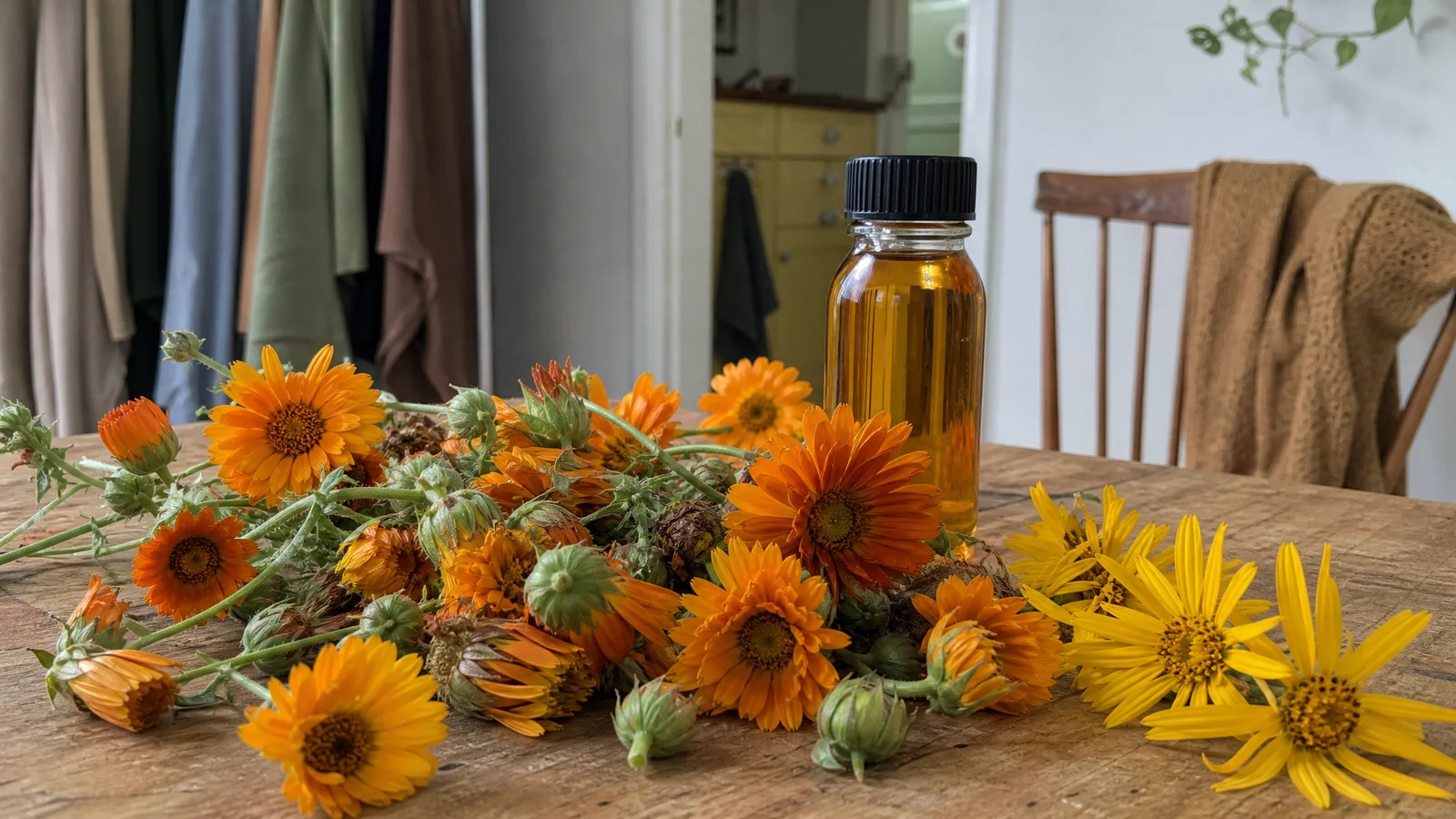
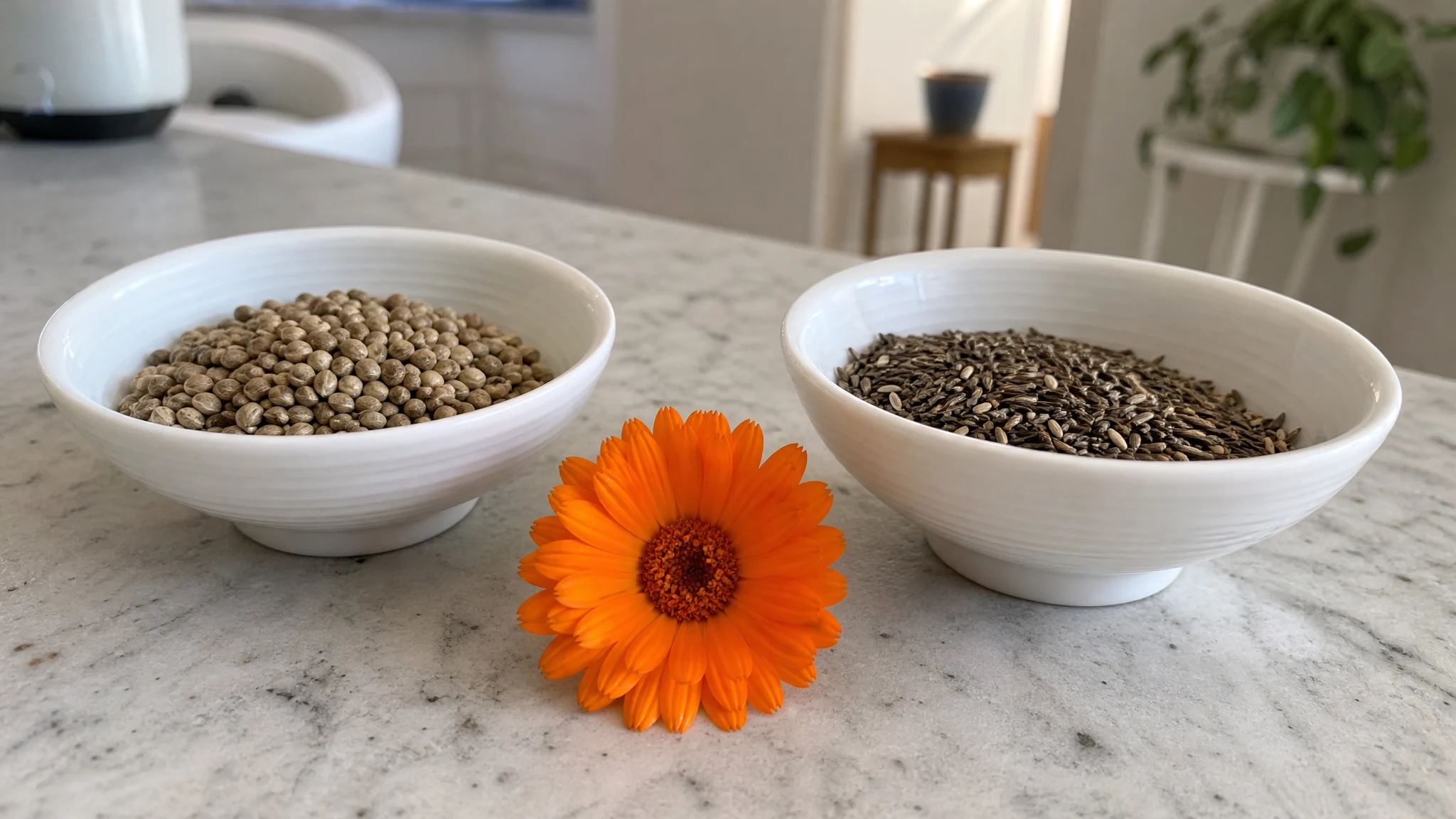
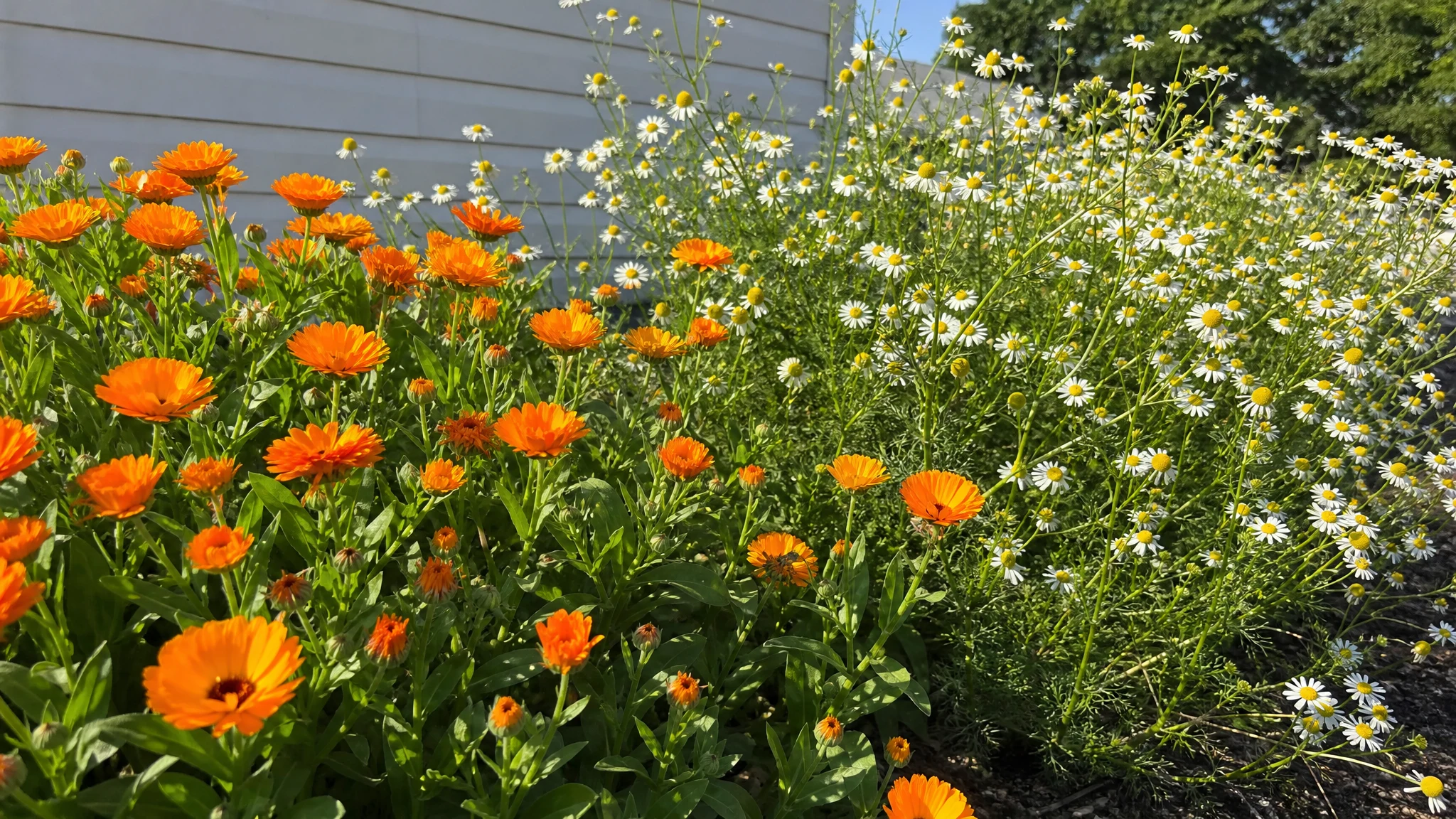
Set dried flowers of each side by side and you would never mix them up. Calendula petals are long, slightly curled and a deep golden orange, and they feel faintly resinous when you rub them between your fingers. Chamomile heads are small, with white petals folding back from a raised yellow center, and the scent is sweet and a little like apple.
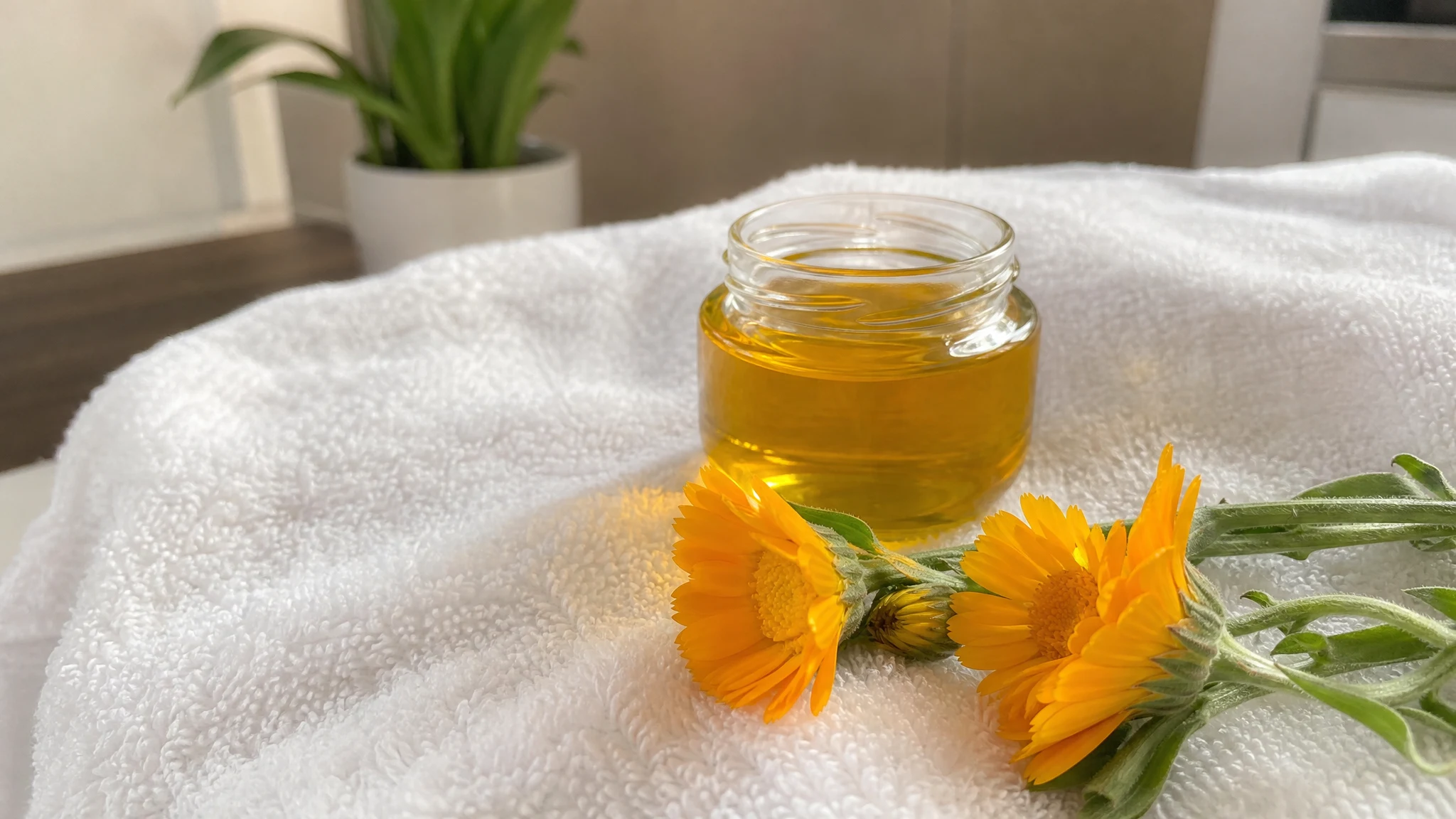
Same family, very different personalities. When we handle calendula, that golden color is what we love: whole, bright petals, and a finished oil with a soft, gently herbal note rather than a perfume.
It is also worth noticing how differently people use the two. Chamomile is mostly a plant you brew and sip or smell; calendula is mostly a plant you infuse into oil. Each has found its natural home in a different corner of the house, and there is no reason to ask one to do the other's job.
A habit worth having at the shelf
Read the plant name on any botanical label with a little care. "Chamomile" can mean German or Roman chamomile, which are different plants, and "marigold" can mean calendula or the garden marigold, which is a different genus altogether. When an ingredient list gives the full botanical name, you know exactly which flower you are holding.
Calendula oil or chamomile: a decision sort
If you react to chamomile, ragweed or daisies: leave both alone until an allergist or dermatologist advises you. If the skin is a young child's, or you are pregnant or breastfeeding: ask your pediatrician, OB/GYN or midwife first. If you have intact skin, no daisy-family allergy, and you like the idea of a plain golden oil: our calendula oil is made for exactly that, and the first step is a patch test. Our patch test walkthrough explains how, and a small bottle is the sensible way to begin.
If you want the oil-versus-oil version of this question, we compare the two plant oils in calendula oil versus chamomile oil, and our ragweed article looks at cross-reactivity in more detail. A rash that persists or broken skin is a job for a dermatologist and not for either herb.
Calendula, then, is our choice for the oil shelf, and chamomile belongs in your teacup; either way, give your skin the small test it deserves first.
Calendula Oil
Nature's Golden Botanical, bottled: small-batch calendula oil in sizes from 0.5 oz to bulk.
From $13.99
Shop Calendula Oil →Sources & Further Reading
- Contact sensitization from Compositae-containing herbal remedies and cosmetics (Paulsen, Contact Dermatitis, 2002).
- Cosmetics and herbal remedies with Compositae plant extracts - are they tolerated by Compositae-allergic patients? (Paulsen et al., Contact Dermatitis, 2008).
- The seamy side of natural medicines: contact sensitization to arnica (Arnica montana L.) and marigold (Calendula officinalis L.) (Reider et al., Contact Dermatitis, 2001).
- A review of the bioactivity and potential health benefits of chamomile tea (Matricaria recutita L.) (McKay and Blumberg, Phytotherapy Research, 2006).
- European Union herbal monograph on Calendula officinalis L., flos (EMA/HMPC/437450/2017, 2018).