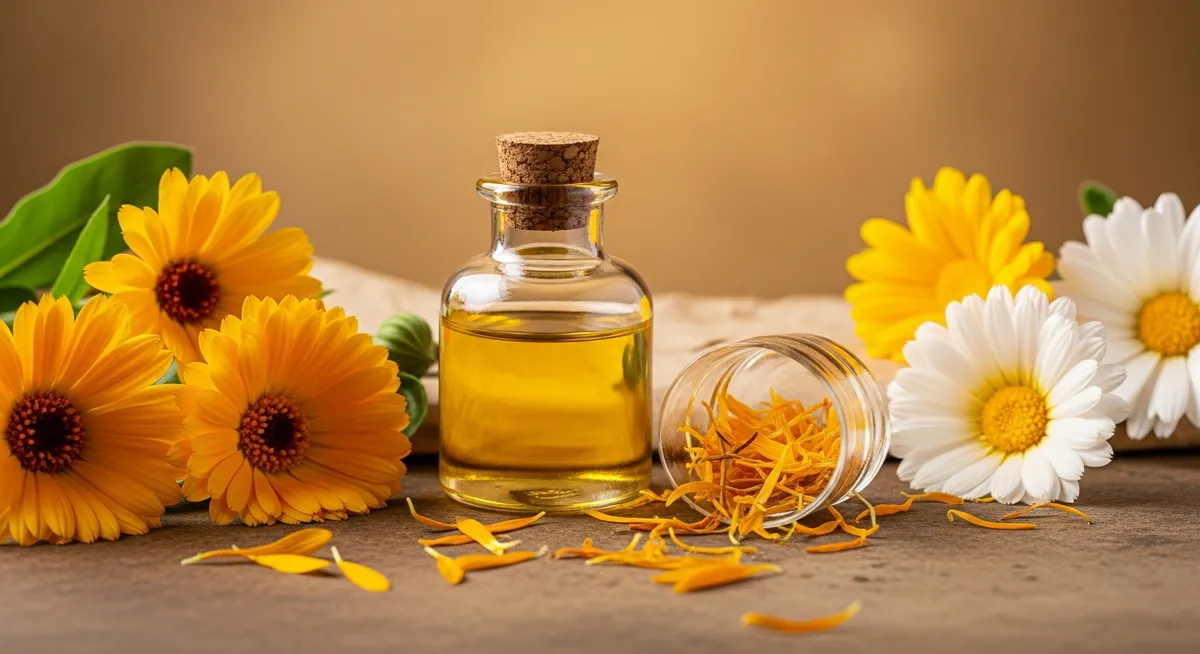
Calendula Oil Explained: What It Is, What Studies Cover
Calendula oil is an infused oil: dried calendula flowers extracted into a carrier oil, which makes it a different product from an essential oil and from a seed oil. The "benefits" you will find listed for it are mostly drawn from studies of ointments and creams, so the useful question is how much of that evidence carries over to an oil. This guide goes in the order we would use if you asked us at the point of purchase: what you are buying, what is in it, what the evidence does and does not show, who should leave it alone, and how to check a bottle.

Calendula Oil
Our own small-batch calendula oil, in sizes from 0.5 oz to bulk.
From $13.99
Shop Calendula Oil →What you are buying
Three different products get called calendula oil, and they are not interchangeable. An essential oil is steam- or hydro-distilled, solvent extracts such as concretes and absolutes are a separate category, and CO2 extracts are neither (Tisserand, on absolutes, concretes and CO2 extracts). In one lab study, hydrodistillation gave 0.9 g of oil per 100 g of dry flowers, and the distilled oil came out without pigment (Salome-Abarca et al., Bot Sci, 2015). An infused oil is plant material soaked in a fixed carrier oil. Calendula petals are not pressed, so "cold-pressed calendula oil" is not a description of how a petal oil is made; cold pressing applies to seeds, kernels, fruits and peels (Dash et al., Front Nutr, 2026). The calendula seed oil with the unusual calendic acid is yet another material, and it comes from seeds, not petals (see our calendic acid article).
Ours is an infused oil, made in two stages. We buy dried flowers, not finished oil, and the whole process runs in-house from dried flower to sealed bottle: calendula alone is extracted first, and that extract is then brought into a carrier oil. The flowers are Calendula officinalis, organically grown on family farms in Egypt, Hungary, the Balkans and Turkey, dried naturally by traditional methods, and we infuse petals separated by hand from sound whole-dried flower heads. Nothing is added: no synthetic preservatives, tocopherol or stabilizers. More on the farms is on the where it comes from page, and the product-type comparison is in infused oil vs essential oil.
What is in the bottle
By weight, most of an infused oil is the carrier. The EU herbal monograph defines the oil extract as a 1:10 preparation in a fatty vegetable oil, with olive oil given as the example (EMA/HMPC, 2018). Reasoning from that ratio, the fatty acid profile of the finished oil is mostly the carrier's. We found no published fatty acid analysis of a calendula-infused oil, so that is an inference. It is the reason we point to the batch paperwork when someone asks about the carrier, which the site does not name.
What the flowers add is better documented. Carotenoids give the gold color and sit mainly in the petals: in one cultivar, petals held about 13 times the carotenoid concentration of the tubular centre florets (Pintea et al., Acta Biol Szeged, 2003). Reasoning from that, infusing petals, as we do, targets the part of the flower where the pigment is concentrated. Where carotenoids end up in the oil depends on the carrier and the method: a 2005 lab comparison reported its highest beta-carotene figure (57.5 mg/kg) from a 72-hour room-temperature maceration in olive oil at 1:5 by weight (Novkovic et al., Hemijska industrija, 2005). Color alone proves nothing, because colorants can be added to oils (see the buying section). We do not publish composition numbers for our oil here; the certificate of analysis is where they belong.
What the evidence shows, with the oil caveat attached
The European regulator accepts calendula flower preparations as traditional herbal medicines for minor skin inflammation such as sunburn and as an aid in healing minor wounds, "exclusively based upon long-standing use" (EMA/HMPC, 2018). It reviewed the clinical studies and judged most of them small with methodological weaknesses, not enough for a well-established-use claim (EMA/HMPC assessment report, 2018). A 2025 periodic review of 67 newer references found none relevant enough to change the monograph (EMA/HMPC, 2025). The long history does not fill the gap: a scholarly overview notes that Gerard's 1597 Herball already said nothing certain was known about the plant's faculties (Touwaide and Appetiti, AHPA, 2023).
The studies people cite, and why they do not settle it:
- Radiotherapy skin reactions. In a 2004 French trial of 254 women, grade 2 or worse acute dermatitis occurred in 41% using a calendula ointment and 63% using trolamine (Pommier et al., J Clin Oncol, 2004). In a 2013 Swedish blinded trial of 411 women, severe reactions occurred in 23% using calendula cream and 19% using a standard cream, no significant difference (Sharp et al., Eur J Oncol Nurs, 2013). Different products, different comparators, opposite outcomes. Neither used an infused oil, and this is a matter for the radiation oncology team.
- Wounds. A 2019 systematic review of 14 studies (7 animal, 7 human) found faster early repair in animal studies, mixed results for chronic ulcers and burns, and asked for larger trials (Givol et al., Wound Repair Regen, 2019). An earlier 2008 review of six trials called the evidence weak (Leach, Wounds, 2008). Open wounds need a clinician, not an oil.
- Diaper dermatitis. A 2012 trial of 66 infants found fewer rash sites with a 1.5% calendula ointment than with aloe cream (Panahi et al., ScientificWorldJournal, 2012); a 2015 trial of 100 infants found complete improvement at three days in 86% with a bentonite cream and 52% with a calendula cream (Mahmoudi et al., Indian J Med Res, 2015). No trial had an untreated or placebo group.
Our position follows from that. We make no medical claim for our oil, and where a source reports a study we report it as a study. If you are looking for an effect on a skin condition, the published evidence does not support promising one from an oil, and the right people are a dermatologist or pediatrician. What the literature does support is narrower and plainer: in the Cosmetic Ingredient Review's 2010 assessment, calendula-derived cosmetic ingredients including flower oil were judged safe in cosmetics at the concentrations assessed, and noted as possible mild eye irritants (Andersen et al., Int J Toxicol, 2010). Keep it away from the eyes.
Who should not use it
Calendula is in the daisy family (Asteraceae), alongside chamomile, arnica, chrysanthemum and ragweed. The EU monograph lists hypersensitivity to other Asteraceae plants as a contraindication and says skin sensitization has been reported, frequency unknown. In one Austrian clinic series, about 2% (9 of 443) of patients referred for dermatitis reacted to marigold (Reider et al., Contact Dermatitis, 2001). Do a patch test first (how) and skip it if you react. The EU monograph also does not recommend skin use under age 6, or use during pregnancy and lactation, because adequate data are lacking. That is an absence of data, not a documented harm, and it is a conversation for a pediatrician, OB/GYN or midwife. For a fuller allergy breakdown, see reactions and what to do. This page is also not about eating the oil; for internal use, see the question in our internal use FAQ.
How to check a bottle before you trust it
Ask for three things: the carrier, the batch paperwork, and the date. Every bottle of ours is dated and lot-numbered, every batch goes to independent third-party labs for physical assays, chemical assays and contaminant screening, and documentation is available if you email the lot number to [email protected]; a certificate of analysis is linked on the shop page. Read any certificate for what it lists. Adulteration of botanical oils is usually done for money, colorants are sometimes added to oils to meet appearance specifications, and the UV-based total-carotenoid tests used on some certificates cannot show which plant the color came from (Gafner et al., J Nat Prod, 2023). We found no documented case of calendula oil specifically being adulterated, so this is general botanical risk, not an accusation about the market. Our broader buying guide goes through the checks.
Storage is the other half. Light, heat, oxygen and trace metals speed oxidation (Gharby et al., Food Chem X, 2025); one commercial macerate data sheet specifies 15-25 C in the closed original container, protected from air and light (Golgemma/Biolandes, FB026, 2025). That is another supplier's specification, so use it as a guide and see our shelf life FAQ. If you make your own, keep to dried flowers: University of Maine extension calls dried herbs the safest choice for infused oils because they lack the moisture C. botulinum needs (UMaine Extension, Bulletin 4385), and our home infusion guide covers the method.
If calendula oil fits after all that, the bulk guide and the size list on the shop page run from 0.5 oz up, and a 4 oz bottle is the size we suggest for compatibility testing if you are formulating.
Calendula Oil
Nature's Golden Botanical, bottled: small-batch calendula oil in sizes from 0.5 oz to bulk.
From $13.99
Shop Calendula Oil →Sources & Further Reading
- Tisserand R. Absolutes, concretes and CO2 extracts. roberttisserand.com
- Salome-Abarca LF et al., 2015. Chemical composition of scented extracts obtained from Calendula officinalis by three extraction methods. scielo.org.mx/bs/v93n3a16
- Dash B et al., 2026. Cold pressed oils: a systematic review. PMC13371722
- EMA/HMPC, 2018. EU herbal monograph on Calendula officinalis L., flos. ema.europa.eu/EMA/HMPC/437450/2017
- Pintea A et al., 2003. HPLC analysis of carotenoids in four varieties of Calendula officinalis L. flowers. abs.bibl.u-szeged.hu
- Novkovic et al., 2005. Determination of total lipids and characterization of marigold flower extracts. doi 10.2298/HEMIND0510254N
- EMA/HMPC, 2018. Assessment report on Calendula officinalis L., flos. ema.europa.eu/EMA/HMPC/603409/2017
- EMA/HMPC, 2025. Addendum to assessment report. ema.europa.eu/EMA/HMPC/12880/2025
- Touwaide A, Appetiti E, 2023. Herbs in History: Calendula. ahpa.org
- Pommier P et al., 2004. Calendula officinalis vs trolamine, radiation dermatitis. PMID 15084618
- Sharp L et al., 2013. Calendula cream vs aqueous cream, radiation skin reactions. PMID 23245940
- Givol O et al., 2019. A systematic review of Calendula officinalis extract for wound healing. PMID 31145533
- Leach MJ, 2008. Calendula officinalis and wound healing: a systematic review. PMID 25941793
- Panahi Y et al., 2012. Aloe vera and Calendula officinalis on diaper dermatitis. PMID 22606064
- Mahmoudi M et al., 2015. Bentonite and calendula, infantile diaper dermatitis. PMID 26831423
- Andersen FA et al., 2010. CIR amended safety assessment of Calendula officinalis-derived cosmetic ingredients. PMID 21164072
- Reider N et al., 2001. Contact sensitization to arnica and marigold. PMID 11722485
- Gafner S et al., 2023. Botanical ingredient forensics. PMC9972475
- Gharby S et al., 2025. Vegetable oil oxidation. PMC12146556
- Golgemma/Biolandes, 2025. Technical data sheet FB026. biolandes.com/FB026
- University of Maine Cooperative Extension. Safe homemade flavored and infused oils, Bulletin 4385. extension.umaine.edu/4385e