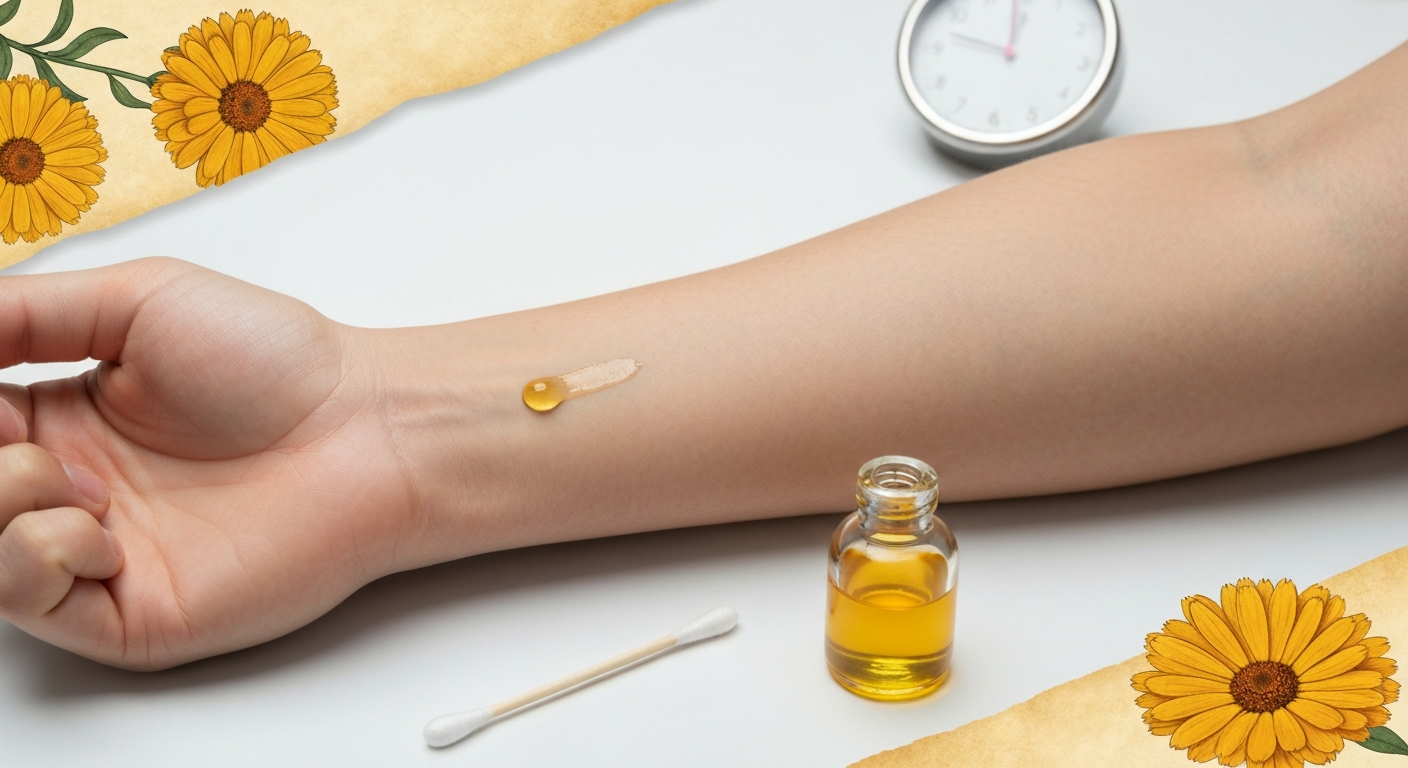
How to Do a Calendula Oil Patch Test: Allergy & Sensitivity Check
A patch test you run at home is a screening step, not the diagnostic patch test a dermatologist runs, and the popular "one dab, wait 24 hours" version has no dermatology-society source behind it that we could find. What the dermatology literature does describe is a repeated open application test: the same product, on the same patch of forearm skin, twice a day for a week or more. Below is how that works, how we would adapt it for a bottle of calendula oil, and who should skip the test and the oil entirely.

Calendula Oil
Our own small-batch calendula oil, in sizes from 0.5 oz to bulk.
From $13.99
Shop Calendula Oil →First, who should not run this test at all
Calendula is in the Asteraceae (daisy) family, along with ragweed, chrysanthemum, chamomile and arnica. The EU herbal monograph lists "hypersensitivity to the active substance and to other plants of the Asteraceae (Compositae) family" as a contraindication and notes that "skin sensitization has been reported. The frequency is not known" (EMA/HMPC, 2018). Our own page on what we do not claim says the same thing in plainer words: patch test first, and skip the oil if you react.
If you already know you react to daisy-family plants, a home test is the wrong tool, because the test itself is an exposure. Allergy specialists report that some people with pollen allergy to ragweed or mugwort also react to herbal products from related plants, including marigold, though the sources we reviewed do not quantify how often (Preda et al., Medicina, 2024). A 2025 meta-analysis also found that people with atopic dermatitis were more likely to test positive to the Compositae mix, a clinic patch-test screen, although not to contact allergens overall (Jensen et al., Contact Dermatitis, 2026). For either situation the better first step is an appointment with a dermatologist or allergist, who can test you in a clinic. See our longer pages on ragweed cross-reactivity and on allergy symptoms.
What a negative home test can and cannot tell you
The only calendula-specific patch-test rate we could verify comes from an Austrian clinic: of 443 consecutive dermatology patients, 9 (about 2%) reacted to a marigold test preparation (Reider et al., Contact Dermatitis, 2001). Those were people referred for dermatitis, so the figure does not describe the general public, and the EU assessor discounted the study because whole aerial parts, not just the florets, were tested. A 2002 review listed marigold among at least 15 Compositae species suspected of causing contact allergy but called most of the evidence anecdotal (Paulsen, Contact Dermatitis, 2002). In its 2025 review of adverse-event reports for calendula ointment, the EU committee counted 15 reports (erythema, itching, papules, burning), judged them possibly related, and saw no need to change the monograph (EMA/HMPC, 2025).
So the honest summary is that reactions look uncommon and poorly quantified. That is exactly why a negative result should be read narrowly. The American Academy of Dermatology notes that an allergic rash "tends to appear hours or days after your skin touches what you're allergic to" (AAD, Contact dermatitis). Reasoning from that, a test you read at 24 hours can finish before a delayed reaction has started. The repeated-application design exists to give such a reaction time to show.
The protocol we would follow
The repeated open application test was described in 1986: the substance was "applied twice daily for 7 days to the flexor aspect of the forearm near the cubital fossa, unless dermatitis appeared earlier" (Hannuksela and Salo, Contact Dermatitis, 1986). A later survey of American Contact Dermatitis Society members found no standardized method; for leave-on products the most common practice was twice daily on the forearm, continued for one week (49%) or two weeks (32%) (Brown et al., Dermatitis, 2015). Our home adaptation of that design, which no dermatology society has endorsed:
- Test the thing you will actually use. If you plan to blend the oil with anything else, test the finished blend, because the other ingredient can be the allergen. For essential oils, the Tisserand Institute states that allergic reactions are the most common type of reaction (Tisserand Institute).
- Pick the inner forearm, near the elbow crease, the site used in the 1986 protocol. Clean, intact skin only.
- Apply a thin layer to one small patch, twice a day, for seven days. If you plan to use the oil long term, a second week matches what about a third of the surveyed specialists do.
- Stop at the first sign of redness, itching, bumps or burning. Those are the reaction types listed in the EU safety review above. Do not push through a mild reaction to finish the week.
- Keep watching for several days after the last application. That follows from the hours-or-days timing, and it is our reasoning, not a sourced interval.
- Write the dates down (start, any reaction, stop), because a dermatologist will ask.
Two limits are worth saying plainly. The forearm is where this protocol was designed; we have no source on how face, lip or eyelid skin compares, so a clear forearm does not guarantee a clear face. And the Cosmetic Ingredient Review panel noted that calendula-derived cosmetic ingredients "may be mild ocular irritants" (Andersen et al., Int J Toxicol, 2010), so keep the oil away from the eyes whatever the forearm showed.
If you do react
The FDA's advice for any cosmetic is to stop using it, call your healthcare provider, and report the reaction to the agency (FDA, Using Cosmetics Safely). Do not repeat the test to confirm it. The AAD says the sooner a dermatologist identifies the cause, the sooner the rash clears (AAD), and the European patch-testing guideline covers testing "materials brought in by the patient," so bring the bottle (Johansen et al., Contact Dermatitis, 2015).
Here is a point where our process knowledge is useful. A reaction to a bottle of infused oil is not automatically a reaction to the flower: the finished oil also contains a carrier. We make our oil in two stages, extracting calendula alone and then bringing that extract into a carrier oil, and the carrier is listed on the batch paperwork. Email the lot number to [email protected] and we will send the documentation, which gives your dermatologist something concrete to test against. We cannot tell you which component caused a given reaction; only clinic testing can.
Finally, screening is not a licence to extend use to people the evidence does not cover. The EU monograph does not recommend skin use under 6 years because adequate data are lacking, so for infants the first conversation is with a pediatrician, not a forearm test (see our page on babies).
If the week passes clean and you are not in either higher-risk group, you have a reasonable, limited basis to start using the oil, and our shop page has the sizes, with a 0.5 oz or 1 oz bottle being plenty for a test and first use.
Calendula Oil
Nature's Golden Botanical, bottled: small-batch calendula oil in sizes from 0.5 oz to bulk.
From $13.99
Shop Calendula Oil →Sources & Further Reading
- EMA/HMPC, 2018. European Union herbal monograph on Calendula officinalis L., flos (Revision 1). ema.europa.eu
- EMA/HMPC, 2025. Addendum to assessment report on Calendula officinalis L., flos. ema.europa.eu
- Reider N et al., 2001. Contact sensitization to arnica and marigold. PubMed 11722485
- Paulsen E, 2002. Contact sensitization from Compositae-containing herbal remedies and cosmetics. PubMed 12492516
- Preda M et al., 2024. Diagnostic workup in IgE-mediated allergy to Asteraceae weed pollen and herbal medicine products in Europe. PubMed 39336535
- Jensen MB et al., 2026. Association between atopic dermatitis and contact sensitization. PubMed 41423749
- Hannuksela M, Salo H, 1986. The repeated open application test (ROAT). PubMed 2941220
- Brown GE et al., 2015. Clinical utilization of repeated open application test among American Contact Dermatitis Society members. PubMed 26367205
- Johansen JD et al., 2015. ESCD guideline for diagnostic patch testing. PubMed 26179009
- Andersen FA et al., 2010. CIR amended safety assessment of Calendula officinalis-derived cosmetic ingredients. PubMed 21164072
- American Academy of Dermatology. Contact dermatitis. aad.org
- U.S. FDA. Using Cosmetics Safely. fda.gov
- Tisserand Institute. Irritation and allergic reactions. tisserandinstitute.org