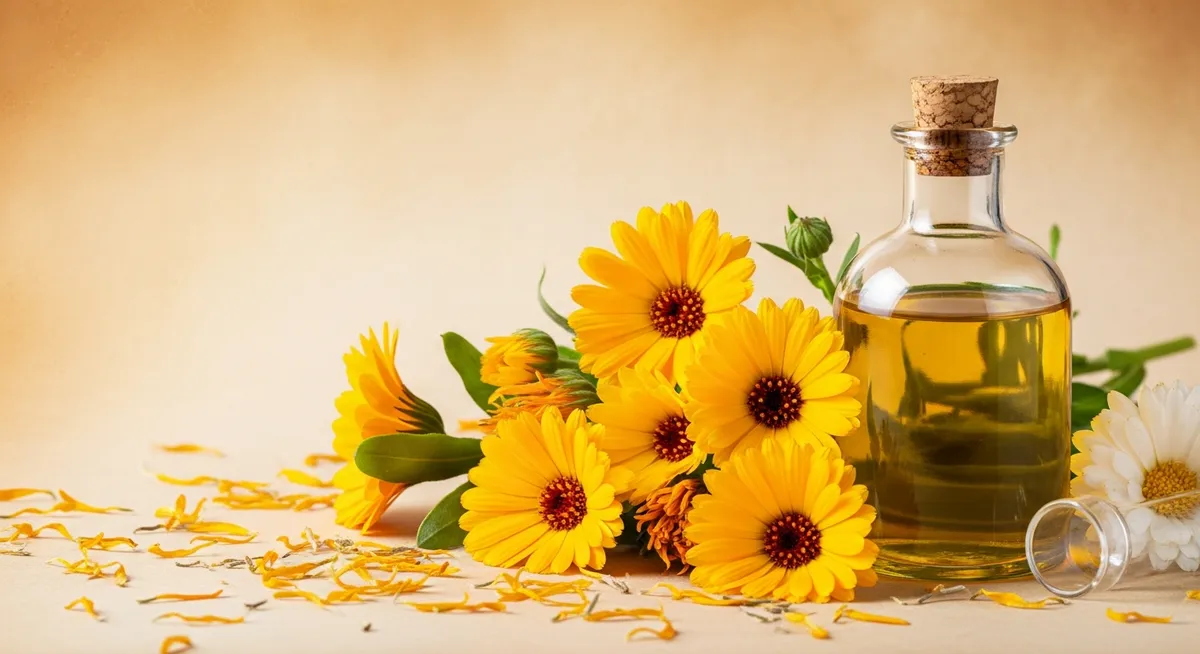
Can You Eat Calendula Oil? Internal Use FAQ
We do not recommend eating our calendula oil, and nothing in the published record gives us a basis to. Calendula flowers have a food history as a seasoning, but our oil is a skin oil: calendula extract in a carrier oil, made and documented for use on skin. The questions below separate the flower, the oil and the supplement, because most online answers blur them.

Calendula Oil
Our own small-batch calendula oil, in sizes from 0.5 oz to bulk.
From $13.99
Shop Calendula Oil →Can you eat calendula oil?
Not ours, and we found no source that establishes a safe amount of any calendula-infused oil to swallow. The reasoning is simple. A food or supplement has an intended dose and a specification for that use. An infused skin oil has neither, and the reader may not know the carrier oil. We name the carrier only on the batch paperwork, which you can request by emailing the lot number to [email protected], and the carrier matters for anyone who plans to swallow an oil. If you are asking because you swallowed some, contact your local poison center or a clinician rather than searching for a threshold; no published figure exists for this product.
Isn't calendula already a food?
Partly, and that is the source of the confusion. US food regulations list pot marigold (Calendula officinalis) among spices and natural seasonings "generally recognized as safe for their intended use" (21 CFR 182.10). NIH's LactMed database repeats that it is generally recognized as safe "when used as a seasoning or flavoring," and Memorial Sloan Kettering says it is "generally safe to use calendula in food and tea" while advising people to talk with a provider before taking supplements (LactMed; MSK, 2023). All of that concerns petals used as a seasoning. None of it addresses a bottled infused oil swallowed by the spoonful, whose strength and carrier are not a food specification.
What does research say about swallowing calendula?
Very little in humans. The EU herbal monograph's mouth and throat indication is a rinse or gargle made from a 2% solution of the tincture, not something to drink, and it says use under 12 is not recommended for that indication (EMA/HMPC, 2018). The same monograph reports no case of overdose, which is an absence of reports, not a safety limit. In EMA's 2025 review, 15 adverse-event reports were for calendula ointment, one of them an accidental ingestion of ointment (EMA/HMPC, 2025). The cosmetic safety panel's 2010 review says calendula-derived ingredients were "not significantly toxic in single-dose oral studies" in animals (Andersen et al., Int J Toxicol, 2010), which is a toxicity screen, not evidence of benefit or of a safe regular intake. Other oral work is in animals using extracts: a hydroalcoholic extract at 150 and 300 mg/kg in hairless mice after UVB exposure (Fonseca et al., J Ethnopharmacol, 2010), and oral flower extract in burned rats (Chandran and Kuttan, J Clin Biochem Nutr, 2008). Reasoning from the route, solvent and species, neither tells you what a spoonful of infused oil would do to a person, and we will not translate a mouse dose into one.
Can swallowing calendula cause an allergic reaction?
It can in people allergic to the daisy family. The EU monograph lists hypersensitivity to Asteraceae (Compositae) as a contraindication, and a 2024 allergy review says some people with weed-pollen allergy react to herbal products from related plants, naming marigold among them (Preda et al., Medicina, 2024). A 1974 Russian-language report is titled as describing anaphylactic shock after gargling with a calendula infusion; only the title is verifiable, so we cite it as a flag, not a finding (Gol'dman, Klin Med, 1974). Our ragweed article goes through the numbers. If you are allergic to chamomile, ragweed or daisies, an allergist, not a bottle label, decides.
Is it safe while pregnant or breastfeeding?
The EU monograph says safety in pregnancy and lactation "has not been established" and recommends against use for lack of data. LactMed says no information is available on oral calendula during breastfeeding, and MSK advises not to take it while pregnant or breastfeeding. Ask an OB/GYN or midwife; see our pregnancy FAQ.
Is there a difference between food-grade and cosmetic-grade oil?
We found no regulatory definition of either phrase for a calendula oil, so treat both as marketing unless a document says what was tested. What we can say about ours: every batch is tested by independent third-party labs (physical and chemical assays and contaminant screening), batches are lot-numbered, and documentation is available on request. A certificate of analysis lists only the tests that were run, so ask which ones (Gafner et al., 2023). That documentation is for skin oil quality, and it does not turn the oil into a food. For supplements, FDA does not approve them before sale, and a product represented for a specific disease is regulated as a drug (FDA, Dietary Supplements Q&A); LactMed adds that "differences are often found between labeled and actual ingredients."
Can I make an edible calendula oil at home?
Here the sources give a method and also a hazard. The hazard is moisture. University of Maine's extension calls dried herbs "the safest way to make infused oils" because fresh plant material most likely carries Clostridium botulinum spores and the bacteria grow without oxygen (UMaine Extension, Bulletin 4385). CDC says to refrigerate homemade oils made with garlic or herbs and throw them away after 4 days (CDC, Botulism prevention), and Health Canada says to use them within one week (Health Canada). Those two cover fresh herbs, and Maine's three-month limit covers dried; they disagree because they describe different material.
The method most home makers cite fills a jar two-thirds with dried calendula, covers it with oil by at least an inch, keeps it warm and shakes it daily for 4 to 6 weeks, then strains it (Mountain Rose Herbs). A faster double-boiler method runs at least 4 hours and up to 2 days (Soap Queen). Those sources state no safe quantity to eat and give no temperature, so what you cannot learn from them is how much is reasonable, how hot is safe, and whether your carrier is an edible one. That is yours to decide with a clinician, and we would not pour it on a salad for the "benefits." Our home infusion guide and drying guide cover the skin-oil version.
What should I use instead?
If the goal is calendula for skin, use it on skin; our face use FAQ covers that. If you want calendula as a food ingredient, use food-grade dried petals sold as such. If you want a supplement, talk to a pharmacist or physician first, since MSK notes herbal supplements can affect how other medications work.
Our calendula oil is for skin, with batch documentation on request, and we would rather say that plainly than suggest a use we cannot support.
Calendula Oil
Nature's Golden Botanical, bottled: small-batch calendula oil in sizes from 0.5 oz to bulk.
From $13.99
Shop Calendula Oil →Sources & Further Reading
- 21 CFR 182.10. Spices and other natural seasonings and flavorings (e-CFR). law.cornell.edu
- Drugs and Lactation Database (LactMed), 2021 revision. Calendula. NICHD. pubmed.ncbi.nlm.nih.gov
- Memorial Sloan Kettering Cancer Center, 2023. About Herbs: Calendula. mskcc.org
- EMA/HMPC, 2018. European Union herbal monograph on Calendula officinalis L., flos (Revision 1), EMA/HMPC/437450/2017. ema.europa.eu
- EMA/HMPC, 2025. Addendum to Assessment report on Calendula officinalis L., flos, EMA/HMPC/12880/2025. ema.europa.eu
- Andersen FA et al., 2010. Final report of the Cosmetic Ingredient Review Expert Panel amended safety assessment of Calendula officinalis-derived cosmetic ingredients. Int J Toxicol 29(6 Suppl). pubmed.ncbi.nlm.nih.gov
- Fonseca YM et al., 2010. Protective effect of Calendula officinalis extract against UVB-induced oxidative stress in skin. J Ethnopharmacol 127(3):596-601. pubmed.ncbi.nlm.nih.gov
- Chandran PK, Kuttan R, 2008. Effect of Calendula officinalis flower extract on acute phase proteins, antioxidant defense mechanism and granuloma formation during thermal burns. J Clin Biochem Nutr 43(2):58-64. pubmed.ncbi.nlm.nih.gov
- Preda M, Smolinska S, Popescu FD, 2024. Diagnostic workup in IgE-mediated allergy to Asteraceae weed pollen and herbal medicine products in Europe. Medicina 60(9):1494. pubmed.ncbi.nlm.nih.gov
- Gol'dman II, 1974. Anaphylactic shock after gargling with an infusion of Calendula (in Russian). Klin Med (Mosk) 52(4):142-3. Title only verified. pubmed.ncbi.nlm.nih.gov
- Gafner S et al., 2023. Botanical ingredient forensics: detection of attempts to deceive commonly used analytical methods for authenticating herbal dietary and food ingredients and supplements. (Europe PMC PMC9972475) pmc.ncbi.nlm.nih.gov
- FDA, content current 08/27/2026. Questions and Answers on Dietary Supplements. fda.gov
- University of Maine Cooperative Extension. Bulletin 4385, Safe Homemade Flavored and Infused Oils. extension.umaine.edu
- CDC, 2026. Botulism: Prevention. cdc.gov
- Health Canada, 2013. Food safety tips for vegetables and herbs in oil. canada.ca
- Mountain Rose Herbs, accessed 2026-10-14. Calendula Uses + Infused Olive Oil Recipe (blog). blog.mountainroseherbs.com
- Soap Queen (Bramble Berry), accessed 2026-10-14. Infusing Oil. soapqueen.com