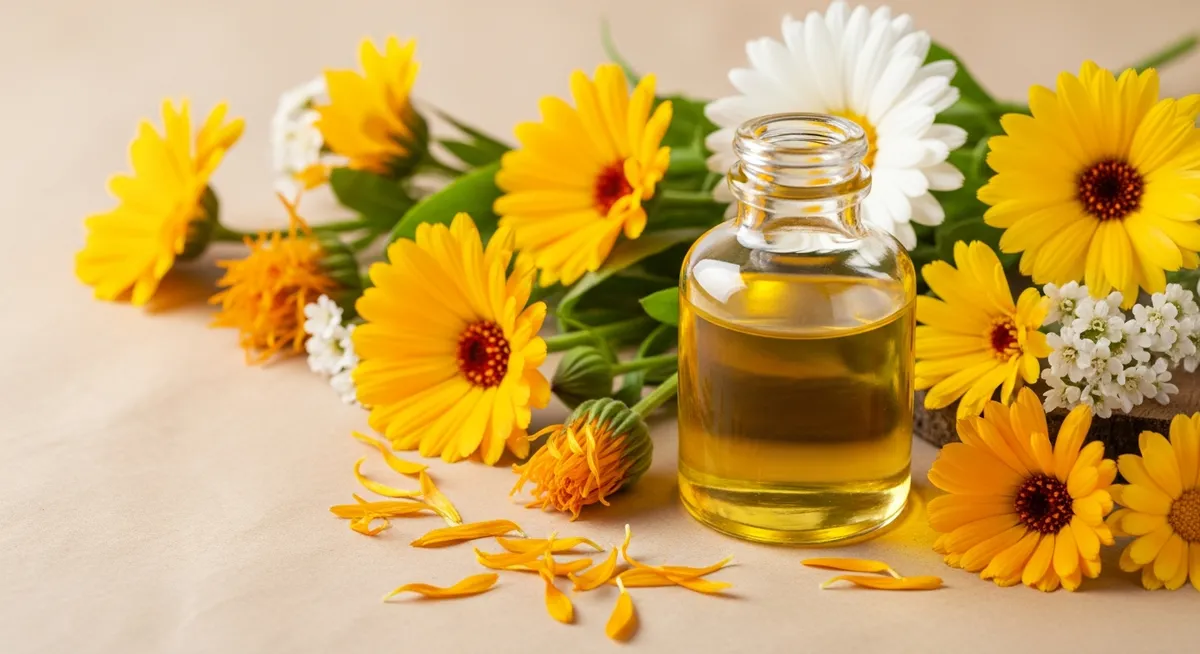
Calendula Infused Oil vs Essential Oil: What's the Difference?
Most products sold as "calendula oil" are infused oils, and a distilled calendula essential oil is a much rarer, lower-yield material that behaves differently on skin and in a recipe. The oil we make is an infusion: calendula extracted into a carrier oil. It is not an essential oil, and it does not need the dilution step an essential oil does. The rest of this article explains the difference so you can read a label for what it says.

Calendula Oil
Our own small-batch calendula oil, in sizes from 0.5 oz to bulk.
From $13.99
Shop Calendula Oil →Four materials share one name
| Material | How it is made | What the sources say |
|---|---|---|
| Infused oil (macerate) | Flowers steeped in a fixed carrier oil | EU monograph lists a 1:10 olive-oil extract as a traditional preparation; colored orange by carotenoids |
| Essential oil | Steam or hydro-distillation of the flowers | Volatile oil is 0.2-0.3% of the herb in the EU assessment report, 0.9% in one lab study; mostly sesquiterpenes; no pigments in that study |
| CO2 extract | Supercritical CO2, often with an ethanol modifier | Recovered far more faradiol esters than solvent ultrasound in one study; a concentrate, not an infused oil |
| Seed oil | Pressed from seeds, not flowers | Calendic acid 51-58% of seed-oil fatty acids in one study |
The sources behind the table: the EU assessment report gives the 0.2-0.3% volatile oil figure (EMA, 2008); a Mexican study measured 0.9 g of hydrodistilled oil per 100 g of dry flowers, dominated by alpha- and delta-cadinene, and noted that hydrodistillation gave an oil without pigments while solvent extraction and enfleurage gave pigmented ones (Salome-Abarca et al., 2015). A 2023 study found supercritical CO2 recovered markedly more faradiol esters than ultrasound extraction under matched solvent use (Atwi-Ghaddar et al., Molecules). Robert Tisserand notes that CO2 extracts are neither essential oils nor absolutes. Seed oil data come from Dulf et al., 2013.
What follows from the way each is made
An infused oil is mostly carrier. Reasoning from published petal and carrier data, the carrier supplies the fatty acid profile and the flower contributes color and a small lipid fraction; we found no published fatty acid analysis of an infused calendula oil, so that is inference. A 2025 study of other herbs found that maceration can shift fatty acid proportions in some oils (Laskos et al., Scientific Reports), so "exactly the carrier's profile" is an approximation. The oil-soluble flower compounds, carotenoids and faradiol esters, are what an oil infusion can carry. We do not state composition numbers for our oil here; the batch Certificate of Analysis is linked on the shop page.
A distilled oil is the opposite: a small volatile fraction with no carrier at all, so it is concentrated and must be diluted before it touches skin. Because the infusion is already diluted in a fixed oil, our oil goes on as it is, and that is our reasoning from how each is made, not a dermatological recommendation. The Tisserand Institute's dilution ranges apply to essential oils: 0.2-1% for sensitive or impaired skin, 0.5-1.2% for facial products, 1-3% for body oils (Tisserand Institute). They do not apply to an infused carrier oil, and they tell you nothing about calendula essential oil specifically, which has no published skin-safety range in the sources we reviewed.
How to tell which one you are holding
- Ingredient list. An infused oil often appears as the carrier oil plus "Calendula Officinalis Flower Extract." A commercial macerate's data sheet is declared as sunflower oil, calendula extract and tocopherol (Golgemma FB026, 2025). The name "Calendula Officinalis Flower Oil" exists in the INCI inventory, but the name alone does not establish composition or concentration (CosIng Checker, a third-party mirror of the EU record).
- Color. An orange oil carries pigments. A hydrodistilled oil lacked them in the study above, so a bright orange product sold as an "essential oil" is worth a question about what it is.
- The word "marigold." The commercial lutein sold as marigold extract is normally Tagetes, a different genus (Kurniawan et al., Foods, 2026).
- Documents. Industry reviews document colorants added to fatty oils and dilution of costly oils (Gafner et al., 2023), though no calendula-specific case turned up. Ask for the lot paperwork. For ours, email the lot number to [email protected].
A search of the supplier and regulatory literature behind this article found no technical data sheet for a steam-distilled calendula essential oil, only laboratory yields. That does not prove none exists; it means we cannot describe a typical commercial one.
The SPF numbers you may have seen
Several papers report in vitro sun protection factors for distilled calendula essential oil: 8.36 for the oil (Lohani et al., 2019), 14.84 for a cream containing it (Mishra et al., 2012) and 18.54 for an encapsulated vesicular cream (Lohani et al., 2021). All are spectrophotometer estimates, with no human testing, on distilled oil, which is chemically a different material from an infusion. The American Academy of Dermatology recommends broad-spectrum, water-resistant sunscreen of SPF 30 or higher, and FDA regulates sunscreens as nonprescription drugs with SPF set by standardized testing (FDA). Our position: no calendula oil, ours included, is a sunscreen. We do not know the SPF of our oil and do not state one. See our SPF article.
Which one fits your project
For a balm, salve or body oil, an infused oil is the usual base, since by our reasoning it needs no dilution calculation and suits melting with waxes and butters; our salve article shows the base. If you want to add an essential oil for scent, those need the dilution ranges above, and the aromatherapy side is outside what we make, so follow a source such as the Tisserand Institute. For research on extraction types see extraction methods compared. FDA notes that a plant origin does not keep a product from being regulated as a drug if it is marketed with therapeutic claims (FDA, Aromatherapy), which is one reason this site makes none.
Keep in mind that both materials come from a daisy-family plant. The EU monograph lists hypersensitivity to Asteraceae plants as a contraindication (EMA/HMPC, 2018), and sesquiterpene lactones are considered the main allergens of the family (Gordon, 1999). Patch test either one, skip it if you react, and read our allergy guide. Concentrated essential oils are a separate problem for pets: veterinary toxicologists advise against applying concentrated essential oils to cats (Pet Poison Helpline), and calendula products for animals belong with a veterinarian.
If a supplier cannot say which of the four materials is in the bottle, which carrier it was infused in, and which lab tested the lot, the name on the front tells you very little. We make the infused version, in two stages: calendula alone is extracted first, then brought into a carrier oil. See where it comes from.
Calendula Oil
Nature's Golden Botanical, bottled: small-batch calendula oil in sizes from 0.5 oz to bulk.
From $13.99
Shop Calendula Oil →Sources & Further Reading
- EMA/HMPC, 2008. Assessment report on Calendula officinalis L., flos (superseded). ema.europa.eu/assessment-report-2008
- Salome-Abarca LF et al., 2015. Chemical composition of scented extracts obtained from Calendula officinalis by three extraction methods. Bot Sci 93(3). scielo.org.mx/bs/v93n3a16
- Atwi-Ghaddar S et al., 2023. Sequential-selective supercritical fluid extraction of flavonoids and esterified triterpenoids from Calendula officinalis. Molecules 28(20):7060. pmc/PMC10609265
- Tisserand R. Absolutes, concretes and CO2 extracts. roberttisserand.com/?p=4514
- Dulf FV et al., 2013. Fatty acid composition of lipids in pot marigold seed genotypes. Chem Cent J 7:8. europepmc/PMC3560196
- Laskos K et al., 2025. Herbal maceration modulates fatty acid profile of cold-pressed oils. Sci Rep 15:38592. pmc/PMC12586497
- Tisserand Institute. Dilution for essential oils. tisserandinstitute.org/dilution-essential-oils
- Golgemma/Biolandes, 2025. Technical data sheet FB026, Calendula organic macerate. biolandes.com/FB026
- Kurniawan SB et al., 2026. Advances in sustainable lutein production. Foods 15(10):1717. pmc/PMC13206640
- Gafner S et al., 2023. Botanical ingredient forensics. J Nat Prod 86(2):460-472. pmc/PMC9972475
- Lohani A et al., 2019. Cosmeceutical potential of geranium and calendula essential oil. J Cosmet Dermatol 18(2). pubmed/30251317
- Mishra A et al., 2012. Assessment of in vitro sun protection factor of Calendula officinalis essential oil formulation. J Young Pharm 4(1). pubmed/22523455
- Lohani A et al., 2021. Topical delivery of geranium/calendula essential oil-entrapped ethanolic lipid vesicular cream. Biomed Res Int. pubmed/34552986
- AAD. Sunscreen recommendations. aad.org/media/stats-sunscreen
- FDA. Sunscreen: how to help protect your skin from the sun. fda.gov/sunscreen
- FDA. Aromatherapy. fda.gov/aromatherapy
- EMA/HMPC, 2018. EU herbal monograph on Calendula officinalis L., flos. ema.europa.eu/monograph
- CosIng Checker. Calendula Officinalis Flower Oil (inventory ref. 74930). cosingchecker.com/74930
- Gordon LA, 1999. Compositae dermatitis. Australas J Dermatol 40(3). pubmed/10439521
- Pet Poison Helpline. Essential oils and cats. petpoisonhelpline.com/essential-oils-cats