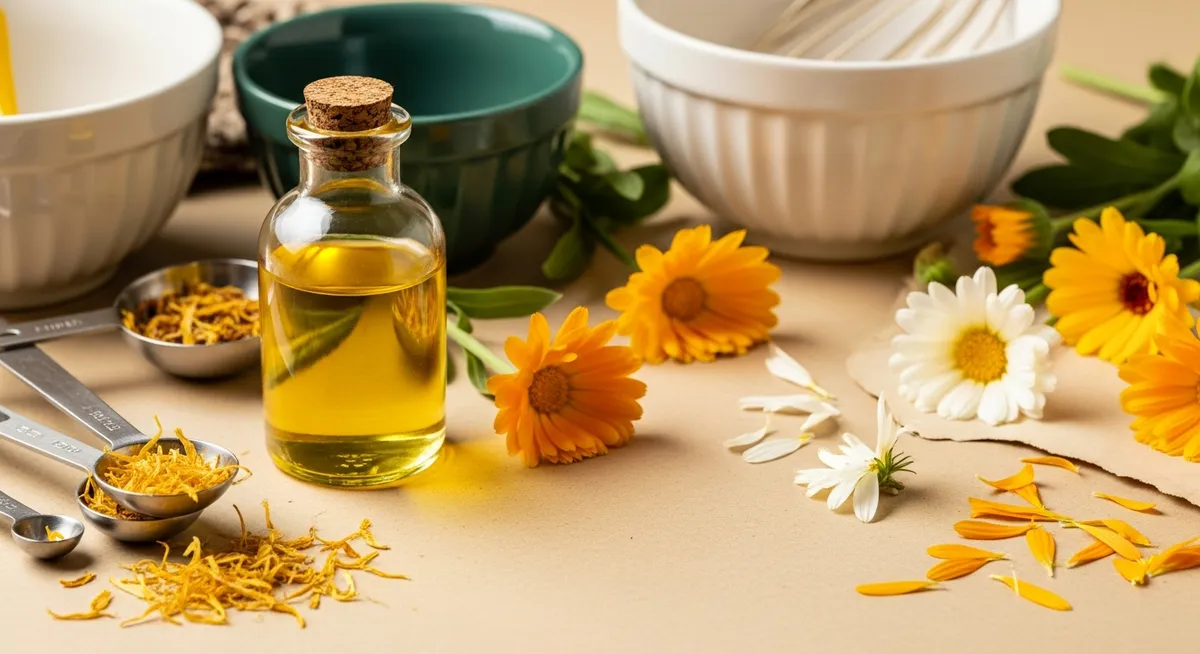
Mother's Day Calendula Oil Gift Box: DIY Assembly Guide
Before you pick ribbon, ask one question about the person you are giving a calendula box to: could she be allergic to daisy-family plants, or is she pregnant or breastfeeding? Calendula is a plant that comes with those two cautions, and a gift for a mother is more likely than most to land in the second group. The rest of this guide is how to build a box that is still a good gift once you have asked.

Calendula Oil
Our own small-batch calendula oil, in sizes from 0.5 oz to bulk.
From $13.99
Shop Calendula Oil →Step one: who the box is for
Calendula is in the Asteraceae (daisy) family. The EU herbal monograph lists hypersensitivity to Asteraceae plants as a contraindication and notes that skin sensitization has been reported, frequency unknown. The same document says safety in pregnancy and lactation has not been established and use is not recommended for lack of data (EMA/HMPC, 2018). Memorial Sloan Kettering's patient page says not to take calendula if you are pregnant or breastfeeding, because the effects have not been studied, and not to take it if you are allergic to daisy-family plants (MSKCC, About Herbs: Calendula). Those two statements are about taking it, not about putting it on skin, and neither is a finding of harm, so I would put it this way: a topical calendula gift is not forbidden for these groups, but it should not be a surprise. Ask her, or ask her midwife or OB/GYN, and if the answer is unclear, choose a different gift.
How common is the allergy? In one Austrian clinic study of 443 dermatitis patients, 9 (about 2%) reacted to a marigold test preparation (Reider et al., Contact Dermatitis, 2001). Those were people sent for testing, so it is not a rate for the public, but it is the figure we can verify. NIH's LactMed says allergic reactions to calendula, including cross-reactions to chrysanthemums, daisies and marigolds, occur rarely (LactMed, Calendula).
Step two: choose what goes in
A calendula oil box can be one product or four. What we can say about each, from the evidence and from how we make the oil:
- The oil itself. It is a finished infusion with nothing added, no preservatives, no added tocopherol and no stabilizers, in a dated, lot-numbered glass bottle. It is the one item in the box we can speak for firsthand. Our oil comes in sizes from 0.5 oz up, and a small one is the right size for a gift.
- A lotion bar or salve. These need no water, so they can be made at home. See our lotion bar walkthrough and the salve ratio post for quantities. Both are made with weights taken from published sources. One caution for gifting: a beeswax bar softens in heat, and the sources say to store it cool, away from hot cars and sunny windows. If the box will sit in a warm room or travel, include a note, or give a salve in a tin.
- A sugar scrub. Our sugar scrub post covers it. If you include one, tell the recipient to keep water out of the jar.
- A candle. I would leave this out. As our candle post explains, no source gives a safe oil load for wax, and the National Candle Association warns against botanicals embedded in candles (NCA, 2022). A candle you have not burn-tested is not a gift.
- Calendula tea or anything she would swallow. Leave it out. MSKCC says it is generally safe in food and tea but to talk to a healthcare provider before taking supplements, and what we say about our oil is about skin, so see our internal use FAQ before anyone swallows it.
What I would not do is put more products in the box than you can label. Three items you can describe properly beat six you cannot.
Step three: put the paperwork in the box
This is the part that separates a gift from a craft project, and it costs almost nothing. Write out a card that includes:
- The ingredient list of every handmade item, in the order of weight if you know it. Name calendula on the card.
- The date made for anything you made, and the date and lot number from the oil bottle. If she asks us about the oil, the lot number is how we find the batch paperwork: she can email it to [email protected].
- A patch-test instruction. Dermatologists who use a repeated open application test most often apply twice daily to the forearm for one to two weeks, and no standard method has been established (Brown et al., Dermatitis, 2015). A short version for a card is: try it on a small area for several days before wider use, and stop if skin turns red or itchy. Our patch test post has the longer one.
- A stop-and-ask line. FDA advises stopping a cosmetic that causes a rash or burn and calling a healthcare provider (FDA, Using Cosmetics Safely).
- A storage line: keep bars and salves cool and dry, keep the bottle capped, and do not dip wet fingers in.
If you are selling the boxes, not just giving one, the rules change. FDA's guidance for small makers says home manufacture of cosmetics is legal, that makers must substantiate safety, that "natural" and "organic" have no FDA definition for cosmetics, and that a post office box or website alone is not an adequate address on a label (FDA, Small Businesses and Homemade Cosmetics Fact Sheet). That is regulatory information, not legal advice; a local business adviser or attorney is the right person for your state.
Step four: assemble so it survives the trip
- Pack the glass bottle upright, wedged so it cannot rattle, with the cap closed.
- Put bars and salves in tins or wrapped paper so they cannot leak or smear.
- Keep the box out of a hot car and away from a sunny porch step. Heat is the one thing the lotion bar sources warn about.
- Put the card on top so she reads it first.
On claims: do not write "good for new mothers" or "for stretch marks" or anything similar on the card. FDA decides whether something is a cosmetic or a drug by its intended use, which can be shown by claims on its label (FDA, Is It a Cosmetic, a Drug, or Both?), and the evidence does not support them for an infused oil anyway. A card that says "made with calendula oil, here is what is in it" is accurate and sufficient.
What I would not promise in the note
Do not tell her it will do anything. The published calendula trials mostly used extracts in creams and ointments, not infused oils, so reading them as evidence about a gift box is an inference. Our sensitive skin post and gift ideas roundup are worth reading if you want other angles, and the gift sets guide covers ready-made options if you do not want to assemble one.
If you do build the box around our oil, the shop page lists the sizes, and the shop's FAQ states free standard shipping over $39 and dispatch within 1-2 business days, which matters if the date is close.
Calendula Oil
Nature's Golden Botanical, bottled: small-batch calendula oil in sizes from 0.5 oz to bulk.
From $13.99
Shop Calendula Oil →Sources & Further Reading
- EMA/HMPC, 2018. European Union herbal monograph on Calendula officinalis L., flos (Revision 1), EMA/HMPC/437450/2017. ema.europa.eu/EMA/HMPC/437450/2017
- Memorial Sloan Kettering Cancer Center, 2023. About Herbs: Calendula. mskcc.org/herbs/calendula
- Reider N et al., 2001. The seamy side of natural medicines. Contact Dermatitis 45(5):269-72. pubmed.ncbi.nlm.nih.gov/11722485
- Drugs and Lactation Database (LactMed), NICHD. Calendula. pubmed.ncbi.nlm.nih.gov/30000917
- National Candle Association, 2022. Botanical-embedded candles can be a fire hazard. candles.org/?p=1126
- Brown GE et al., 2015. Clinical utilization of repeated open application test among American Contact Dermatitis Society members. Dermatitis 26(5):224-9. pubmed.ncbi.nlm.nih.gov/26367205
- U.S. FDA. Using Cosmetics Safely. fda.gov/using-cosmetics-safely
- U.S. FDA, 2025. Small Businesses and Homemade Cosmetics: Fact Sheet. fda.gov/small-businesses-homemade-cosmetics
- U.S. FDA. Is It a Cosmetic, a Drug, or Both? (Or Is It Soap?). fda.gov/it-cosmetic-drug-or-both-or-it-soap