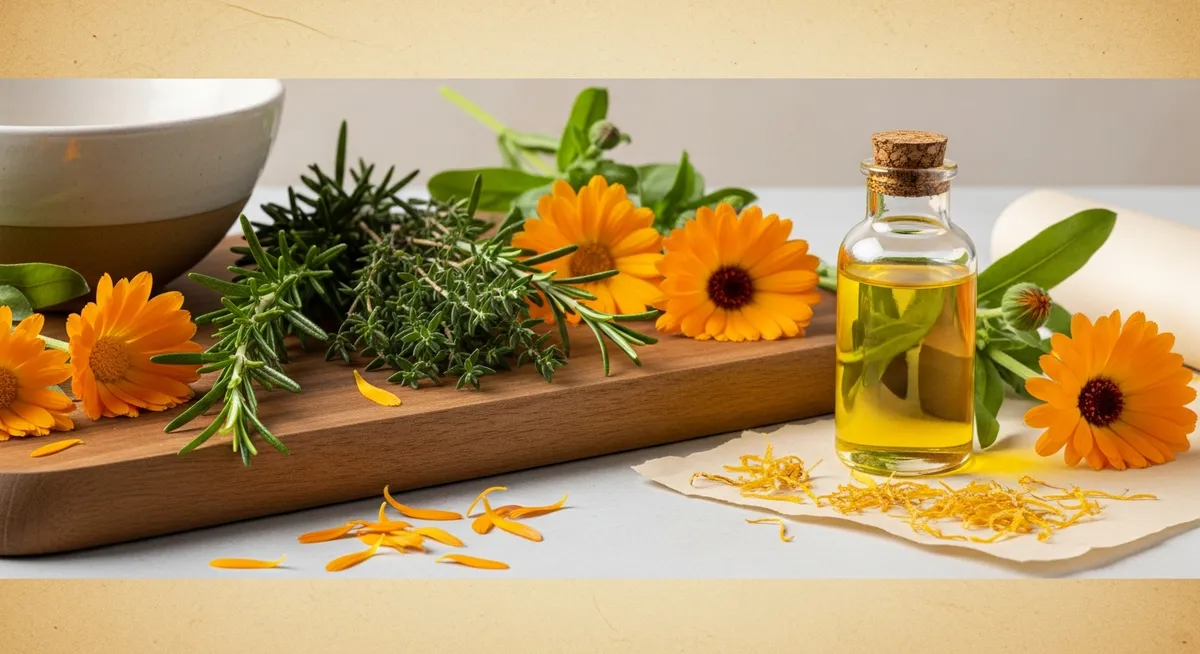
Calendula Oil Sugar Scrub Recipe for Exfoliation
A sugar scrub made with calendula oil takes about two minutes, and the real decision is not the recipe but whether the skin you want to scrub should be scrubbed at all. Dermatology guidance is more cautious about scrubbing than most recipe pages are. So this piece starts with who should skip it, then gives the method, then covers the two practical hazards: water in the jar and a slippery floor.

Calendula Oil
Our own small-batch calendula oil, in sizes from 0.5 oz to bulk.
From $13.99
Shop Calendula Oil →First, decide if you should scrub
Work through these in order.
- Acne on that skin? The American Academy of Dermatology says not to scrub it: "Scrubbing can irritate your skin, causing acne to flare" (AAD, skin care habits that can worsen acne). Skip it on the face if that describes you.
- Rosacea? The AAD is blunter: "If you exfoliate your skin, stop," and it lists rubbing, scrubbing or massaging skin with rosacea among things to avoid (AAD, rosacea tips).
- The face generally? For everyday washing the AAD says to resist the temptation to scrub because scrubbing irritates the skin, and that a washcloth, mesh sponge or anything other than fingertips can irritate (AAD, face washing 101). Those pages are about washing and acne, not about sugar scrubs specifically, so read it as direction of travel: facial skin tolerates scrubbing poorly. Our reasoning is that sugar crystals are sharp-edged relative to skin cells, so if you want to use a scrub on the face at all, make the grains fine and the pressure close to zero. We have no source that rates sugar grain sizes.
- Dry, cracked, sunburned, or recently shaved skin? Reasoning from the same irritation point, wait. A scrub is a mechanical stress. Skin that is already raw has nothing left to give.
- Elbows, knees, heels and thicker body skin? This is where a scrub is most reasonable, used gently.
The AAD's page on large pores says exfoliating may make pores less noticeable but must be done safely to avoid damaging the skin, and also says to never scrub, rub, pick at or squeeze the skin on your face (AAD, large pores). For a schedule, the only figure we could verify is from a different concern: for ingrown hairs in the beard area, a dermatologist quoted by the AAD recommends a gentle exfoliating scrub 1-2 times per week and moisturizing immediately afterward (AAD, healthy beard). That is advice for one skin concern, not a universal figure. Start with less.
The recipe, and why we give no cup ratio
There are two ingredients: sugar and infused calendula oil. We could not find a tested ratio from a source we could verify, and ratios depend on how coarse your sugar is and how oily you want the finish. So here is a method that finds it for you.
- Put dry sugar in a clean, dry jar or bowl.
- Stir in calendula oil a little at a time, until the sugar looks like wet sand and a pinch holds together when pressed.
- Write down what you used, so the next batch is repeatable.
- Use a clean, dry spoon to take scrub out of the jar. Do not dip wet fingers in.
That last step matters for the next section.
The hazard nobody mentions: water in the jar
Sugar and oil together contain no water, so the scrub can be made without a preservative. This is the same principle as any balm: microbes need liquid water, and a 1995 review states that the cosmetics most in need of preservatives are those that contain water (Brannan, J Soc Cosmet Chem, 1995). But a scrub lives in the shower, which is the one place a water-free product is certain to meet water. FDA says contaminated cosmetics can cause serious infections, and its advice includes washing hands before dipping fingers into a container (FDA, Microbiological Safety and Cosmetics). Reasoning from both: keep the jar out of the shower stream, scoop with a dry spoon, put the lid back on immediately, and make small batches. Do not add water, juice, honey or fresh fruit to a scrub you plan to keep, since that makes a water-containing product with no tested preservative. If the scrub gets wet and sits, throw it out. Mold or an off smell means discard.
Second hazard: a slick floor
An oily scrub leaves an oil film on skin and, when it rinses off, on tub and shower floors. We have no study to cite, but it follows from what the product is: use a mat, rinse the surface well, and do not stand on a surface you have just oiled. The oil also stays on the skin after rinsing, which is part of the point; it also means you may not need a separate moisturizer on that skin straight away. The AAD advises moisturizing after bathing while skin is still damp (AAD, dry skin guidance), so rinse, pat, and decide by feel.
Where calendula fits, and where it does not
Calendula is not what exfoliates. The sugar does that. The calendula oil is the lubricant that lets the crystals move without tearing at skin. The oil is also the part with the most variables: the carrier makes up most of the bottle, and carriers differ on the skin barrier. In a 19-person forearm study, olive oil applied twice daily for four weeks reduced stratum corneum integrity and sunflower oil did not (Danby et al., Pediatr Dermatol, 2013). That was daily use, not a weekly scrub, but it is a reason to find out what carrier you are using. Ours is on the batch paperwork on request: email the lot number to [email protected]. We make one oil, from dried organically grown flowers, extracted alone and brought into a carrier oil, with no preservative, tocopherol or stabilizer added. Because nothing slows oxidation, buy a size you will use and keep it closed and cool (Gharby et al., Food Chem X, 2025). A 1 oz or 2 oz bottle from the shop is a sensible start for something you will mix a little at a time. See also storage and shelf life.
We found no human trial that tests calendula in a scrub or as an exfoliation aid, so we make no claim about it.
Who should not use it
- Anyone allergic to ragweed, daisies, chrysanthemums or marigolds. Calendula is in the Asteraceae family. The EU herbal monograph lists hypersensitivity to that family as a contraindication and says skin sensitization has been reported, frequency unknown (EMA/HMPC, 2018). Patch test first, away from where you plan to scrub, and stop if you react; see our patch test article.
- Children under 6, and pregnancy or breastfeeding. The monograph does not recommend skin use under 6 and says safety in pregnancy and lactation has not been established. Ask a pediatrician or OB/GYN or midwife.
- Anyone with eczema, psoriasis or any inflamed skin. Ask a dermatologist before using a scrub on it.
For other uses of the oil in a bath or shower routine, our foot soak article is the nearest neighbor. For what to do instead of scrubbing dry, rough skin, see calendula oil for dry skin.
In short: scrub body skin gently if you scrub at all, keep the jar dry, mix small batches, and skip the scrub where a dermatologist would tell you to.
Calendula Oil
Nature's Golden Botanical, bottled: small-batch calendula oil in sizes from 0.5 oz to bulk.
From $13.99
Shop Calendula Oil →Sources & Further Reading
- American Academy of Dermatology. 10 skin care habits that can worsen acne. aad.org
- American Academy of Dermatology. 7 rosacea skin care tips dermatologists recommend. aad.org
- American Academy of Dermatology. Face washing 101. aad.org
- American Academy of Dermatology. Large facial pores aad.org
- American Academy of Dermatology. A dermatologist's top tips for a healthy beard. aad.org
- American Academy of Dermatology. Dermatologists' top tips for relieving dry skin. aad.org
- Brannan DK, 1995. Cosmetic preservation. J Soc Cosmet Chem 46:199-220. library.scconline.org
- FDA. Microbiological Safety and Cosmetics. fda.gov
- Danby SG et al., 2013. Effect of olive and sunflower seed oil on the adult skin barrier. pubmed.ncbi.nlm.nih.gov/22995032
- Gharby S et al., 2025. Vegetable oil oxidation. PMC12146556
- EMA/HMPC, 2018. European Union herbal monograph on Calendula officinalis L., flos. ema.europa.eu