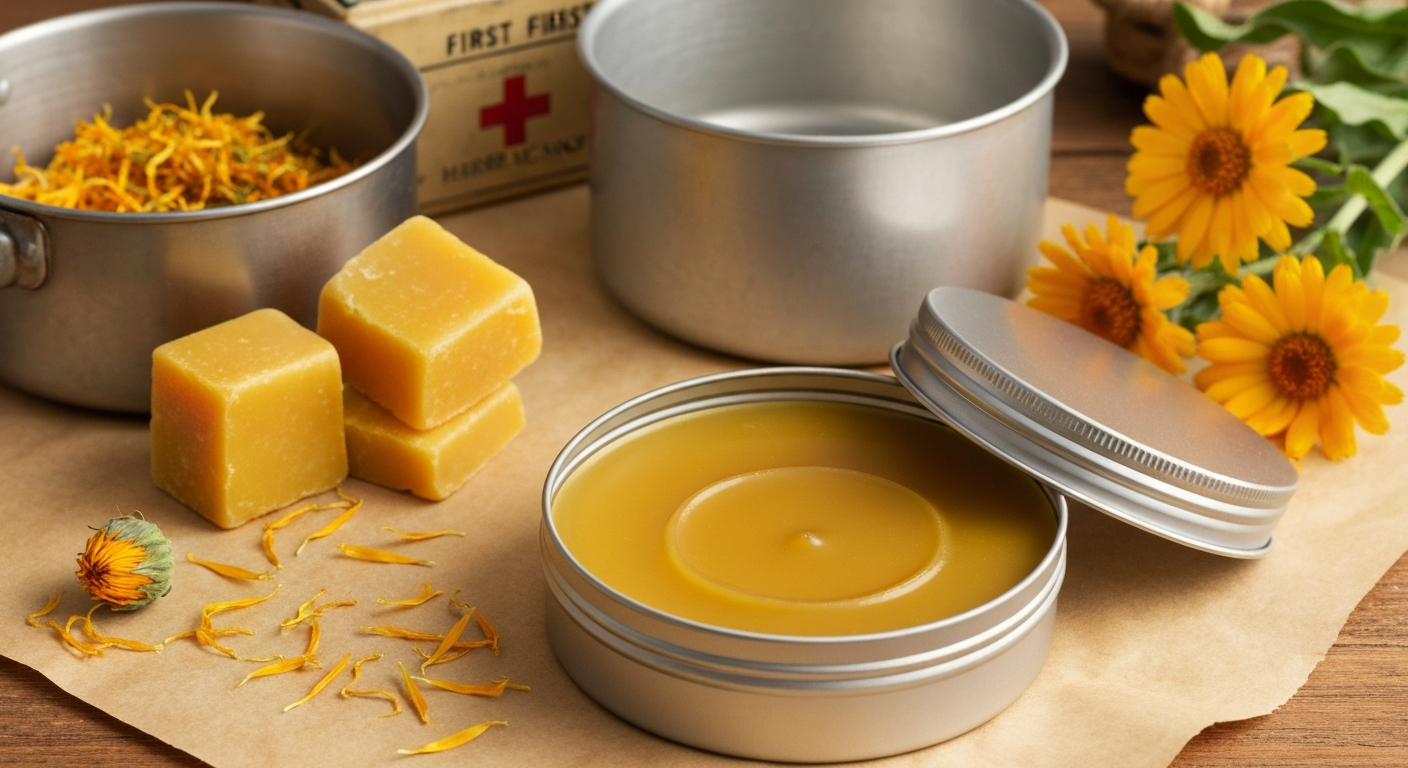
How to Make a Calendula Oil Salve: Ratio, Steps and Limits
A calendula salve is two ingredients and ten minutes: infused oil and beeswax, melted together and poured into a tin. The ratio is the only number that matters, and a published starting point is about 1 part beeswax to 4 parts infused oil. The harder question is the one in the old title: whether a home salve belongs in a first-aid kit at all, and I would say it does not replace one.

Calendula Oil
Our own small-batch calendula oil, in sizes from 0.5 oz to bulk.
From $13.99
Shop Calendula Oil →The ratio, and how to adjust it
Mountain Rose Herbs' salve recipe makes 5 oz from 1 oz beeswax and 4 oz infused oil, optionally with essential oil, and says to use less beeswax for a softer salve and more for a firmer one (Mountain Rose Herbs, How to Make Herbal Salves). Their ounces mix a weight (the wax) with a fluid volume (the oil), so weigh both on a scale if you want the same result every time. That is our adjustment, not theirs.
Here is how I would walk someone through it.
- Use finished infused oil. Because our calendula oil is already a finished infusion, you skip the flower-steeping stage that makes most salve recipes long. You start at the melting step.
- Melt the beeswax in a double boiler on low heat, add the oil, and stir until the two are one clear liquid. The source gives no temperature; low heat and patience are the instruction. Do not heat the oil harder than you need to. Reasoning from the fact that oil oxidizes faster as it gets hotter (Gharby et al., Food Chemistry X, 2025), melt the wax and stop.
- Test the firmness before you pour. Put a spoonful on a cold plate for a minute. If it is harder than you want, add oil; if it is runny, add wax. Adjust in small steps.
- Pour into clean, dry tins or jars, let it set without a lid, then close it.
- Label it with the date and the lot number on your oil bottle.
Why this is a cosmetic project, not a first-aid one
The word "first aid" carries a regulatory weight that the recipe does not. FDA decides whether a product is a cosmetic or a drug by its intended use, and that intent can be shown by its claims, so a salve sold or labeled to address wounds or burns is a drug, whatever it is made of (FDA, Is It a Cosmetic, a Drug, or Both?). For something you make for your own household, the law is not the main point. The main point is that the salve has never been tested as a wound product.
What the evidence does show is narrow. The EU herbal committee recognizes calendula flower only for traditional use on minor skin inflammation, such as sunburn, and minor wounds, and says this rests on long-standing use, not on trials; it also says the clinical studies it reviewed were inconclusive because of design problems (EMA, Calendulae flos). The preparations in that framework are defined extracts, not a salve from your kitchen. Oil extracts were described at 1:10 in a fatty vegetable oil such as olive oil, and semi-solid forms contained the equivalent of 2-8% herbal substance (EMA/HMPC, 2018). We do not know how a home salve compares, because we do not give the herbal-substance equivalent of our oil, and no source we found lets us calculate it.
The same monograph advises seeing a doctor or qualified practitioner if symptoms last longer than a week. Our rule is the practical version: a salve is for dry or chapped skin and minor irritation you can see and understand. A deep cut, a puncture, an animal bite, a burn that blisters, a wound that looks infected, or anything on a baby: see a pharmacist, a doctor or an urgent care clinic. A tin of salve in the kit is fine, but it is not the first thing you reach for.
Shelf life: the sources disagree, so decide with a rule
Mountain Rose says its salves keep 1 to 3 years in a cool place when made with dried herbs. The University of Maine's extension bulletin on homemade infused oils (written for culinary oils) says not to keep them more than three months (University of Maine Cooperative Extension, Bulletin 4385). These are different products, with different risks, and one number cannot be pulled out of them. A supplier data sheet for a commercial calendula macerate gives 36 months for the sealed oil stored cool and protected from light and air, but that is for that supplier's product and that supplier's packaging (Golgemma/Biolandes, FB026, 2025).
Reasoning from this, make small batches and write the date on the tin. If the salve smells like old oil, discard it. We have no shelf-life test data for our own oil and do not state a figure; the bottle carries a date and lot number so you can track age from your own batch.
Do not make a salve from fresh flowers, and do not add fresh herbs or water to a finished one. The CDC advises refrigerating homemade oils made with garlic or herbs and discarding them after 4 days (CDC, Preventing Botulism). That is the reason to start from a finished oil and keep water out. Dip clean fingers or a spatula, not a wet hand.
Who should not use it
Calendula is in the daisy family (Asteraceae). The EU monograph lists hypersensitivity to Asteraceae plants as a contraindication and notes skin sensitization has been reported, frequency not known, and says use during pregnancy and breastfeeding is not recommended because safety has not been established, and that skin use is not recommended under age 6 (EMA/HMPC, 2018). That is a licensed-product framework, not a verdict on every salve, but we would not hand a calendula salve to someone in any of those groups without their doctor or pharmacist agreeing. One Austrian patch-test study of 443 dermatitis patients found 9 (about 2%) reacted to marigold (Reider et al., Contact Dermatitis, 2001). Our patch test post goes through a way to test before you apply it widely, and the pregnancy FAQ covers that group.
Other things to put in, and why I would skip most of them
Essential oils are optional in the recipe above. If you add them, the Tisserand Institute's dilution ranges are 0.2-1% for sensitive or impaired skin and 1-3% for body oils and lotions (Tisserand Institute). For something meant to go on irritated skin, I would leave them out: the calendula is the point, and a fragrance gives an irritated reaction a second suspect. Our beeswax and herb blend salve and lip balm variations cover those variants, and our first-aid uses roundup says what it can and cannot do.
If you would rather not make one, the oil on its own is a simpler product: no wax, no melting, nothing to spoil in a tin. The shop page lists the sizes, and the lot number on the bottle gets you the batch paperwork.
Calendula Oil
Nature's Golden Botanical, bottled: small-batch calendula oil in sizes from 0.5 oz to bulk.
From $13.99
Shop Calendula Oil →Sources & Further Reading
- Mountain Rose Herbs. How to Make Herbal Salves. blog.mountainroseherbs.com/diy-herbal-salves
- Gharby S et al., 2025. Vegetable oil oxidation: mechanisms, impacts on quality, and approaches to enhance shelf life. Food Chemistry X 28:102541. pmc.ncbi.nlm.nih.gov/PMC12146556
- U.S. FDA. Is It a Cosmetic, a Drug, or Both? (Or Is It Soap?). fda.gov/it-cosmetic-drug-or-both-or-it-soap
- EMA. Calendulae flos, herbal medicinal product. ema.europa.eu/calendulae-flos
- EMA/HMPC, 2018. European Union herbal monograph on Calendula officinalis L., flos (Revision 1), EMA/HMPC/437450/2017. ema.europa.eu/EMA/HMPC/437450/2017
- University of Maine Cooperative Extension. Safe Homemade Flavored and Infused Oils, Bulletin 4385. extension.umaine.edu/4385e
- Golgemma/Biolandes, 2025. Technical data sheet, Calendula Org Macerate FB026. biolandes.com/FB026
- CDC. Preventing Botulism. cdc.gov/botulism/prevention
- Reider N et al., 2001. The seamy side of natural medicines. Contact Dermatitis 45(5):269-72. pubmed.ncbi.nlm.nih.gov/11722485
- Tisserand Institute. Dilution for essential oils. tisserandinstitute.org/dilution-essential-oils