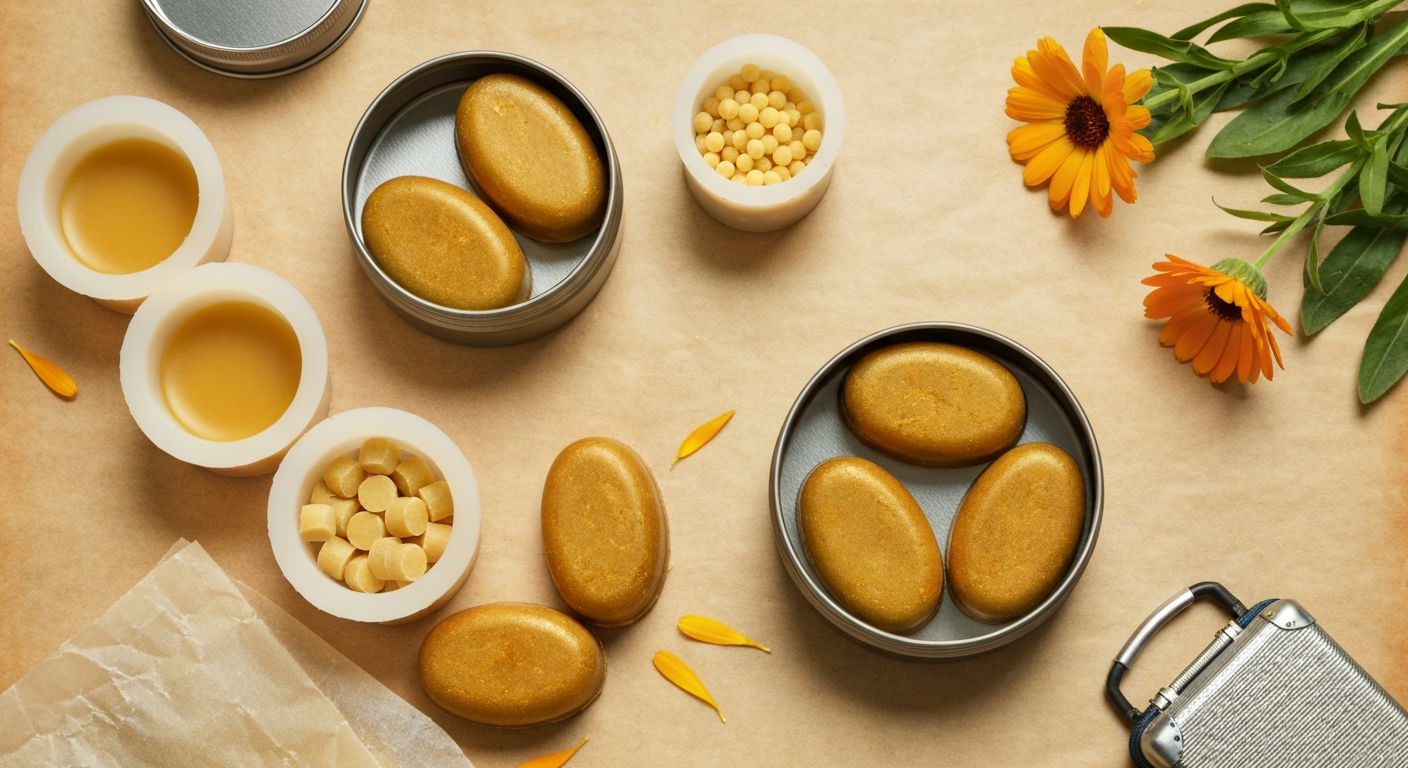
How to Make Calendula Oil Lotion Bars for Travel
A lotion bar is the easiest calendula oil project to carry in a bag, because it has no water in it: just wax, a solid butter and a liquid oil. Calendula oil takes the place of the liquid oil. The recipe below uses published quantities from two sources, and where those sources stop, I say what you have to decide yourself.

Calendula Oil
Our own small-batch calendula oil, in sizes from 0.5 oz to bulk.
From $13.99
Shop Calendula Oil →The recipe, with weights
The most specific published version we could verify is the Soap Queen (Bramble Berry) beeswax lotion bar: 3.5 oz olive oil, 3.5 oz shea butter and 2.5 oz yellow beeswax, plus 3 mL fragrance oil, for six bars in a silicone mold (Soap Queen, Beeswax Lotion Bars DIY). Their method is to melt the oil and beeswax together, stir in the shea butter, add fragrance, pour, and let the bars set for several hours or overnight.
To make a calendula bar, swap our calendula oil in for the olive oil in that list, and leave the fragrance out. That substitution is ours, not theirs, so treat it as a first test batch. The reason to test is that the carrier oil in a calendula infusion is not necessarily olive oil, and a different carrier can make a softer or harder bar. If you want to know the carrier in your bottle, email the lot number to [email protected]; the batch paperwork names it. We do not state it in articles because the carrier is a batch detail, and we would rather you read it off your own lot.
- Weigh, do not scoop. Use a kitchen scale for the oil, butter and wax. The Soap Queen recipe is in ounces by weight, and volume measures will not reproduce it.
- Melt the wax with the oil gently. Soap Queen uses short microwave bursts and warns that a container can break if it gets too hot; a double boiler is the safer route. A second source, Lappe's Bee Supply, melts everything in a jar set in a water bath, stirring constantly, because a double boiler helps prevent scorching (Lappe's Bee Supply, Beeswax Lotion Bars Recipe). Neither source gives a temperature, so we will not invent one: melt until the mixture is clear and smooth.
- Stir in the shea butter until it is fully melted.
- Pour into molds and let the bars cool completely before you unmold. Several hours or overnight is the published set time.
- Label and date it with the batch and the date you poured, so you know what you are carrying.
The travel problem: heat
This is where most advice gets vague, so here is what the sources say. Soap Queen says to store the bars in a cool, dry, dark place to avoid melting or softening, and that the bars can soften in extremely high temperatures. Lappe's makes a firmer bar with a 1:1:1 blend of beeswax, oil and body butter by volume, says heat can soften or melt beeswax bars, warns against hot cars, sunny windows and warm shipping, and notes that adding more beeswax increases heat resistance.
Reasoning from those two statements, if the bar will travel in a hot place, the lever to pull is more wax, not a different oil. We cannot give you a tested wax percentage for a summer bar because no source we could verify states one. The practical way to find yours is to make the bar, leave a test piece somewhere warm for an afternoon, and add wax in small steps to the next batch until it holds its shape. Pack the finished bar in a tin or a lined box rather than loose in a bag.
The two recipes also differ: Soap Queen's wax is about 26% of the total weight (2.5 of 9.5 oz) and Lappe's equal-parts version is a third by volume. Because one is by weight and one by volume, do not mix their numbers.
Why a bar does not need a preservative, and what that does not mean
Water is what lets microbes grow. A 1995 review in the Journal of the Society of Cosmetic Chemists says the cosmetics that most need preservatives are those that contain water, and that "the only limit to microbial life is the availability of liquid water" (Brannan, J Soc Cosmet Chem, 1995). A bar of wax, butter and oil has no water in it, so it is in the low-risk group. That is also why a lotion bar is a good home project and a lotion is not: a lotion is an emulsion with water and needs a tested preservation system (Halla et al., Molecules, 2018).
Low risk is not no risk. Water from a wet hand, a damp mold or a wet storage tin can get into a bar, and FDA lists contaminated raw materials and water among the sources of contaminated cosmetics (FDA, Microbiological Safety and Cosmetics). Dry the molds, keep the bar dry, and do not add water-based extras such as aloe gel or hydrosols.
What calendula oil adds and what it does not
In the bar, the oil is a skin-feel and color ingredient, not a promise of any effect. Most calendula studies tested extracts in creams or ointments, often with other ingredients, not infused oils, so extending them to a bar is an inference. If you want the evidence, our clinical studies post covers what was tested and how. For a bar, assume you are making a moisturizer base. For a different format with the same oil, see the salve post, and for a whipped one see whipped body butter.
Patch test, and who should not make this
Calendula belongs to the daisy family (Asteraceae). The EU herbal monograph lists hypersensitivity to Asteraceae plants as a contraindication and says skin sensitization has been reported, frequency not known (EMA/HMPC, 2018). In one Austrian clinic study of 443 patients tested for contact dermatitis, 9 (about 2%) reacted to a marigold test preparation (Reider et al., Contact Dermatitis, 2001). Those were dermatitis patients, not the general population, but it is the number we can verify.
A home patch test has no dermatology-society standard. The test dermatologists use, the repeated open application test, is most often twice daily on the forearm for one to two weeks (Brown et al., Dermatitis, 2015). Our patch test post goes through it. If you react, stop and see a dermatologist; do not keep using the bar to "push through" it. Skip the recipe, or ask a pharmacist first, if you are making it for a baby, for broken skin or for someone with a known daisy-family allergy.
Storage and what our paperwork helps with
A bar keeps as long as its least stable ingredient. Our oil has no added preservatives, tocopherol or stabilizers, so the bar has none either unless you add them, and the bottle date and lot number are on the glass for your own records. Keep the finished bars cool, dry and out of light. If you have made a batch and cannot say when, make a fresh one.
If you are making these in quantity, the 4 oz or 8 oz bottle suits a test batch and the 16 oz suits a first small run, which is also what our bulk guide suggests. For a few bars, the smaller sizes on the shop page are enough.
Calendula Oil
Nature's Golden Botanical, bottled: small-batch calendula oil in sizes from 0.5 oz to bulk.
From $13.99
Shop Calendula Oil →Sources & Further Reading
- Soap Queen (Bramble Berry). Beeswax Lotion Bars DIY. soapqueen.com/?p=60272
- Lappe's Bee Supply. Beeswax Lotion Bars Recipe. lappesbeesupply.com/beeswax-lotion-bars-recipe
- Brannan DK, 1995. Cosmetic preservation. J Soc Cosmet Chem 46:199-220. library.scconline.org/Cosmetic-Preservation
- Halla N et al., 2018. Cosmetics preservation: a review on present strategies. Molecules 23(7):1571. pubmed.ncbi.nlm.nih.gov/29958439
- U.S. FDA. Microbiological Safety and Cosmetics. fda.gov/microbiological-safety-and-cosmetics
- EMA/HMPC, 2018. European Union herbal monograph on Calendula officinalis L., flos (Revision 1), EMA/HMPC/437450/2017. ema.europa.eu/EMA/HMPC/437450/2017
- Reider N et al., 2001. The seamy side of natural medicines: contact sensitization to arnica and marigold. Contact Dermatitis 45(5):269-72. pubmed.ncbi.nlm.nih.gov/11722485
- Brown GE et al., 2015. Clinical utilization of repeated open application test among American Contact Dermatitis Society members. Dermatitis 26(5):224-9. pubmed.ncbi.nlm.nih.gov/26367205