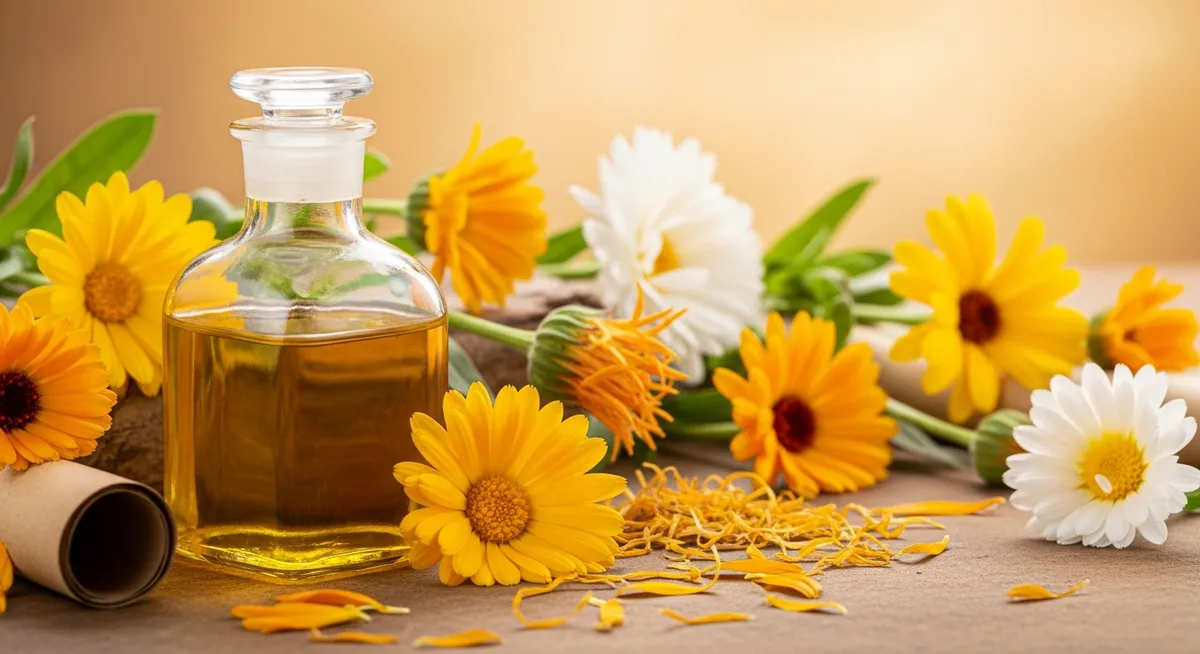
Calendula Oil vs Other Oils: Which Should I Choose? FAQ
Calendula oil is not in the same product category as most of the oils it gets compared with. The oil we make is an infused oil: calendula flower extract brought into a carrier oil. Jojoba, sweet almond, rosehip and coconut are oils taken from seeds, nuts or fruit, and an essential oil is a third kind of thing again. Which one you should choose depends first on which category answers your question, so that is the order we would walk through it.

Calendula Oil
Our own small-batch calendula oil, in sizes from 0.5 oz to bulk.
From $13.99
Shop Calendula Oil →First question: do you want a base, or do you want calendula?
If you only want a base oil for massage, blending or a routine, you do not need calendula oil, and we will say so plainly. The base oils differ in ways you can measure. USDA reference data list high-linoleic sunflower oil at about 66% linoleic acid and high-oleic sunflower oil at about 83% oleic acid, sweet almond oil at about 69% oleic, and grapeseed oil at about 70% linoleic (USDA FoodData Central, SR Legacy). Jojoba is a different animal: a 2024 review describes it as a liquid wax of over 98% waxes, mainly wax esters, rather than a triglyceride oil (Abdalla et al., ACS Omega, 2024). Rosehip is at the polyunsaturated end, around 75% PUFA in one analyzed sample (Nikolova et al., Molecules, 2025).
Why this matters for a calendula bottle: an infused oil is mostly its carrier by weight, so how it feels and how it keeps follow the carrier more than the flower. A commercial calendula macerate data sheet, for example, lists sunflower oil as the carrier plus 0.2% added tocopherol (Golgemma/Biolandes, FB026, 2025). We make our oil in two stages, extracting calendula alone and then bringing that extract into a carrier oil, with nothing else added. We do not name the carrier in articles; it is on the batch paperwork, and you can get it by emailing the lot number to [email protected].
Is it the same as calendula essential oil, calendula seed oil or a CO2 extract?
No, and this is the most common label confusion. Steam or hydro-distillation of calendula flowers gives only a small volatile fraction, 0.2-0.3% in the EU assessment report and 0.9% in one lab study, dominated by sesquiterpenes (EMA/HMPC, 2008, superseded; Salome-Abarca et al., Botanical Sciences, 2015). That is not the orange, pigment-coloured infused oil. Calendula seed oil is another material: in an 11-genotype study calendic acid made up 51-58% of the seed-oil fatty acids, while solvent extracts of petals were mostly oleic and linoleic acid (Dulf et al., Chem Cent J, 2013; Rafajlovska et al., 2012). Our oil is made from petals, so none of the seed-oil properties are ours to claim. The infused versus essential oil article goes further.
Which oil for which job
- A neutral base to dilute or blend into: jojoba, almond, sunflower or olive, chosen by feel and keeping quality. Our carrier oil comparison and the jojoba comparison cover this.
- A face oil with a rosehip-type fatty acid profile: that is a rosehip question, and we take it up in the rosehip comparison.
- The flower itself in an oil: an infused calendula oil. This is the only case where our product is the answer.
- Concern about breakouts: do not choose by a comedogenic number. Those scales trace largely to rabbit-ear assays whose own authors called the model "not an ideal animal model" (Fulton et al., J Am Acad Dermatol, 1984), and a 2006 human study found that finished products with so-called comedogenic ingredients are not necessarily comedogenic (Draelos and DiNardo, 2006). Persistent acne belongs with a dermatologist; our comedogenicity article has the detail.
- Arnica or chamomile instead: these are different plants with their own evidence and their own allergy profile, discussed in the arnica comparison.
Can I blend calendula oil with other oils?
Oils mix freely, but we found no published study of calendula-oil blend ratios, so we cannot tell you a ratio that performs better than another. Reasoning from the table of carriers above, a blend takes on some of the feel and storage behavior of whatever you add, and a polyunsaturated oil such as rosehip, which had the shortest oxidation induction time of four oils in a 2026 accelerated test, will pull the blend in that direction (Fagoaga et al., Antioxidants, 2026). Treat that as a relative ranking, not a shelf-life figure.
If you add essential oils, the Tisserand Institute lists 0.5-1.2% for facial products and 1-3% for body oils, and says to start low (Tisserand Institute, dilution guide). The same group notes that expressed citrus rind oils can be phototoxic, while sweet orange is generally thought not to be even when expressed (Tisserand Institute, citrus oils); our Sunmeadow Blend article uses that pairing.
Does choosing a different oil get around a calendula allergy?
Only if you drop the calendula. The EU herbal monograph lists hypersensitivity to Asteraceae (Compositae) plants as a contraindication and notes skin sensitization has been reported, frequency unknown (EMA/HMPC, 2018). In one Austrian clinic series of 443 dermatitis patients, 9 (about 2%) reacted to a marigold patch-test preparation, a selected patient group and not a population rate (Reider et al., Contact Dermatitis, 2001). The carrier can add its own risk: the EU assessment report advises against peanut oil as the solvent because of higher probability of adverse reactions. If you have a plant allergy, ask an allergist or dermatologist, and read our patch test article before using it.
How to compare two calendula oils on a shelf
Ask four things of any supplier, including us: which carrier, which part of the flower, what else is in the bottle, and what was tested on this batch. Our answers: the carrier is on the batch paperwork; we infuse petals separated by hand from sound, whole-dried flower heads; nothing is added, no preservatives, tocopherol or stabilizers; and every batch is tested by independent third-party labs for physical and chemical assays and contaminants, with documentation on request. The fourth question needs care. A certificate of analysis lists only the tests that were run, and spectrophotometric assays can be fooled by lower-cost substitutes, so look at which assays are listed (Gafner et al., J Nat Prod, 2023). Our storage article explains why the dated, lot-numbered bottle matters.
If what you want is the flower in an oil, our calendula oil is built for that and the batch paperwork is available to read before you buy. If you want a base oil or a different plant, one of the oils above is the better pick and we are not the right shop for it.
Calendula Oil
Nature's Golden Botanical, bottled: small-batch calendula oil in sizes from 0.5 oz to bulk.
From $13.99
Shop Calendula Oil →Sources & Further Reading
- USDA ARS. FoodData Central, SR Legacy (oil entries, retrieved 2026). fdc.nal.usda.gov
- Abdalla S, Aroua MK, Gew LT, 2024. A Comprehensive Review of Plant-Based Cosmetic Oils. ACS Omega 9:44019-44032. PMC11541506
- Nikolova K et al., 2025. Characterization of Bulgarian Rosehip Oil. Molecules 30(19):3964. PMC12525901
- Golgemma/Biolandes, 2025. Technical data sheet, Calendula Org Macerate/Oil, FB026. biolandes.com
- EMA/HMPC, 2008. Assessment report on Calendula officinalis L., flos (superseded), EMEA/HMPC/179282/2007. ema.europa.eu
- EMA/HMPC, 2018. European Union herbal monograph on Calendula officinalis L., flos (Revision 1), EMA/HMPC/437450/2017. ema.europa.eu
- Salome-Abarca LF et al., 2015. Chemical composition of scented extracts obtained from Calendula officinalis by three extraction methods. Botanical Sciences 93(3):633-638. scielo.org.mx
- Dulf FV et al., 2013. Fatty acid composition of lipids in pot marigold seed genotypes. Chem Cent J 7:8. PMC3560196
- Rafajlovska V et al., 2012. Characterization and extraction of marigold cultivated in Macedonia. Analecta Technica Szegedinensia. acta.bibl.u-szeged.hu
- Fulton JE Jr et al., 1984. Comedogenicity of current therapeutic products, cosmetics, and ingredients in the rabbit ear. J Am Acad Dermatol 10(1):96-105. PMID 6229554
- Draelos ZD, DiNardo JC, 2006. A re-evaluation of the comedogenicity concept. J Am Acad Dermatol 54(3):507-512. PMID 16488305
- Fagoaga C et al., 2026. Oxidative Stability and Kinetics of Oxidation of Rosehip, Sunflower, Olive and Jojoba Oils. Antioxidants 15(5):646. doi:10.3390/antiox15050646
- Tisserand Institute. Dilution for essential oils. tisserandinstitute.org
- Tisserand Institute. Citruses: a comparison of different oils. tisserandinstitute.org
- Reider N et al., 2001. The seamy side of natural medicines: contact sensitization to arnica and marigold. Contact Dermatitis 45(5):269-72. PMID 11722485
- Gafner S et al., 2023. Botanical Ingredient Forensics. J Nat Prod 86(2):460-472. PMC9972475