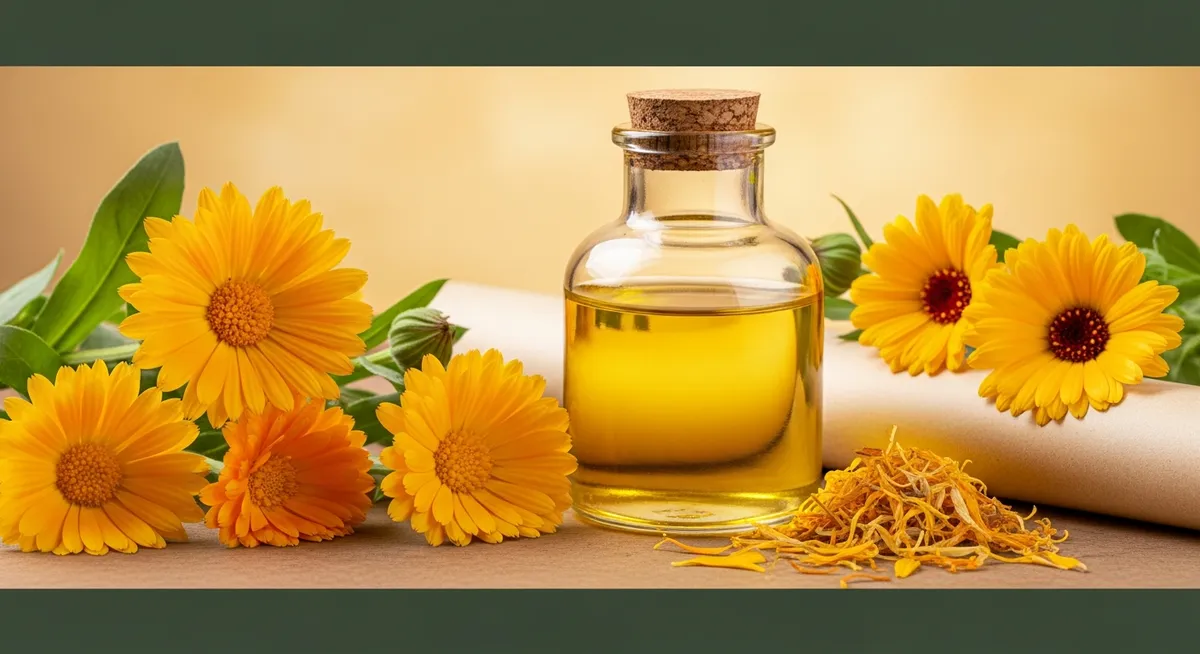
Calendula Oil vs Arnica: Different Jobs, Different Rules
Calendula oil and arnica are not rivals for one job, and for a bruise, a sprain or a sore muscle we would not point you to our calendula oil. We make calendula oil and nothing else; arnica is a different plant with a different traditional use and a stricter set of warnings. The useful question is which problem you actually have, and the answer sorts into three cases below.

Calendula Oil
Our own small-batch calendula oil, in sizes from 0.5 oz to bulk.
From $13.99
Shop Calendula Oil →Start with the problem, not the plant
A bruise, sprain or sore muscle
This is the territory traditionally assigned to arnica, not calendula. The EU herbal committee's arnica monograph lists a traditional indication for "the relief of bruises, sprains and localised muscular pain," based exclusively on long-standing use (EMA/HMPC, 2014). Its calendula monograph covers minor skin inflammation such as sunburn and minor wounds, not bruises (EMA/HMPC, 2018). A PubMed search we ran on 14 October 2026 for randomized trials of calendula with bruise or sprain terms returned two hits, both wound-healing trials where ecchymosis was merely one line on a scoring scale. So for bruising, calendula has a tradition that does not point there and no trial that does.
That does not mean arnica has a strong record either, and it is worth seeing the evidence before choosing it:
- A rater-blinded trial of laser-induced bruises found 20% arnica ointment improved bruising more than white petrolatum (P=0.003), though not more than 5% vitamin K cream (Leu et al., Br J Dermatol, 2010).
- A double-blind study of 19 patients after pulsed-dye laser found no significant difference between arnica gel and vehicle (Alonso et al., Dermatol Surg, 2002).
- An American Academy of Ophthalmology review of 11 studies on homeopathic agents and vitamins after oculofacial surgery reported that in 7 controlled studies perioperative arnica gave no or negligible benefit versus placebo (Tao et al., Ophthalmology, 2022).
- In a placebo-controlled trial of 53 people doing calf raises, pain at 24 hours was higher on the arnica-treated leg (3.04 vs 2.36 on a scale), with no difference at later times (Adkison et al., Ann Pharmacother, 2010).
- For hand osteoarthritis, a Cochrane review found moderate evidence from a single trial of 174 people that arnica gel gave similar benefit to ibuprofen gel (Cameron and Chrubasik, Cochrane, 2013). Joint pain is a job for a physician or rheumatologist first.
The honest summary: mixed, with the best signals on a 20% ointment (laser bruising) and a tincture gel (hand osteoarthritis), and several null trials. EMA's own summary says firm conclusions on effectiveness could not be drawn (EMA, Arnicae flos summary). A bruise that is large, very painful, appears without a cause or keeps growing needs a clinician, not a topical.
Dry, rough or irritated skin
Here the plant that fits is not arnica. Arnica's monograph says the preparation should not be used on broken skin, and the committee limits use to adults and adolescents from 12 (EMA/HMPC, 2014). A calendula oil on dry skin is a cosmetic emollient job, and the oil is made for it. We do not claim it changes any skin condition, and for eczema, a rash that persists or a wound, the person to see is a dermatologist or physician. See our dry skin page.
You want to massage something
Both are sold as oils for massage. The comparison matters less than what you use them for. The claim "arnica oil for sore muscles" rests on the trials above, most of which tested gels, creams and ointments, not oils.
An arnica "oil" is not what the trials tested
This is the point most "versus" pages skip. The arnica preparations in the EU monograph are tinctures (20-25%), a liquid for dressings, and a 50% liquid extract in a base, applied as semi-solids. The trials above used a 20% ointment, a gel with a 1:20 tincture (Widrig et al., Rheumatol Int, 2007), and a cream. An arnica flower infused in a carrier oil is a different preparation with no strength standard we could find. Calendula has the opposite arrangement on paper: the calendula monograph does list an oil extract at 1:10 in a fatty vegetable oil such as olive oil, as a traditional preparation, which is the nearest regulatory match to an infused oil like ours.
Reasoning from that, the practical consequence is that a bottle of "arnica oil" cannot borrow the trial results of an arnica gel, and our calendula oil cannot borrow results from calendula ointments either. Most calendula trials used extracts, ointments or creams, often combination products, and applying them to an infused oil is an inference, not a finding. The EU committee judged most calendula skin studies small and methodologically weak (EMA/HMPC, 2018).
What they share: both are daisy-family plants
Arnica and calendula both belong to the Asteraceae family. Both EU monographs list hypersensitivity to Asteraceae plants as a contraindication. In a clinic study of 443 patients patch-tested for contact allergy, 5 (about 1.13%) reacted to arnica and 9 (about 2.03%) to marigold, and the Compositae mix was positive in 18 (Reider et al., Contact Dermatitis, 2001). Those are dermatology-clinic patients, not the general public, so the percentages do not give an everyday risk. The practical rule is simple: if you have reacted to chamomile, ragweed, chrysanthemums or daisies, ask an allergist or dermatologist before either. Our ragweed article covers the cross-reactivity question, and the patch test page shows how to test a small area first. Our own stated limit is that if you react, you stop.
Neither plant is established for pregnancy or lactation: both monographs say safety has not been established and recommend against use without sufficient data, and both are not recommended for young children (calendula skin use under 6, arnica under 12). An OB/GYN, midwife or pediatrician is the right person to ask. Do not use either on pets without a veterinarian.
Where our oil fits
If after reading this you want calendula oil for dry skin or as a base to blend, our oil is an infusion of calendula alone brought into a carrier oil, with no preservatives, tocopherol or stabilizers added. Batches are third-party tested, and the paperwork, which names the carrier, comes by emailing the lot number to [email protected]. It is not a bruise product, a sports product or a replacement for arnica, and we would rather you not buy it for those reasons.
Calendula Oil
Nature's Golden Botanical, bottled: small-batch calendula oil in sizes from 0.5 oz to bulk.
From $13.99
Shop Calendula Oil →Sources & Further Reading
- EMA/HMPC, 2014. Community herbal monograph on Arnica montana L., flos. ema.europa.eu/arnica-monograph
- EMA, 2016. Arnicae flos: summary for the public. ema.europa.eu/herbal/arnicae-flos
- EMA/HMPC, 2018. EU herbal monograph on Calendula officinalis L., flos. ema.europa.eu/calendula-monograph
- EMA/HMPC, 2018. Assessment report on Calendula officinalis L., flos. ema.europa.eu/herbal-report
- Leu et al., 2010. Accelerated resolution of laser-induced bruising with topical 20% arnica. Br J Dermatol. pubmed/20412090
- Alonso et al., 2002. Effects of topical arnica gel on post-laser treatment bruises. Dermatol Surg. pubmed/12174058
- Tao et al., 2022. Homeopathic agents or vitamins in reducing ecchymosis after oculofacial surgery. Ophthalmology. pubmed/34176651
- Adkison et al., 2010. The effect of topical arnica on muscle pain. Ann Pharmacother. pubmed/20807867
- Cameron and Chrubasik, 2013. Topical herbal therapies for treating osteoarthritis. Cochrane. pubmed/23728701
- Widrig et al., 2007. Choosing between NSAID and arnica for topical treatment of hand osteoarthritis. Rheumatol Int. pubmed/17318618
- Reider et al., 2001. The seamy side of natural medicines: contact sensitization to arnica and marigold. Contact Dermatitis. pubmed/11722485