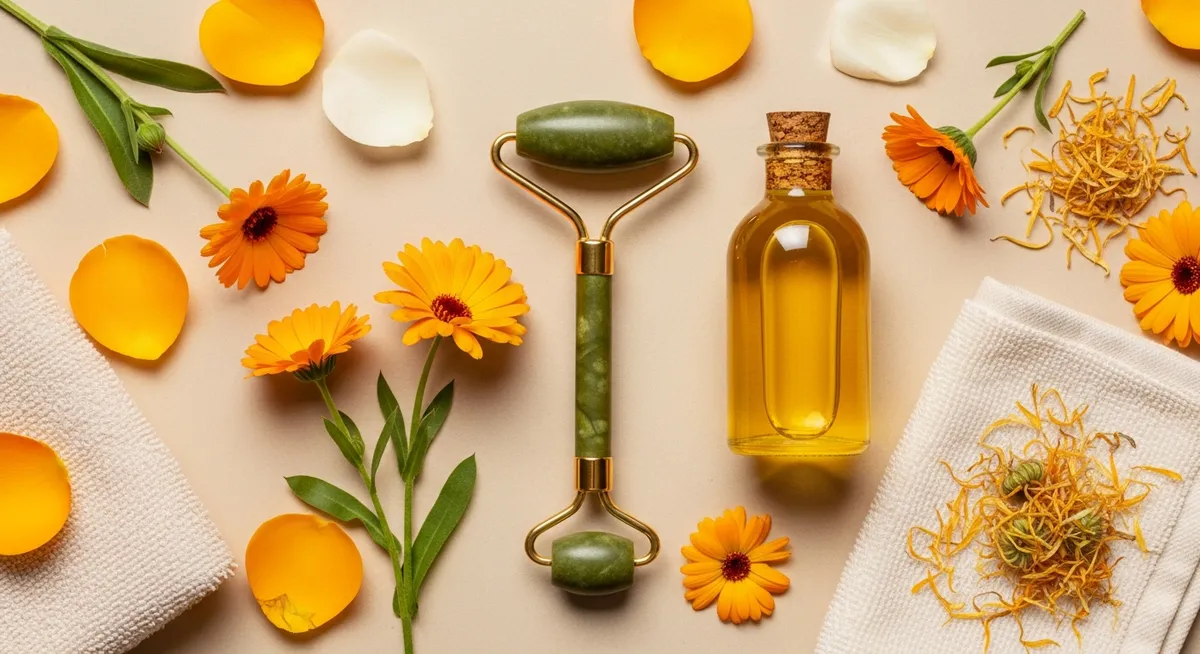
Calendula Oil vs Rosehip Oil: What Each One Actually Is
Calendula oil and rosehip oil are not rivals, because they are different kinds of product that happen to share a shelf. Rosehip oil is a seed oil: pressed from the seeds of the rose fruit. Calendula oil, the kind we make, is an infused oil: calendula flower extract brought into a carrier oil. So the useful question is not which is better for a face, but what each bottle actually contains and which of those properties you want.

Calendula Oil
Our own small-batch calendula oil, in sizes from 0.5 oz to bulk.
From $13.99
Shop Calendula Oil →What is in each bottle, in plain terms
| Question | Rosehip seed oil | Our calendula oil |
|---|---|---|
| What it is | Oil from the seeds of the rose fruit | Whole-flower calendula infusion: extract made from calendula only, then brought into a carrier oil |
| What sets its fatty acids | The seed itself | Mostly the carrier (the carrier is listed on the batch paperwork) |
| What else is in the bottle | Depends on the brand | Nothing added: no preservatives, tocopherol or stabilizers |
| Where the orange colour comes from | Not applicable | Flower pigments, mainly carotenoids |
The carotenoid point is documented: in a four-variety study, orange calendula varieties held several times more carotenoids per gram of fresh flower than yellow ones (276 versus 48 mg/100 g), and the pigment mix differed by variety (Pintea et al., Acta Biologica Szegediensis, 2003). We make no composition claim for our own oil here; the batch paperwork is where numbers live.
The part of rosehip oil people skip: it varies, and it spoils faster
Rosehip oil is rich in polyunsaturated fatty acids, about 75% PUFA in one analyzed sample. Seven commercial rosehip oils in a 2025 study split into two groups: five dominated by linoleic acid (45-51%) and two dominated by alpha-linolenic acid (47-49%). The authors proposed routine screening because of oxidation and counterfeiting concerns (Nikolova et al., Molecules, 2025). In plain words, two bottles labeled rosehip oil can be quite different oils.
The more polyunsaturated an oil is, the faster it oxidizes. A 2025 review gives relative oxidation rates for pure C18 fatty acids of 1 for stearic, 10 for oleic, 100 for linoleic and 150 for linolenic acid, and names light, heat, oxygen and trace metals as the drivers (Gharby et al., Food Chemistry X, 2025). That table is for pure acids at 100 C, so read it as direction, not as months on a shelf. The direction matches a 2026 accelerated test of four oils, where rosehip had the shortest oxidation induction time, behind sunflower, olive and jojoba (Fagoaga et al., Antioxidants, 2026). Reasoning from those two, the practical consequence is that a rosehip bottle deserves a small size, a dark cool spot, a tight cap and attention to smell. A cold-pressed oil review makes the same storage point: dark glass, cool, away from heat, airtight (Dash et al., Frontiers in Nutrition, 2026).
Our oil is not exempt from oxidation either, and we add no antioxidant to it. We do not publish a shelf-life figure in articles. The bottle is dated and lot-numbered in glass, and our storage article covers handling.
Claims we could not source
The popular rosehip pitch includes vitamin C. None of the studies we reviewed measured vitamin C in a rosehip seed oil, so we are not repeating a number or an effect. If a label makes that claim, ask the seller for the assay and the method. On the calendula side we cannot source the common "gentle champion" framing either. What exists is thinner than the marketing: the EU herbal committee accepts calendula flower preparations only as traditional-use products for minor skin inflammation and minor wounds, and judged most of the clinical studies small and methodologically weak (EMA/HMPC, 2018). Most of those trials also used extracts, ointments or creams, not infused oils, so applying them to our oil is an inference.
Comedogenic ratings are the other claim to handle carefully. Reviews label oils comedogenic or not (Abdalla et al., ACS Omega, 2024), but a 2006 human study found that finished products using ingredients rated comedogenic in animals are not necessarily comedogenic (Draelos and DiNardo, 2006). Neither oil can be declared safe or unsafe for breakouts from a rating. Our comedogenicity article shows the full chain of evidence.
Where the two actually meet
Rosehip can be a carrier for calendula rather than a competitor. In a 2024 Chilean agronomy thesis (not peer reviewed), dried petals macerated for 30 days in the dark took up the most carotenoid in rosehip oil (0.061 mg/g) and avocado oil (0.057 mg/g) among the four oils tested (Molina Garcia, Universidad de Concepcion, 2024). That is a single small study, and it measured pigment uptake, not anything about skin. We do not make a rosehip-based oil and have not compared one with ours.
Who should pick which, and who should skip both
One more practical point before the list: because both bottles are oils, neither one replaces a sunscreen, a cleanser or a medical product. The AAD recommends broad-spectrum, water-resistant sunscreen of SPF 30 or higher (AAD, sunscreen recommendations), and no oil here is a stand-in for that.
- You want a polyunsaturated seed oil and will finish it fast: rosehip is a reasonable choice, in a small bottle. We are not the right shop for it.
- You want the flower in an oil: that is the job of an infused calendula oil. Ask any supplier about carrier, plant part, additives and batch testing, as we explain in our oil choice FAQ.
- You react to chamomile, ragweed or daisies: calendula is in the Asteraceae family, and the EU monograph lists hypersensitivity to that family as a contraindication. A patch test first (how we would do it), and an allergist or dermatologist if you have a history.
- You want to use both: introduce them a week or so apart. This is our reasoning, not a published protocol: if skin reacts, you will know which one did it.
- You have acne, rosacea or eczema: neither oil is a decision to make alone; see a dermatologist.
If you decide the flower is what you are after, our calendula oil comes with batch documentation on request. If a seed oil is what you need, rosehip is a fair pick and you can make that call without us.
Calendula Oil
Nature's Golden Botanical, bottled: small-batch calendula oil in sizes from 0.5 oz to bulk.
From $13.99
Shop Calendula Oil →Sources & Further Reading
- American Academy of Dermatology. Sunscreen recommendations. aad.org
- Pintea A, Bele C, Andrei S, Socaciu C, 2003. HPLC analysis of carotenoids in four varieties of Calendula officinalis L. flowers. Acta Biologica Szegediensis 47(1-4):37-40. abs.bibl.u-szeged.hu
- Nikolova K et al., 2025. Characterization of Bulgarian Rosehip Oil by GC-MS, UV-VIS, Colorimetry, FTIR and Fluorescence. Molecules 30(19):3964. PMC12525901
- Gharby S et al., 2025. Vegetable oil oxidation: mechanisms, impacts on quality, and approaches to enhance shelf life. Food Chemistry X 28:102541. PMC12146556
- Fagoaga C et al., 2026. Oxidative Stability and Kinetics of Oxidation of Rosehip, Sunflower, Olive and Jojoba Oils. Antioxidants 15(5):646. doi:10.3390/antiox15050646
- Dash B et al., 2026. Cold pressed oils: a systematic review. Frontiers in Nutrition 13:1747029. PMC13371722
- EMA/HMPC, 2018. European Union herbal monograph on Calendula officinalis L., flos (Revision 1), EMA/HMPC/437450/2017. ema.europa.eu
- Abdalla S, Aroua MK, Gew LT, 2024. A Comprehensive Review of Plant-Based Cosmetic Oils. ACS Omega 9:44019-44032. PMC11541506
- Draelos ZD, DiNardo JC, 2006. A re-evaluation of the comedogenicity concept. J Am Acad Dermatol 54(3):507-512. PMID 16488305
- Molina Garcia FJ, 2024. Extraccion de carotenoides y polifenoles totales de petalos de Calendula officinalis L. mediante oleo maceracion. Universidad de Concepcion (thesis). repositorio.udec.cl