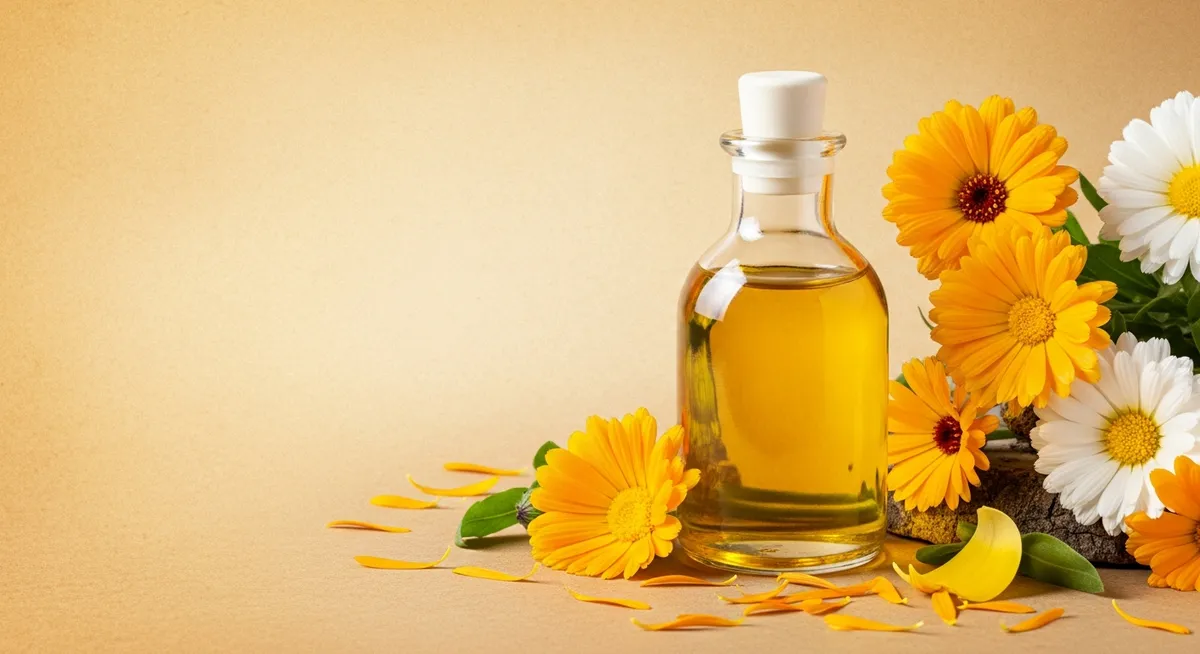
Is Calendula Essential Oil the Same as Calendula Infused Oil? Separating Fact from Fiction
No. Calendula infused oil, the orange oil we make, and calendula essential oil, a distilled aromatic, are different materials made by different processes, and they are not interchangeable on skin. If a label or a seller blurs the two, the practical risk is that you apply something far more concentrated than you intended, or pay for something that is not what the name suggests. Here is how to tell which one is in your hand.

Calendula Oil
Our own small-batch calendula oil, in sizes from 0.5 oz to bulk.
From $13.99
Shop Calendula Oil →Check 1: how was it made?
An infused oil is plant material soaked in a fixed carrier oil. An essential oil is a steam- or water-distilled product; solvent extracts (concretes, absolutes) and CO2 extracts are separate categories again. The aromatherapy author Robert Tisserand puts it bluntly: "CO2 extracts are neither essential oils nor absolutes," and concretes and absolutes always carry traces of the solvent, usually 1-5 ppm (Tisserand, blog post on absolutes, concretes and CO2 extracts).
What we make is the first kind. We buy dried flowers, infuse petals separated by hand from whole-dried flower heads, extract calendula alone first, and bring that extract into a carrier oil. Nothing is distilled. Which carrier it is can be found on the batch paperwork (email the lot number to [email protected]). That is why we describe it as an infused oil and not as an "essential oil of calendula."
Check 2: what does the colour and the smell say?
A lab study that compared three ways of getting scented extracts from calendula flowers found that hydrodistillation gave an oil without pigments, while solvent extraction and enfleurage gave oils containing pigments (Salome-Abarca et al., Botanical Sciences, 2015). A four-variety HPLC study attributes the yellow-to-orange colour of the flowers mostly to carotenoids (Pintea et al., Acta Biologica Szegediensis, 2003). In practical terms, reasoning from that study, a distilled calendula essential oil should not be the deep orange of an infused oil. If a "calendula essential oil" is bright orange, it is either not distilled or has been coloured or blended with something. Conversely, if an infused oil smells like a perfume, ask what was added to it.
Check 3: how much material is behind the bottle?
Calendula gives very little distilled oil. The EU assessment report puts the volatile oil at 0.2-0.3% of the herb, mostly sesquiterpenes such as alpha-cadinol (EMA assessment report, 2008, superseded). The 2015 lab study measured 0.9 g per 100 g of dry flowers by hydrodistillation, higher than EMA's figure; the sources disagree and we give both, and the gap is likely down to genotype and method. Either way it is a small yield. The same study got 6.7 g from solvent extraction and 7.1 g from enfleurage per 100 g, but those are concretes or absolutes, not steam-distilled essential oil. We found no supplier specification for a steam-distilled calendula essential oil, so we cannot tell you what a genuine commercial one looks like. Reasoning from the low yield, you should be sceptical of a bottle of "calendula essential oil" priced like a bulk carrier oil. For comparison, a commercial calendula macerate's data sheet describes sunflower oil as its carrier, calendula flower extract and 0.2% tocopherol (Golgemma/Biolandes FB026, 2025): almost all of that bottle is the carrier.
Check 4: the label name
An infused oil often appears on an ingredient list as the carrier oil plus "Calendula Officinalis Flower Extract," while "Calendula Officinalis Flower Oil" is also a listed INCI name, described as "the oil derived from the flowers of the Calendula" (CosIng record via CosIng Checker, a third-party mirror). The record itself notes that an INCI name does not establish composition, concentration or equivalence. So the name does not settle it. The carrier named on the label, the colour, and the maker's description of the process do.
Why it matters for skin: dilution
This is the practical stake. Essential oils are used at low percentages: the Tisserand Institute lists about 0.2-1% for sensitive or impaired skin, 0.5-1.2% for facial products and 1-3% for body oils (Tisserand Institute, Dilution for essential oils). Those ranges are for essential oils, not for calendula infused oil, which is used as an oil. The Institute also says allergic reactions are the most common reaction to essential oils and that risk rises with dilution. If your bottle is a concentrated essential oil and you treat it like an infused oil, you are applying it undiluted. Pet Poison Helpline's veterinary toxicologist advises that concentrated essential oils should never be applied directly to cats, and that oils can be swallowed during grooming (Pet Poison Helpline, Essential oils and cats); that page does not discuss calendula-infused oil, and for any pet question your veterinarian is the one to ask.
The reverse problem is smaller but real. A reader who reads a study on "calendula essential oil" and assumes it applies to an infused oil is extrapolating across two materials. For example, laboratory studies report in vitro sun protection values for distilled calendula essential oil, about 8.36 for the oil and 14.84 for a cream containing it (Lohani et al., J Cosmet Dermatol, 2019; Mishra et al., J Young Pharm, 2012). Those are spectrophotometer estimates on a distilled oil, not human tests and not infused oil; nothing there supports relying on any calendula product for sun protection. We make no such claim; see our SPF page.
A quick comparison
| Product | Made by | Typical sign on the label | How it is used |
|---|---|---|---|
| Infused oil (ours) | Plant material extracted into a fixed carrier oil | A carrier oil named, calendula as extract or infusion | As an oil, on its own or in balms and blends |
| Essential oil | Steam or water distillation | "Essential oil," Latin name, small volume bottle | Diluted, in the ranges above |
| CO2 extract | Supercritical CO2 as solvent | "CO2 extract," often a stated carotenoid or marker specification | As a formulation ingredient |
| Concrete or absolute | Solvent extraction, usually hexane | "Concrete" or "absolute" | As a fragrance ingredient |
The "made by" column follows the category definitions in the Tisserand post and the methods compared in the 2015 lab study; the label and use columns are our own summary, not a standard.
Who this is not for, and where to go next
If you want a fragrance or aromatherapy material, our oil is the wrong product. It is a plain infused oil, and we do not pretend otherwise. If you are allergic to daisy-family plants, skip either form: the EU herbal monograph lists Asteraceae hypersensitivity as a contraindication (EMA/HMPC, 2018), and our patch test page explains how to test. For the finer points of the different products, see the sibling comparison, the volatile compounds page and our extraction methods page.
The short version for buying: look for a named carrier, a described process, a lot number and a colour that fits an infusion, and treat anything labelled essential oil as a concentrate that needs dilution.
Calendula Oil
Nature's Golden Botanical, bottled: small-batch calendula oil in sizes from 0.5 oz to bulk.
From $13.99
Shop Calendula Oil →Sources & Further Reading
- Tisserand R. Absolutes, concretes and CO2 extracts (blog post). roberttisserand.com
- Salome-Abarca LF et al., 2015. Chemical composition of scented extracts obtained from Calendula officinalis by three extraction methods. Botanical Sciences. scielo.org.mx
- EMA/HMPC, 2008. Assessment report on Calendula officinalis L., flos (superseded). ema.europa.eu
- Golgemma/Biolandes, 2025. Technical data sheet FB026, Calendula Org Macerate/Oil. biolandes.com
- CosIng record 74930, Calendula Officinalis Flower Oil (via CosIng Checker). cosingchecker.com
- Pintea A et al., 2003. HPLC analysis of carotenoids in four varieties of Calendula officinalis flowers. Acta Biologica Szegediensis. abs.bibl.u-szeged.hu
- Tisserand Institute. Dilution for essential oils. tisserandinstitute.org
- Pet Poison Helpline. Essential oils and cats. petpoisonhelpline.com
- Lohani A et al., 2019. Cosmeceutical potential of geranium and calendula essential oil. J Cosmet Dermatol. pubmed.ncbi.nlm.nih.gov/30251317
- Mishra A et al., 2012. In vitro sun protection factor of Calendula officinalis essential oil formulation. J Young Pharm. pubmed.ncbi.nlm.nih.gov/22523455
- EMA/HMPC, 2018. European Union herbal monograph on Calendula officinalis L., flos. ema.europa.eu