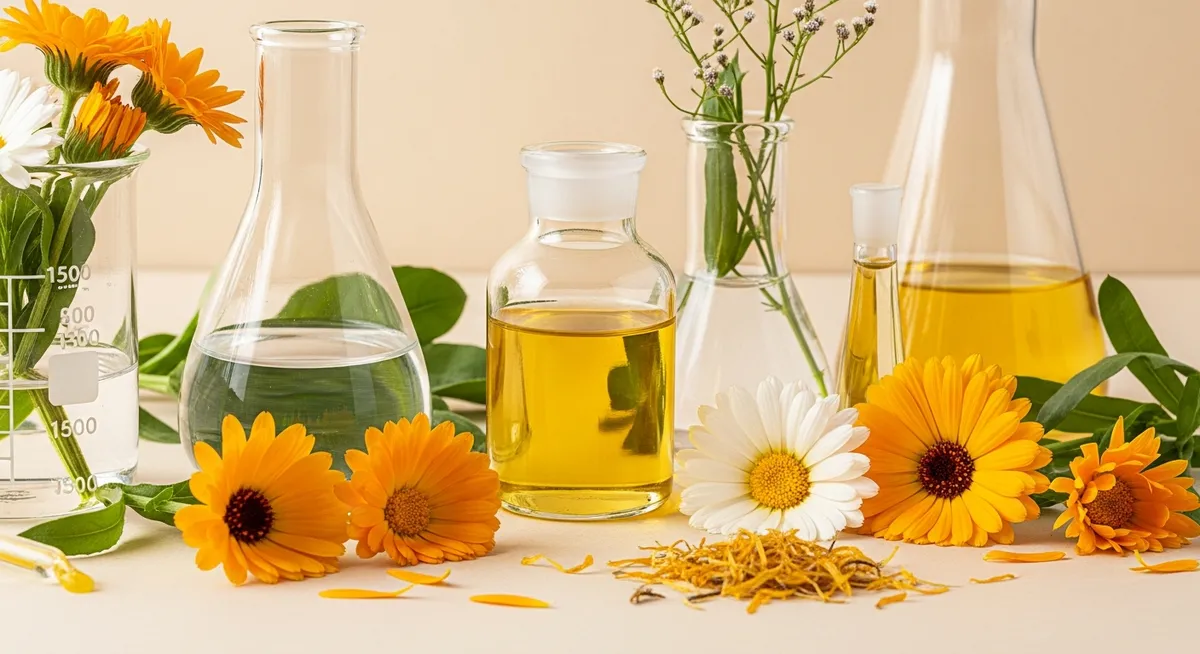
Calendula Volatile Compounds: Aroma Chemistry, Honestly
Calendula flowers hold a small volatile fraction, 0.2 to 0.3 percent of the dried herb in the EU assessment report, mostly sesquiterpenes. That is not what gives the orange infused oil its colour, and it is not what most buyers are getting when they buy "calendula oil." Our product is an infused oil, made by bringing a calendula extract into a carrier oil. It is not an essential oil, we have no data on its volatile content, and we do not claim aromatic effects for it.

Calendula Oil
Our own small-batch calendula oil, in sizes from 0.5 oz to bulk.
From $13.99
Shop Calendula Oil →First, which product do you mean?
Three very different products get called "calendula oil" or "calendula essential oil." The yields, taken from one laboratory comparison of extraction methods on calendula flowers, show how different they are (Salome-Abarca et al., Botanical Sciences, 2015).
| Product | How it is made | Yield per 100 g dry flowers (one lab study) | Colour |
|---|---|---|---|
| Essential oil | Hydrodistillation | 0.9 g | No pigments |
| Solvent extract (concrete or absolute type) | Organic solvent | 6.7 g | Contains pigments |
| Enfleurage extract | Enfleurage (a fat-based method) | 7.1 g | Contains pigments |
| Infused oil (ours) | Flower extract brought into a carrier oil | Not applicable: a recipe, not a yield | Orange, from carotenoid pigments in the flower |
The aromatherapy author Robert Tisserand makes the same distinction: concretes and absolutes are solvent extracts that always contain traces of solvent, in the 1 to 5 ppm range, and CO2 extracts are "neither essential oils nor absolutes" (Tisserand, blog post on absolutes, concretes and CO2 extracts). An infused oil is a fourth thing: plant material in a fixed carrier. Our infused versus essential oil explainer covers the shopping side of this.
What the volatile fraction contains
The EU assessment report gives the volatile oil as 0.2 to 0.3 percent of the herb, mostly sesquiterpenes such as alpha-cadinol (EMA/HMPC assessment report, 2008). In the Mexican laboratory study the main compounds were alpha-cadinene and delta-cadinene. A 2022 review adds that typical volatiles identified by GC-MS include linalool, limonene, beta-myrcene, pinenes, sabinene, gamma-terpinene, terpinen-4-ol and terpinolene (Olennikov and Kashchenko, Molecules, 2022). The yield and the mix vary with the plant, the extraction and the lab. EMA's 0.2 to 0.3 percent and the 0.9 percent measured in the research study do not agree, and neither source explains why. Our guess would be variety and method, but that is only a guess.
What reaches an infused oil: arithmetic, not measurement
No source we found measured volatile compounds in a calendula infused oil. We can still bound the question. The EU monograph describes the oil preparation as 1:10 in a fatty vegetable oil (EMA/HMPC, 2018), which means 10 g of dry flowers per 100 g of oil. Take the two volatile-oil figures above and assume, generously, that every bit of it transferred. Then 10 g of flowers would carry 0.02 to 0.03 g of volatile oil at EMA's figure, or 0.09 g at the laboratory yield, into about 100 g of oil: at most roughly 0.02 to 0.09 percent of the bottle. Actual transfer cannot exceed that bound, and no one appears to have measured where in the range it falls.
So the aroma of an infused oil is, in practice, a blend of the carrier's own smell and whatever of the flower survived. One supplier's data sheet for its organic macerate describes the odour as "floral, slightly bitter" (Golgemma/Biolandes, FB026, 2025), but that describes its own product, and we have not tested it. We have no sensory or GC data for ours to put beside it, and we do not publish a description we cannot back. If you need a defined aroma profile for a formulation, order our 4 oz or 8 oz size, smell it yourself, and ask us for the batch paperwork.
"Therapeutic effects" is where we stop
Volatile compounds like linalool and limonene are well known in other plants, but we found no human study of calendula's volatiles, inhaled or applied, in the sources we compiled, so we make no aromatic or therapeutic claim. The best-documented calendula research concerns the non-volatile side: triterpene esters, carotenoids, flavonoids. Even that is mostly laboratory work, and the EU herbal committee's public summary says clinical studies "did not support firm conclusions because of design problems" (EMA, Calendulae flos summary, 2018). See our articles on composition and carotenoids for what is measured.
Checking a "calendula essential oil" listing
If you do see a product sold as calendula essential oil, this is the order we would check it in:
- The botanical name. It should say Calendula officinalis. "Marigold" is also the common name for Tagetes, a different genus that is the established commercial source of lutein (Kurniawan et al., Foods, 2026).
- The method. Hydrodistilled oil, solvent extract and CO2 extract are different materials, and the colour of the liquid is a clue: in the lab comparison above, only the hydrodistilled oil came out without pigments.
- The quantity of plant behind it. The lab yield was 0.9 g of oil per 100 g of flowers, so a distilled oil is a concentrated, low-yield material, and the batch it came from should be traceable.
- A gas chromatography report for that batch. GC-MS is the method used to identify volatile oil components (as the 2022 review notes), so a seller who sells a volatile oil should be able to show a profile for the lot.
An infused oil is judged differently, by its carrier, its colour, its freshness and its batch documentation. That is the standard we hold ours to, and it is why our shop page links a Certificate of Analysis and why we ask for a lot number when you want the paperwork.
If you plan to scent the oil
Adding essential oils to an infused oil changes the safety picture, because essential oils are concentrated and allergic reactions are the most common problem with them. The Tisserand Institute lists dilution ranges of 1 to 3 percent for body oils and lotions and 0.2 to 1 percent for sensitive or impaired skin (Tisserand Institute, dilution guidance). Those ranges are for essential oils, not for our oil, and the same page notes dilution and risk are directly related. Expressed citrus rind oils can be phototoxic, while distilled citrus oils are not (Tisserand Institute, citrus oils), so check which kind you bought before using it on skin that will see sun. If you share your home with a cat, a veterinary toxicologist advises that concentrated essential oils should never be applied to cats and that oils can be swallowed during grooming (Pet Poison Helpline). That page is about essential oils and does not address calendula infused oil, so ask your veterinarian about anything you plan to put on a pet.
Calendula itself is in the Asteraceae family, and the EU monograph lists hypersensitivity to that family as a contraindication, with skin sensitization reported at unknown frequency. Patch test before use, and if you react, see a dermatologist or allergist. The monograph does not recommend use on skin under age 6, and says safety in pregnancy and breastfeeding has not been established, so ask a pediatrician or OB/GYN first.
In short, calendula's volatile oil is real but small, the infused oil is a different product, and the honest description of ours is the process on the where it comes from page and the paperwork on request.
Calendula Oil
Nature's Golden Botanical, bottled: small-batch calendula oil in sizes from 0.5 oz to bulk.
From $13.99
Shop Calendula Oil →Sources & Further Reading
- Salome-Abarca LF et al., 2015. Chemical composition of scented extracts obtained from Calendula officinalis by three extraction methods. Bot Sci 93:633-638. scielo.org.mx/v93n3a16
- Tisserand R. Absolutes, concretes and CO2 extracts (blog post). roberttisserand.com/?p=4514
- EMA/HMPC, 2008. Assessment report on Calendula officinalis L., flos (EMEA/HMPC/179282/2007, superseded). ema.europa.eu/herbal-report
- Olennikov DN, Kashchenko NI, 2022. Marigold metabolites: diversity and separation methods of Calendula genus phytochemicals from 1891 to 2022. Molecules 27:8626. PMC9736270
- EMA/HMPC, 2018. European Union herbal monograph on Calendula officinalis L., flos (EMA/HMPC/437450/2017). ema.europa.eu/herbal-monograph
- EMA, 2018. Calendulae flos (calendula flower), herbal medicinal product: summary for the public. ema.europa.eu/calendulae-flos
- Golgemma/Biolandes, 2025. Technical data sheet FB026, Calendula Org Macerate/Oil. biolandes.com/FB026
- Tisserand Institute. Dilution for essential oils. tisserandinstitute.org/dilution-essential-oils
- Tisserand Institute. Citruses: a comparison of different oils. tisserandinstitute.org/citruses
- Benson K, Pet Poison Helpline. Essential oils and cats. petpoisonhelpline.com/essential-oils-cats
- Kurniawan SB et al., 2026. Advances in sustainable lutein production: sources, technologies, and functional applications. Foods 15:1717. PMC13206640