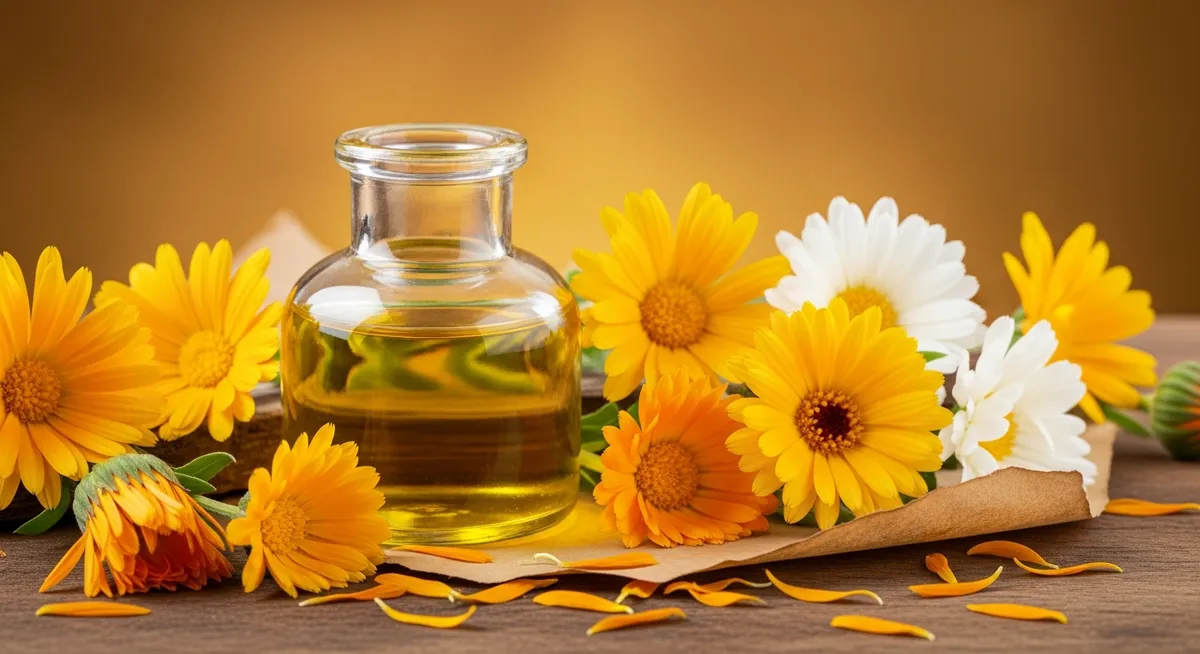
The Ultimate Guide to Calendula Oil Extraction Methods: Cold-Pressed vs Infused vs CO2
There is no such thing as pressing calendula petals into oil, so a bottle that says "cold-pressed calendula oil" needs a follow-up question: what exactly was pressed? Petals hold too little oil to press, and the orange oil sold for skin is made by soaking petals in a carrier oil. This page sorts out the four different things that get called "calendula oil," so you can read a label before you buy.

Calendula Oil
Our own small-batch calendula oil, in sizes from 0.5 oz to bulk.
From $13.99
Shop Calendula Oil →Start with the label word, not the method
"Cold-pressed" has a plain meaning: a 2026 review in Frontiers in Nutrition describes it as mechanical pressing that avoids added heat and solvents, applied to "seeds, kernels, fruits, and peels." Petals are not on that list, and none of the sources we read describes pressing calendula flowers. When "cold-pressed" turns up on a calendula oil, one of two things is usually being described.
The first is that the carrier was cold-pressed. One US herbal company's product page, for example, says its calendula flowers are "dried and then extracted into cold-pressed, Certified Organic Olive oil" (Herb Pharm product page, read 2026). The pressing happened to the olives, not the flowers. The second is that the product is calendula seed oil, which is pressed, and which is a different material (see below). Neither makes the petal extraction "cold-pressed."
The four products that share the name
1. Infused oil (maceration): what we make
Petals are soaked in a fatty oil and the colour and oil-soluble constituents move into it. The EU herbal monograph defines this as a "liquid extract (1:10), extraction solvent fatty vegetable oil e.g. olive oil" (EMA/HMPC, 2018). We make one product, and it is this kind. We buy dried flowers, separate the petals by hand from sound, whole-dried flower heads, extract calendula alone first, and then bring that extract into a carrier oil to make the finished oil. Which carrier is listed on the batch paperwork; email the lot number to [email protected] and ask.
The published numbers show that conditions matter and that nobody has settled a single best protocol. In a 2005 lab comparison, the highest carotene content (57.5 mg/kg, expressed as beta-carotene) came from a 72-hour room-temperature maceration in olive oil at 1:5 by weight (Novkovic et al., Hemijska industrija, 2005, abstract only). Only the abstract was available to us, so we cannot report how a 70 C maceration compared. A Chilean agronomy thesis found that 30-day dark maceration in rosehip and avocado oil took up more carotenoid than almond oil (Molina Garcia, Universidad de Concepcion, 2024; an unpublished student thesis, so indicative at best). The honest summary: carrier choice and conditions change what ends up in the bottle, and a shopper cannot see either from the front label.
2. CO2 extract
Supercritical CO2 is used as the solvent and the result is a concentrated extract, not an infused oil. In a 2023 laboratory study, a two-step supercritical process with an ethanol modifier recovered much more of the faradiol esters than solvent ultrasound did; the ultrasound runs recovered 10.4% to 23% of the supercritical yield depending on solvent (Atwi-Ghaddar et al., Molecules, 2023). One retail listing specifies a calendula CO2 extract at 0.7-1.4% carotenoids (Mireille Lab listing), a seller's own figure that we could not verify. The EU assessment report notes that CO2 extracts do not meet the criteria for traditional-use status (EMA assessment report, 2008), which is a regulatory category, not a quality ranking. CO2 extract is a raw material for formulators. It is not what you rub into skin straight from a bottle, and we do not make it.
3. Distilled essential oil
Steam or water distillation yields a small amount of volatile oil: 0.2-0.3% of the herb in the EU assessment report, and 0.9 g per 100 g dry flowers in one lab study, mostly sesquiterpenes (Salome-Abarca et al., Botanical Sciences, 2015). In that study the distilled oil came out without pigments, which is why it is not orange. Our sibling page on calendula essential oil versus infused oil goes further into this.
4. Calendula seed oil
Seeds do contain pressable oil: 13.6-21.7 g per 100 g seed across 11 genotypes, with calendic acid at 51.4-57.6% of the fatty acids (Dulf et al., Chemistry Central Journal, 2013). That is a legitimate cold-pressed oil, and it is a different ingredient from a petal infusion. We cover how it differs in the fatty acid profile page.
What the ingredient list can and cannot tell you
The INCI name does not carry the method. A commercial organic macerate data sheet lists its ingredients as sunflower seed oil, calendula flower extract and tocopherol, with the calendula under the "extract" name and the carrier listed separately (Golgemma/Biolandes data sheet FB026, 2025). The ingredient name "Calendula Officinalis Flower Oil" exists too, but the entry's own commentary notes that an INCI name does not establish composition, concentration or equivalence (CosIng record via CosIng Checker, a third-party mirror). So a label can tell you the carrier and whether additives are present. It cannot tell you the ratio of flower to oil, the temperature, or the time. Those come from the maker.
That is why we think the useful questions are these:
- Which carrier oil, and is it named on the paperwork?
- Is anything added (preservative, tocopherol, stabilizer)? Ours has nothing added; some data sheets list 0.2% tocopherol, which is a legitimate choice, just a different product.
- What did the lab test: physical and chemical assays and contaminant screening, or only a colour reading? A certificate of analysis lists only the tests that were run, and a UV-based total-carotenoid number cannot show which plant the colour came from (Gafner et al., J Nat Prod, 2023).
- Was the plant material dried flower? Dried material is what extension services call the safest basis for infused oils, because it lacks the moisture needed for bacterial growth (University of Maine Cooperative Extension, Bulletin 4385; written for food oils, so applying it to cosmetic oil is an extrapolation).
Which one to buy depends on the job
If you are a formulator who needs a concentrated, standardised extract at a tiny dose, CO2 extract is the legitimate route and an infused oil is the wrong tool. If you want an oil-phase ingredient for balms, serums or massage blends, an infused oil is the right category, and what separates one from another is the carrier, the batch documentation and the handling of the flowers. If you want a fragrance material, you want distilled oil, and calendula gives little of it. If a page promises a "pure cold-pressed calendula oil" from petals, ask what was pressed.
The one thing we would add: the published evidence for skin effects almost all comes from extracts, ointments and creams, often combination products, not from infused oils, so no extraction method on this list has been shown to give a better skin result than another. If you are buying for a skin condition, see a dermatologist rather than choosing by extraction method. Our cold-pressed versus infused buying page and the where it comes from page describe how we handle the flowers.
We do not know of a head-to-head study that settles warm versus room-temperature infusion for calendula, and we would rather say so than invent a rule. What we can document is our own process and the lot-level paperwork, which is available on request.
Calendula Oil
Nature's Golden Botanical, bottled: small-batch calendula oil in sizes from 0.5 oz to bulk.
From $13.99
Shop Calendula Oil →Sources & Further Reading
- Dash B et al., 2026. Cold pressed oils: a systematic review. Frontiers in Nutrition. pmc.ncbi.nlm.nih.gov/PMC13371722
- Herb Pharm. Calendula Oil External Use (product page). herb-pharm.com
- EMA/HMPC, 2018. European Union herbal monograph on Calendula officinalis L., flos. ema.europa.eu
- EMA/HMPC, 2008. Assessment report on Calendula officinalis L., flos (superseded). ema.europa.eu
- Novkovic et al., 2005. Determination of total lipids and characterization of marigold flower extracts. Hemijska industrija. doi.org/10.2298/HEMIND0510254N
- Molina Garcia FJ, 2024. Oleo-maceration of Calendula officinalis petals (thesis). repositorio.udec.cl
- Atwi-Ghaddar S et al., 2023. Sequential-selective supercritical fluid extraction of Calendula officinalis. Molecules. pmc.ncbi.nlm.nih.gov/PMC10609265
- Mireille Lab. Marigold flower CO2 extract listing. mireillelab.com
- Salome-Abarca LF et al., 2015. Scented extracts from Calendula officinalis by three extraction methods. Botanical Sciences. scielo.org.mx
- Dulf FV et al., 2013. Fatty acid composition of lipids in pot marigold seed genotypes. Chemistry Central Journal. pmc.ncbi.nlm.nih.gov/PMC3560196
- Golgemma/Biolandes, 2025. Technical data sheet FB026, Calendula Org Macerate/Oil. biolandes.com
- CosIng record 74930, Calendula Officinalis Flower Oil (via CosIng Checker). cosingchecker.com
- Gafner S et al., 2023. Botanical ingredient forensics. J Nat Prod. pmc.ncbi.nlm.nih.gov/PMC9972475
- University of Maine Cooperative Extension. Bulletin 4385, Safe Homemade Flavored and Infused Oils. extension.umaine.edu/4385e