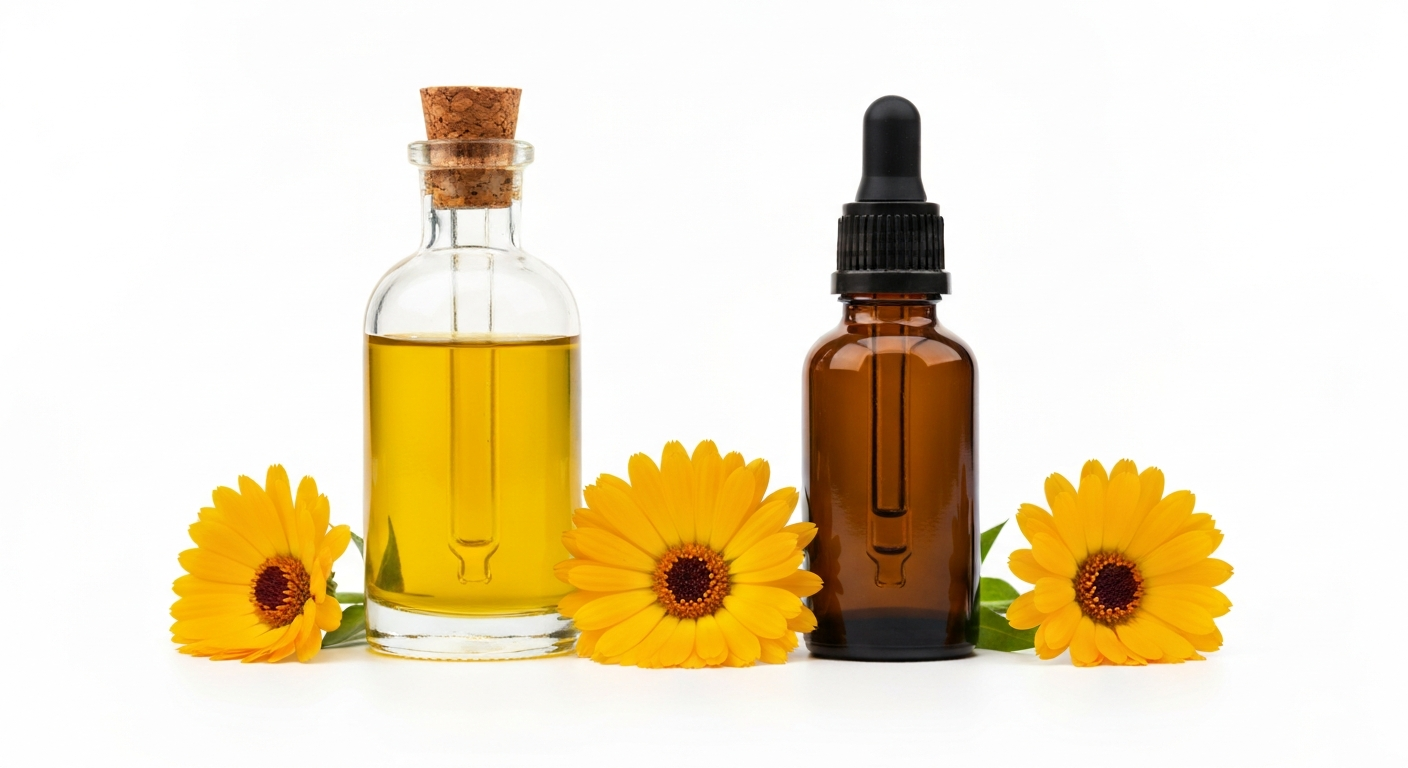
How to Choose Between Calendula Oil and Calendula Extract
The choice between calendula oil and calendula extract is mostly a choice of base, not of plant. "Extract" on a label can mean an oil infusion, an alcohol tincture, a water and glycol extract or a supercritical CO2 extract, and these dissolve different things from the same flower. We make one product, an infused calendula oil, so we are not neutral. Where your product is water-based and needs a water-soluble extract, our oil is not the answer, and this page says how to tell.

Calendula Oil
Our own small-batch calendula oil, in sizes from 0.5 oz to bulk.
From $13.99
Shop Calendula Oil →What "extract" can mean on a label
Start with the ingredient list. A commercial organic calendula macerate declares its ingredients as sunflower seed oil, "Calendula Officinalis Flower Extract" and tocopherol (Golgemma/Biolandes, FB026, 2025). In other words, an infused oil can appear under the word "extract," and the name alone does not say how much calendula is present. The other meanings are different products:
- Tincture. The EU herbal monograph lists a 1:5 tincture in 70-90% ethanol and 1:1 liquid extracts in 40-50% ethanol (EMA/HMPC, 2018).
- Oil extract. The same monograph lists a 1:10 liquid extract in a fatty vegetable oil, "e.g. olive oil." That is the traditional preparation closest to an infused oil.
- CO2 extract. Supercritical CO2 extracts non-polar compounds such as carotenoids and fatty acids, and in one laboratory study with an ethanol modifier it recovered far more faradiol esters than solvent ultrasound extraction (Atwi-Ghaddar et al., Molecules, 2023). One retailer sells a CO2 extract specified at 0.7-1.4% carotenoids (Mireille Lab listing). That is a concentrated extract, a different thing from a petal-infused oil.
- Hydroglycolic extract. The extract used in a Brazilian series of wound studies was a hydroglycolic spray (Buzzi et al., J Wound Care, 2016).
Our extraction methods article compares the methods, and our essential oil article covers the distilled product, which is different again.
What each base carries out of the flower
The EU assessment report lists triterpene saponins at 2-10% of the herb, and notes water-soluble polysaccharides at up to 15% (EMA/HMPC, 2008, superseded). The same report describes the saponins as oleanolic acid derivatives with a sugar (glucuronic acid) attached. Reasoning from that, sugar-bearing and water-soluble compounds are not expected in an oil infusion; we found no study measuring them in oil. What an oil does take up are fat-soluble pigments: in a 2005 lab comparison, the highest carotene content (57.5 mg/kg as beta-carotene) came from a 72-hour room-temperature maceration of flowers in olive oil at 1:5 by weight (Novkovic et al., Hemijska industrija, 2005). Faradiol esters, the triterpene esters found in the flower heads, are reported in plant tissue at about 12-13 mg per gram of dry ray petal each for the myristate and palmitate (Golubova et al., Nat Commun, 2025), but we found no measurement of how much of them ends up in an oil.
The practical consequence: if you want the water-soluble side of the flower, an oil is the wrong vehicle. If you want what an oil carries, a water extract is the wrong vehicle. The carrier also matters: in a 2024 Chilean thesis (not peer reviewed), carotenoid uptake from dried petals after 30 days differed by carrier oil (Molina Garcia, Universidad de Concepcion, 2024). When we make our oil we extract calendula alone first and then bring that extract into a carrier oil; the carrier is named on the batch paperwork.
Do not choose by the research, because the research is mostly on other preparations
This is the part we would most like you to take away. When a page says calendula is "studied," look at what was tested. The 2004 trial of 254 breast cancer patients that favoured calendula over trolamine used a Boiron ointment made from fresh aerial parts in petroleum jelly (Pommier et al., J Clin Oncol, 2004). The venous ulcer series used a hydroglycolic extract spray. A 2025 study in 20 healthy volunteers tested a cream with 1% supercritical CO2 extract (Crncevic et al., Acta Pharm, 2025). None of these was an infused oil, and the EU committee concluded that most calendula skin studies are small and methodologically weak and the evidence is not sufficient for "well-established use" (EMA/HMPC assessment report, 2018). Applying any of it to an oil is an inference, not a finding, and later radiation-skin trials did not reproduce the 2004 result (Sharp et al., Eur J Oncol Nurs, 2013).
A decision by what you are making
- Water-free product (balm, salve, lip balm, body oil, oil serum): use the oil. Its base matches yours. See how to add calendula oil to existing products for the mixing cautions.
- Water-based product (toner, gel, the water phase of a lotion): oil does not belong in the water phase, and a water-containing product needs a preservative; the 1995 preservation review says the cosmetics that most need preservatives are those containing water (Brannan, 1995). Source a water or glycol extract from a cosmetic-ingredient supplier. We do not make one.
- Emulsion (cream or lotion): the oil goes in the oil phase, and the whole formula needs a preservation system that someone has tested. If you are not a formulator, buy a finished product rather than build one.
- You want a concentrated, specified extract: a CO2 or other supplier extract, bought against a specification sheet. For the oil, request batch documentation instead. We do not publish composition numbers for ours.
For limits on use, the Cosmetic Ingredient Review's index lists calendula flower extract at up to 6% and calendula flower oil at up to 0.1% in cosmetics, per its 2010 assessment (CIR quick reference table, 2017). We could not verify how CIR defines "flower oil," so do not equate it with an infused oil, and treat it as a sign that the two names are not interchangeable in the safety record either.
What does not change with the base
The allergy question is the same for oil and extract, because it concerns the flower. The EU monograph contraindicates hypersensitivity to Asteraceae plants and does not recommend use in pregnancy and lactation or on skin under age 6 for lack of data. A 2001 Austrian patch-test series found 9 of 443 dermatitis patients (about 2%) reacting to a marigold preparation (Reider et al., Contact Dermatitis, 2001), a referred group and not a general rate. Patch test either way; our walkthrough explains how, and a dermatologist is the person to ask about a skin condition.
If your product is oil-based, our calendula oil comes with batch documentation on request; if it is water-based or you want a specified extract, look to an ingredient supplier and ask for the spec sheet before you pay for anything.
Calendula Oil
Nature's Golden Botanical, bottled: small-batch calendula oil in sizes from 0.5 oz to bulk.
From $13.99
Shop Calendula Oil →Sources & Further Reading
- Golgemma/Biolandes, 2025. Technical data sheet, Calendula Org Macerate/Oil, FB026. biolandes.com
- EMA/HMPC, 2018. European Union herbal monograph on Calendula officinalis L., flos (Revision 1). ema.europa.eu
- EMA/HMPC, 2018. Assessment report on Calendula officinalis L., flos (EMA/HMPC/603409/2017). ema.europa.eu
- EMA/HMPC, 2008. Assessment report on Calendula officinalis L., flos (superseded). ema.europa.eu
- Atwi-Ghaddar S et al., 2023. Sequential-selective supercritical fluid extraction of flavonoids and esterified triterpenoids from Calendula officinalis flowers. Molecules 28(20):7060. PMC10609265
- Mireille Lab. Marigold flower (0.7-1.4% carotenoids), CO2 extract of marigold flowers (retailer listing). mireillelab.com
- Buzzi M et al., 2016. Therapeutic effectiveness of a Calendula officinalis extract in venous leg ulcer healing. J Wound Care 25(12):732-739. PMID 27974009
- Novkovic et al., 2005. Determination of total lipids and characterization of marigold flower extracts. Hemijska industrija. doi:10.2298/HEMIND0510254N
- Golubova D et al., 2025. Biosynthesis and bioactivity of anti-inflammatory triterpenoids in Calendula officinalis. Nat Commun. PMC12304140
- Molina Garcia FJ, 2024. Extraccion de carotenoides y polifenoles totales de petalos de Calendula officinalis L. mediante oleo maceracion. Universidad de Concepcion (thesis). repositorio.udec.cl
- Pommier P et al., 2004. Phase III randomized trial of Calendula officinalis compared with trolamine for the prevention of acute dermatitis during irradiation for breast cancer. J Clin Oncol 22(8):1447-53. PMID 15084618
- Sharp L et al., 2013. No differences between Calendula cream and aqueous cream in the prevention of acute radiation skin reactions. Eur J Oncol Nurs 17(4):429-35. PMID 23245940
- Crncevic MS et al., 2025. Double-blind randomised controlled trial of an emollient cream with and without 1% supercritical CO2 extract of Calendula officinalis in contact dermatitis. Acta Pharm 75(4):699-708. PMID 41527980
- Brannan DK, 1995. Cosmetic preservation. J Soc Cosmet Chem 46:199-220. library.scconline.org
- Cosmetic Ingredient Review, 2017. Quick reference table: review conclusion. cir-safety.org
- Reider N et al., 2001. The seamy side of natural medicines: contact sensitization to arnica and marigold. Contact Dermatitis 45(5):269-72. PMID 11722485