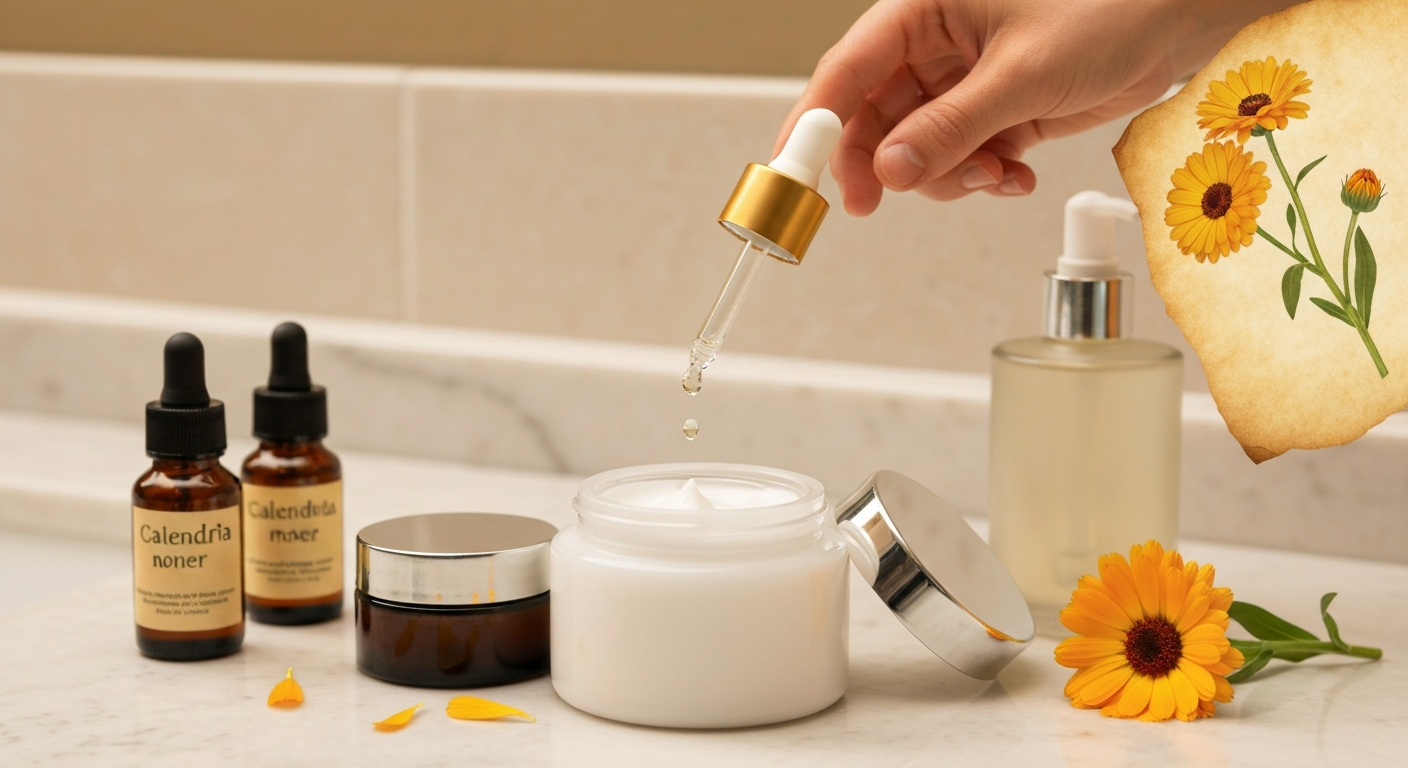
How to Add Calendula Oil to Your Existing Skincare Products
For most skincare you already own, the better move is to put calendula oil on top of the product, not into the jar. Mixing it in only makes sense for products that contain no water, and never for sunscreen or medicated products. This page sorts your products into those groups, gives a layering method you can follow today, and is straight about where the sources give an amount and where they do not.

Calendula Oil
Our own small-batch calendula oil, in sizes from 0.5 oz to bulk.
From $13.99
Shop Calendula Oil →Step 1: sort the product you want to add it to
| Product type | Our call | Why |
|---|---|---|
| Contains water: lotions, creams, gels, toners, most serums, cleansers | Layer on top. Do not mix into the jar. | The preservative system was built for that formula, and adding something changes it. |
| No water: balm, salve, lip balm, body oil, oil serum | Can blend, as a small test batch first. | Water is what supports microbial growth, and these products have none. |
| Sunscreen | Never add anything. | The SPF on the label belongs to the finished product as tested. |
| Prescription or medicated cream | Ask a pharmacist or dermatologist first. | Not our call, and not a cosmetic. |
The reasoning behind the first row is in the preservation literature. A 1995 review of cosmetic preservation states that the cosmetics which most need preservatives are those containing water, and that "the only limit to microbial life is the availability of liquid water" (Brannan, J Soc Cosmet Chem, 1995). A 2018 review says water-containing cosmetics require preservation, verified by methods such as challenge testing (Halla et al., Molecules, 2018). FDA lists an "ineffective preservation system" among the ways cosmetics become contaminated (FDA, microbiological safety). FDA's page names added water as the thing that dilutes preservatives. We found no study of adding oil to a preserved emulsion, so the following is reasoning: stirring an unknown amount of oil into a jar changes a formula that someone tested, and you become its formulator without the testing. That is a bigger step than most people mean when they say "add a few drops."
For sunscreen, FDA says SPF values come from a test that measures protection against sunburn on the finished product (FDA, sunscreen). Reasoning from that, a diluted jar no longer matches its label. A 2019 study of popular Pinterest recipes found 68% would give insufficient UV protection (Merten et al., Health Communication, 2019). Our SPF article covers why calendula oil is not a sunscreen.
Step 2: patch test before anything else
Calendula belongs to the Asteraceae (daisy, ragweed, chamomile) family. The EU herbal monograph lists hypersensitivity to Asteraceae as a contraindication and states that skin sensitization has been reported, frequency unknown (EMA/HMPC, 2018). The original repeated open application test applied a substance twice daily for 7 days to the inner forearm unless a reaction appeared sooner (Hannuksela and Salo, 1986); dermatologists who use it most often run one to two weeks, and no standard exists (Brown et al., Dermatitis, 2015). Do that on the calendula oil alone, then again with your product combination. A same-day dab proves little because allergic rashes tend to appear hours or days after contact (AAD). Our patch test walkthrough has the details. Skip all of this if you are allergic to daisy-family plants, are pregnant or breastfeeding (the EMA monograph does not recommend use for lack of safety data), or are buying for a child under 6 (use is not established); ask the relevant professional.
Step 3: layer, do not stir
- Apply your existing product exactly as you do now.
- Add the calendula oil afterwards, in the smallest amount you can spread thinly. No source gives a drop count for facial or body use, so we will not invent one: start with less than you think you need and change one thing at a time.
- Keep it to one new product at a time. If you change two things and your skin reacts, you cannot tell which did it.
- Watch for a reaction over the following days, not minutes. If you get a rash, redness or burning, stop and see a healthcare provider; FDA also asks users to report reactions to a cosmetic (FDA, using cosmetics safely).
Layering also keeps the oil out of your product's jar, so you are not introducing fingers or water into it. FDA's guidance tells users to wash their hands before dipping into containers.
If you do blend it into a product without water
For a balm, salve or body oil, a blend is reasonable. Here is what the sources give for amounts. European reference texts cited by the EMA describe calendula oil as flowers extracted in olive oil at about 1 part flower to 10 parts oil, and ointments traditionally containing 20-80% of that oil (EMA/HMPC assessment report, 2008, superseded). The 2018 monograph lists semi-solid products at the equivalent of 2-8% herbal substance for the oil extract. These are traditional-use medicinal preparations, not cosmetic recommendations, and we do not state a flower-to-oil ratio for our oil here, so you cannot map our bottle onto those percentages. The percentage you use is yours to decide by testing; the sources do not set one for a cosmetic blend.
The ingredient-list wording adds a wrinkle. A commercial calendula macerate declares itself as the carrier oil, "Calendula Officinalis Flower Extract" and tocopherol (Golgemma/Biolandes, FB026, 2025), and the INCI name alone does not say how much calendula is present. If you sell what you make, FDA does not require pre-approval but expects safety substantiation and correct labelling (FDA, homemade cosmetics fact sheet).
Practical checks for the test batch:
- Make a small batch first. Our bulk guide suggests a 4 oz or 8 oz bottle for formulation stability and compatibility testing before a larger run.
- Label it with the date and the oil's lot number, so you can request the batch documentation (email the lot number to [email protected]).
- Look for separation, texture change and smell. Rancidity shows up as a characteristic odour from aldehydes that form in later oxidation (Cawood Scientific, 2020).
- Store it closed, dark and cool; light, heat and oxygen all speed oxidation (Gharby et al., Food Chem X, 2025). Our oil has no added tocopherol or other stabilizer, and we have no published shelf-life test data for it, so do not assume the blend keeps longer than the shorter-lived part of it.
We also have no data on how calendula oil interacts with active ingredients such as acids or retinoids. The EMA monograph lists no interactions, but that is regulatory text for traditional medicines, not testing of cosmetic combinations. A pharmacist or dermatologist is the person to ask.
If your product has water in it, our advice is the plain one: keep your jar as the maker intended and add the oil as its own step. If you are building a water-free product of your own, our crafter's guide and shop page cover the sizes, and the daily-use side is in our routine article.
Calendula Oil
Nature's Golden Botanical, bottled: small-batch calendula oil in sizes from 0.5 oz to bulk.
From $13.99
Shop Calendula Oil →Sources & Further Reading
- Brannan DK, 1995. Cosmetic preservation. J Soc Cosmet Chem 46:199-220. library.scconline.org
- Halla N et al., 2018. Cosmetics preservation: a review on present strategies. Molecules 23(7):1571. PMID 29958439
- FDA. Microbiological safety and cosmetics. fda.gov
- FDA. Sunscreen: how to help protect your skin from the sun. fda.gov
- Merten JW et al., 2019. Homemade sunscreen on Pinterest (Health Communication); Nationwide Children's Hospital release. nationwidechildrens.org
- EMA/HMPC, 2018. European Union herbal monograph on Calendula officinalis L., flos (Revision 1). ema.europa.eu
- EMA/HMPC, 2008. Assessment report on Calendula officinalis L., flos (superseded). ema.europa.eu
- Hannuksela M, Salo H, 1986. The repeated open application test (ROAT). Contact Dermatitis 14(4):221-7. PMID 2941220
- Brown GE et al., 2015. Clinical utilization of repeated open application test among American Contact Dermatitis Society members. Dermatitis 26(5):224-9. PMID 26367205
- American Academy of Dermatology. Contact dermatitis. aad.org
- FDA. Using cosmetics safely. fda.gov
- FDA, 2025. Small businesses and homemade cosmetics: fact sheet. fda.gov
- Golgemma/Biolandes, 2025. Technical data sheet, Calendula Org Macerate/Oil, FB026. biolandes.com
- Cawood Scientific, 2020. Peroxide value, anisidine value and total oxidation value. cawood.co.uk
- Gharby S et al., 2025. Vegetable oil oxidation: mechanisms, impacts on quality, and approaches to enhance shelf life. Food Chem X 28:102541. PMC12146556