Calendula Oil and Psoriasis: What Research Exists
Psoriasis is a medical condition, and we make a cosmetic oil, so we start this article with a clear line: we do not offer calendula oil for psoriasis, and no human study would let us. What we can do is explain what psoriasis is, what is known about calendula and psoriasis, and the questions worth settling with a dermatologist if you are curious about an oil anyway.

Calendula Oil
Our own small-batch calendula oil, in sizes from 0.5 oz to bulk.
From $13.99
Shop Calendula Oil →Psoriasis care belongs with a dermatologist
The American Academy of Dermatology describes psoriasis as a condition in which the body makes new skin cells in days rather than weeks, so cells pile up as thick, scaly patches (Psoriasis: Overview). It says most people who get psoriasis have it for life, and that it can be linked with other conditions such as psoriatic arthritis. The joint AAD and National Psoriasis Foundation guideline on topical therapy calls it a chronic, inflammatory, multisystem disease (Joint AAD-NPF Guidelines of care for the management and treatment of psoriasis with topical therapy and alternative medicine modalities for psoriasis severity measures).
That is the reason we do not frame an oil as an answer. Psoriasis is far more than dry skin, and a plain oil sits on the surface. A board-certified dermatologist can confirm the diagnosis and build a plan, and the AAD notes that most people use medication applied to the skin, with stronger cases needing light therapy or medicine that works throughout the body.
Is there research on calendula and psoriasis?
For people, we found no study of calendula and psoriasis. The single item in the literature is a mouse study in which animals with psoriasis-like skin inflammation received water extracts of calendula leaves and of another plant, alone and combined (Phytochemical Screening and Metallic Ion Content and Its Impact on the Antipsoriasis Activity of Aqueous Leaf Extracts of Calendula officinalis and Phlebodium decumanum in an Animal Experiment Model). It is an interesting early result for researchers, and it tells us little about a person using a flower oil: the extracts came from leaves, not the flowers we use, they were water extracts rather than an oil infusion, and the animals were not people.
The European herbal medicines committee, looking at calendula more broadly, lists traditional use for minor skin inflammation and minor wounds, and psoriasis is not among them (European Union herbal monograph on Calendula officinalis L., flos).
Questions to settle before using calendula oil with psoriasis
People with psoriasis often have very dry skin too, and it is natural to wonder whether a gentle oil has a place. If you do, here is how we would approach it.
- Ask your dermatologist first. Check that an oil is fine alongside what you have been prescribed, and never reduce a prescribed treatment for an oil.
- Mention where the psoriasis is. The AAD advises telling your dermatologist if it appears on the genitals, scalp or nails. We would keep our oil off those areas unless your dermatologist agrees.
- Patch test on healthy skin. Calendula is a daisy-family (Asteraceae) plant, and the European monograph lists hypersensitivity to that family as a contraindication. A reaction on inflamed skin can be hard to tell from a flare, so try a small spot elsewhere first, using our patch test guide, and stop at any new redness, burning or itching.
- Pregnancy and young children. The monograph says safety in pregnancy and breastfeeding has not been established and does not recommend skin use under age 6, so check with your doctor first.
If a cosmetic ever causes a rash or burn, the FDA's advice is to stop using it and contact a healthcare provider (Using Cosmetics Safely).
Preparing for a psoriasis appointment about oils
If you are curious about an oil, a little preparation makes the visit more useful. We suggest writing down everything you currently put on your skin, prescription and otherwise, and bringing the bottles if you can. Photos of your skin on a good day and a bad day help your dermatologist see the pattern. And ask the question plainly: is there a plain oil you would be happy for me to use on the dry areas, and where should I keep it away from?

A dermatologist sees skin of all kinds every day, and a calm question about moisturizing is exactly the sort of thing they are glad to answer.
Calendula oil on ordinary dry skin elsewhere
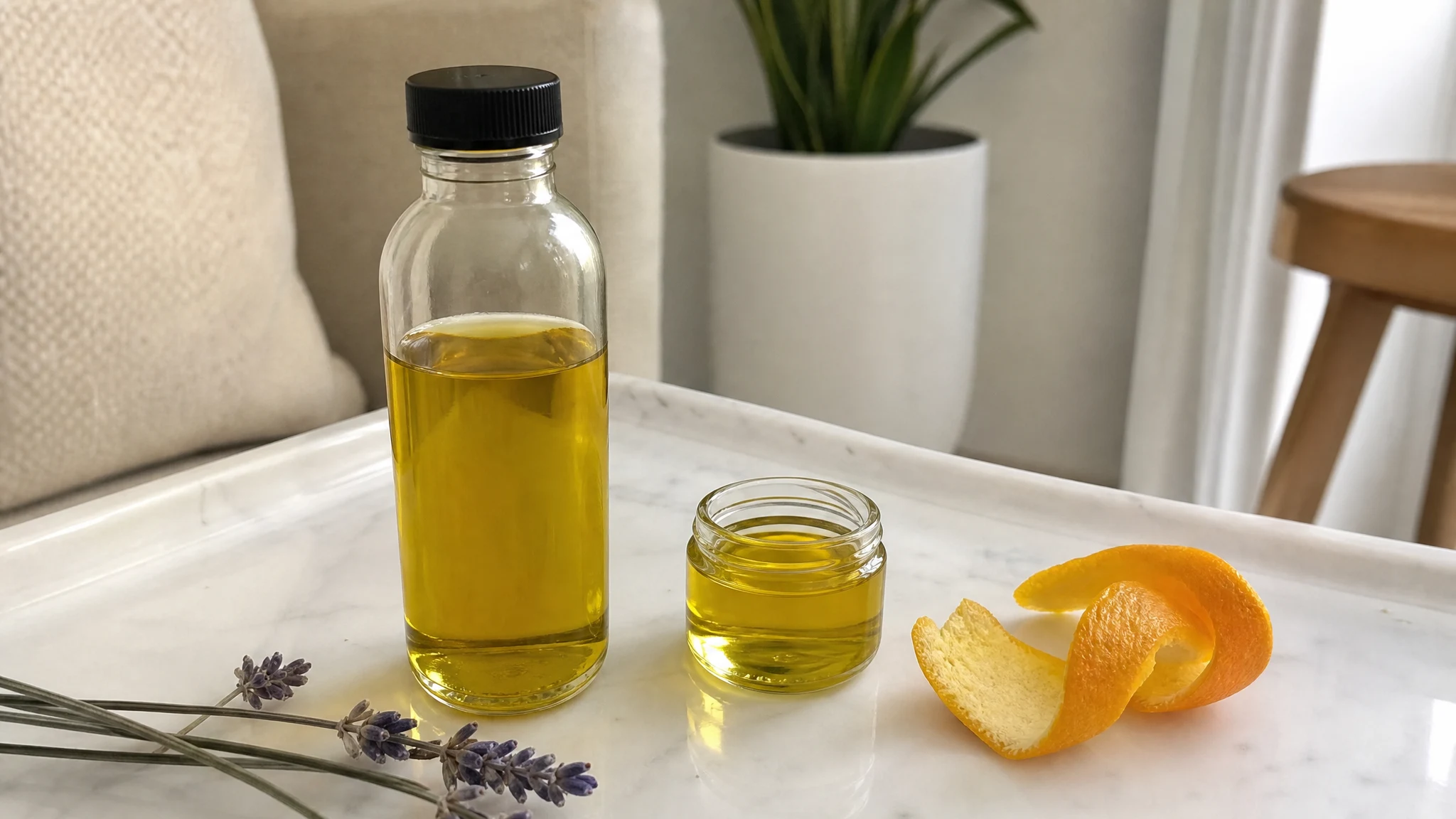
If you are simply looking for an oil for ordinary dry skin elsewhere on your body, the pleasures are small and practical. A few drops on damp skin after washing spread easily and leave skin feeling soft and smooth. You will notice the golden color and a mild, plant-like aroma. Let it sink in before you dress, because the oil is golden-orange and can tint pale clothing.
Keep it to areas your dermatologist has said are fine, and wash your hands afterward. That is all there is to it, and there is no need for a bigger story.
What is in the bottle of calendula oil?
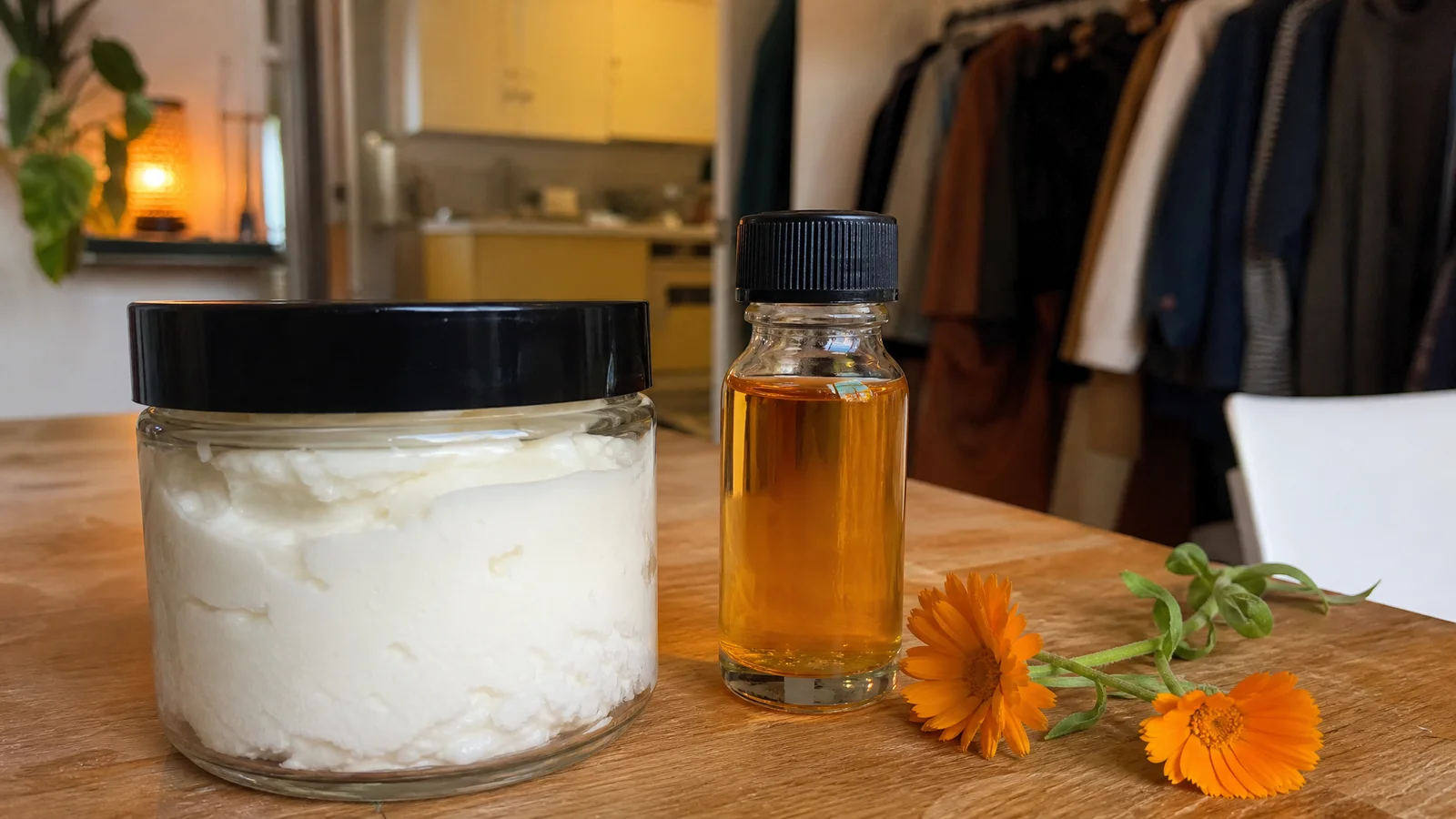
We can say what is in the bottle: calendula flowers, dried naturally, extracted on their own and brought into a carrier oil, with no preservatives, tocopherol or stabilizers added. Each batch is tested by independent third-party labs, and if you email the lot number to [email protected] we will send the batch documentation, which is handy to show your dermatologist. For plain dry skin, which is a different question altogether, our dry skin article is the place to go, and our article on sensitive skin covers a related set of questions.
We would rather point you to the right person than overpromise. For psoriasis, that person is a dermatologist.
Calendula Oil
Nature's Golden Botanical, bottled: small-batch calendula oil in sizes from 0.5 oz to bulk.
From $13.99
Shop Calendula Oil →Sources & Further Reading
- American Academy of Dermatology, "Psoriasis: Overview." aad.org
- Elmets CA et al., "Joint AAD-NPF Guidelines of care for the management and treatment of psoriasis with topical therapy and alternative medicine modalities for psoriasis severity measures." J Am Acad Dermatol, 2021. PubMed
- Das S et al., "Phytochemical Screening and Metallic Ion Content and Its Impact on the Antipsoriasis Activity of Aqueous Leaf Extracts of Calendula officinalis and Phlebodium decumanum in an Animal Experiment Model." Turk J Pharm Sci, 2019. PubMed
- European Medicines Agency, "European Union herbal monograph on Calendula officinalis L., flos" (EMA/HMPC/437450/2017). ema.europa.eu
- US Food and Drug Administration, "Using Cosmetics Safely." fda.gov