Whipped Calendula Body Butter: Ratios and Ice Bath Tips
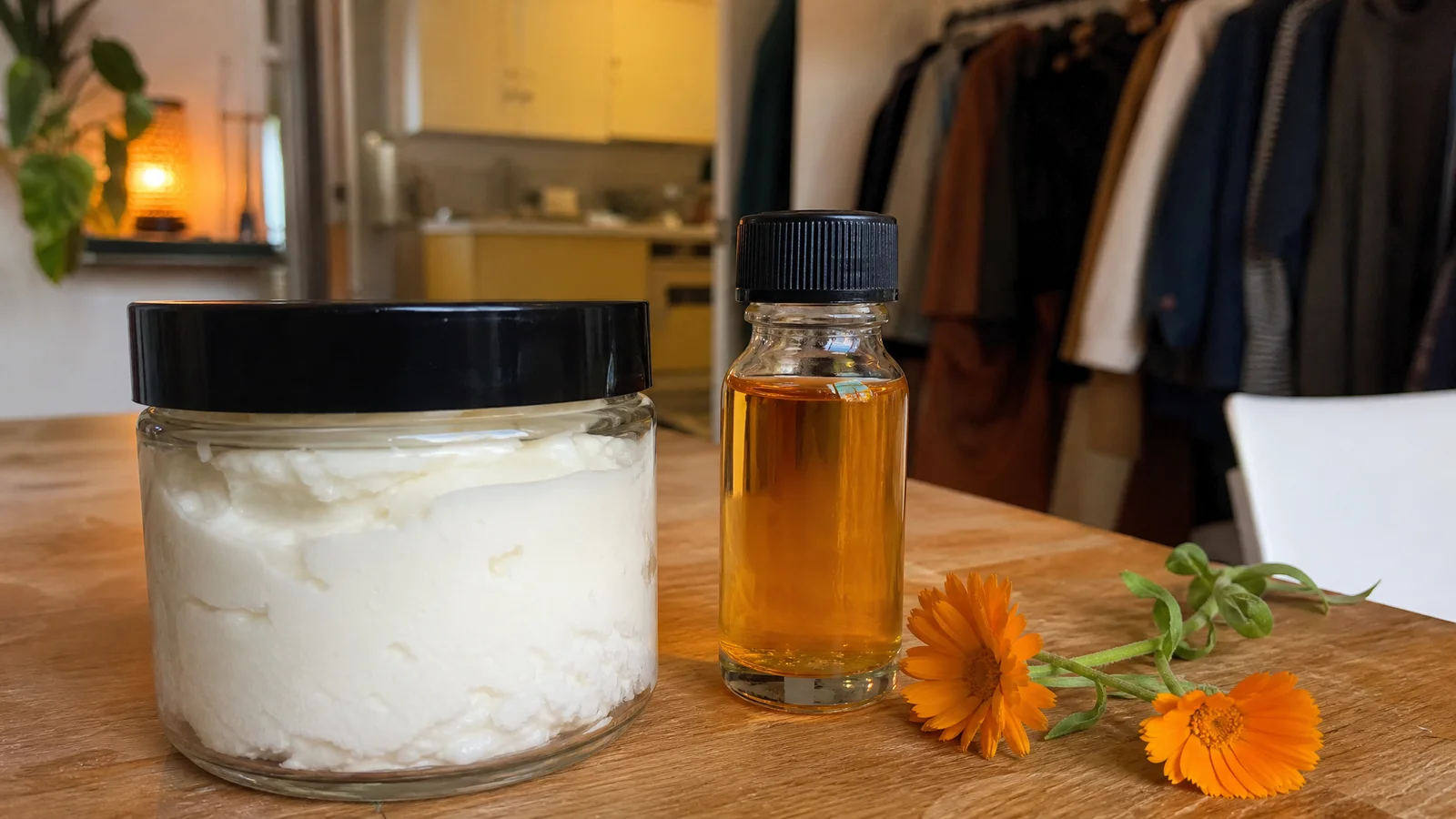
Whipped body butter looks like frosting and feels like a very good moisturizer, and it is made from just two things: a solid butter and a liquid oil. Calendula oil makes a lovely liquid half, with its golden color tinting the finished butter. The real skill is not in the ingredients but in how you cool the mixture, so that is where we will spend most of our time.

Calendula Oil
Our own small-batch calendula oil, in sizes from 0.5 oz to bulk.
From $13.99
Shop Calendula Oil →Calendula body butter ratio: shea butter to oil
Lab Muffin, a cosmetic science blog, calls the most basic whipped body butter 3 parts butter to 2 parts oil, and its batch was 100 g of shea butter to 67 mL of grapeseed oil (DIY whipped body butter | Lab Muffin Beauty Science). We like that ratio as a first batch because it is easy to scale, and we would build it by weight. Oils differ a little in density, so a scale is more reliable than a measuring cup.
As a suggestion, built from that ratio: 150 g shea butter and 100 g calendula oil makes about 250 g, enough for two or three small jars. Shea is a common choice, but the same post notes that cocoa, mango and olive butters work too, depending on the feel you want. Butters and oils from a craft supply store, pharmacy or grocery will do; we make calendula oil only, so that is the part we can speak to firsthand.
Ice bath whipping for smooth body butter texture
Here is the method Lab Muffin used, which is also the heart of smooth texture:
- Melt the butter completely, in short bursts or over gentle heat, until no crystals are left.
- Stir in the calendula oil.
- Set the bowl in a tub of ice and whip now and then until the mixture is thick enough to hold a soft peak.
- Whip it hard until it turns pale and fluffy, then spoon it into clean jars.
The reason the ice bath matters is crystals. Lab Muffin explains that grainy butter is shea that melted and then re-set into large crystals, and that smooth texture comes from small crystals, much like ice cream. Cooling quickly while stirring keeps them small. That also tells you what to do if a batch comes out grainy or too soft: melt it fully, adjust the weights, and cool it again in ice. (Do this once, and quickly, rather than repeatedly, since oils prefer less heat.)
What you will notice while whipping is that the mixture changes character quickly. At first it looks like thin, glossy oil. Then it turns cloudy and starts to hold the track of the whisk, and a minute or two later it goes opaque and fluffy. Stop when it holds a peak and no longer. Whipping past that point gives you a stiff, hard-to-scoop butter, and it is better to stop a little early than a little late.
Set up before you melt anything: jars washed and dried, a spatula and a bowl that fits in your ice tub, and a towel for the drips. Once the butter starts to cool, you do not want to be hunting for a clean jar.
Why does calendula body butter contain no water?
This butter is not a lotion, and that is on purpose. A classic review of cosmetic preservation notes that the cosmetics most in need of preservatives are those that contain water (Cosmetic preservation), and a later review says water-containing cosmetics need a verified preservation system, such as challenge testing (Cosmetics Preservation: A Review on Present Strategies). So we keep the butter to oil and fat only. Skip water, hydrosol, aloe juice and tea, and you keep a simple, stable formulation without needing a preservative recipe.
Adjusting body butter firmness with oil and butter
More oil makes a softer butter, and more butter makes a firmer one. Change only one thing at a time and note the weights, and you will find your favorite in a few batches. Warm rooms soften any butter, so a jar that feels perfect in winter may want a little extra butter in July. That is our reasoning from how fats behave, not a tested figure.
Which calendula infused oil goes in the jar?
Because calendula oil is roughly 40 percent of what you jar (that is simple arithmetic from the ratio above), the oil matters. Ours is made from dried flowers with nothing added, and each bottle is dated and lot-numbered. Since the oil is flowers extracted into a carrier, ask us for the carrier on the batch paperwork if you want to know exactly what is in your jar. Keep the finished butter cool and out of the sun, and use a clean spatula instead of fingers each time to keep water and bacteria out. For ideas on keeping oils fresh, see our storage guide.
When the butter is done, give the jars a day on the counter before you judge the texture. It often firms up slightly as it settles, and what felt a touch soft at the end of whipping may be just right the next morning. A thin layer goes a long way, so warm a small scoop between your fingers first and smooth it on in one pass. The golden tint is gentle, and you may see a hint of color on your palms the first time you use it.
Daisy-family allergy, children and pregnancy cautions
Calendula is in the daisy family, and the EU herbal monograph lists hypersensitivity to Asteraceae plants as a contraindication. It also does not recommend skin use for children under 6 and says safety in pregnancy and breastfeeding has not been established (European Union herbal monograph on Calendula officinalis L., flos). Do a patch test first, and ask your doctor, pediatrician or midwife if any of those situations apply.
If you enjoy projects like this, a firmer, travel-ready cousin is our lotion bar, and the salve works the same way with wax. A good body butter is mostly patience with the ice bath.
Calendula Oil
Nature's Golden Botanical, bottled: small-batch calendula oil in sizes from 0.5 oz to bulk.
From $13.99
Shop Calendula Oil →Sources & Further Reading
- Lab Muffin Beauty Science. DIY whipped body butter. labmuffin.com
- Brannan DK, 1995. Cosmetic preservation. J Soc Cosmet Chem 46:199-220. library.scconline.org
- Halla N et al., 2018. Cosmetics Preservation: A Review on Present Strategies. Molecules. PMID 29958439
- European Medicines Agency, HMPC. European Union herbal monograph on Calendula officinalis L., flos. ema.europa.eu