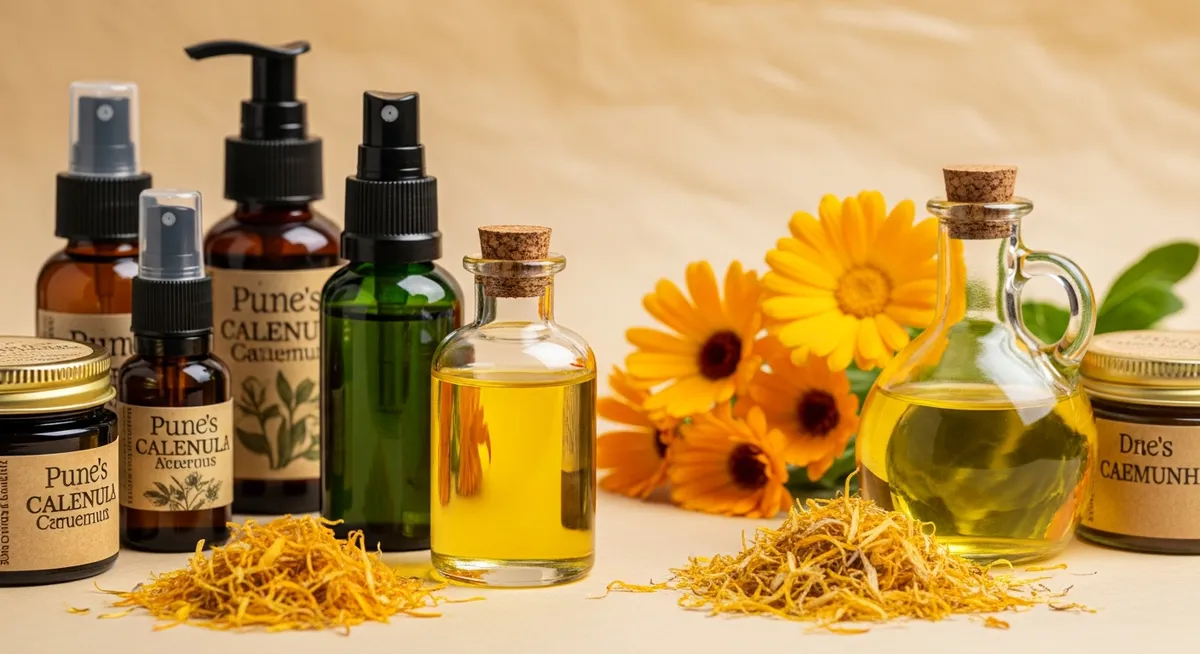
Calendula Oil in Aromatherapy: Base Oil, Not Diffuser Oil
Calendula oil is a poor choice for a diffuser, and the reason is what it is. The oil we make is an infused oil: calendula extracted and brought into a carrier oil. A carrier oil is a fixed oil, not a volatile one, so it is not built to evaporate into a room the way an essential oil does. Where it earns a place in aromatherapy is as the base oil you blend essential oils into for skin application.

Calendula Oil
Our own small-batch calendula oil, in sizes from 0.5 oz to bulk.
From $13.99
Shop Calendula Oil →Three different things get called "calendula oil" in this field
The confusion is the main reason aromatherapy advice on calendula goes wrong, so it helps to separate them.
- Infused oil (what we make). Flowers are infused in a carrier oil. It is orange, mild in scent and made to be used on skin.
- Calendula essential oil. A steam- or hydro-distilled product, and a minor one. The EU assessment report gives a volatile oil content of 0.2-0.3% of the dried flower, mostly sesquiterpenes (EMA/HMPC); one lab study measured 0.9 g per 100 g of dried flower by hydrodistillation, with a pigment-free oil, against 6.7-7.1 g for solvent and enfleurage extracts that carried pigments (Salome-Abarca et al., Bot Sci, 2015). Those sources disagree on yield, probably because of method and plant material, and neither describes the product on a retail shelf. We do not make an essential oil.
- CO2 extracts, absolutes and concretes. Other extraction products again. A CO2 extract is neither an essential oil nor an absolute (Tisserand).
Our infused vs essential oil explainer and its companion go further. The practical consequence: instructions written for essential oils (drops in a diffuser, inhaler or steam bowl) do not transfer to an infused oil, and anyone selling "diffusing calendula oil" is mixing up the categories.
Do not diffuse it, and do not light it
Reasoning from what a fixed oil is: it does not vaporize at a diffuser's temperatures the way a distilled oil does, so the likely outcome is residue in the device and on surfaces, not scent in the air. Check your diffuser's manual before putting any oil in it; we have not tested any diffuser. Heat sources are a separate hazard. The National Candle Association warns that botanicals embedded in candle wax can burn and feed a flame, and advises never leaving a burning candle unattended (NCA, Botanical-embedded candles; NCA, Candle Safety Tips). We do not recommend dropping infused oil onto a warmer or burner.
The role it can play: base oil for a skin blend
If you blend, the infused oil is the carrier and the essential oil is the percentage you calculate. The Tisserand Institute lists essential-oil dilutions of 0.2-1% for sensitive or impaired skin, 0.5-1.2% for facial products, 1-3% for body oils and lotions and 3-10% for pain rollerballs, and says to start low (Tisserand Institute). The National Association for Holistic Aromatherapy says most blends are between 1% and 5% and that 0.5-2.5% is generally used for infants, toddlers and young children (NAHA). These ranges are for essential oils, not for calendula, and the two organizations overlap without agreeing. Pick one and record which. Arithmetic: in a 10 mL roller bottle, 1% is 0.1 mL of essential oil, 3% is 0.3 mL. Measure with a pipette. Drop size varies by oil.
Which essential oils pair well is a matter of scent preference and your own skin, and we do not have a tested pairing list. Two safety points do not depend on preference. Expressed (cold-pressed) citrus rind oils can be phototoxic because of furanocoumarins, whereas distilled citrus oils are not (Tisserand Institute, Citruses). Our own Sunmeadow Blend is 3:1 calendula oil to sweet orange; check the type of orange oil before you apply a blend to skin that will be in sunlight. And allergic reactions are the most common reaction to essential oils, and they can last days or weeks (Tisserand Institute, Irritation and allergic reactions). Two Asteraceae-based ingredients in one bottle (calendula plus chamomile, for example) gives a daisy-family allergy more to react to; that is reasoning, not a measured rate.
Who should be left out of the blend
- Cats. Veterinary toxicologists at Pet Poison Helpline advise that concentrated essential oils should never be applied directly to cats and note that cats can swallow what they groom off (Pet Poison Helpline). Dogs are also at risk: tea tree oil applied to skin is a common cause of poisoning (Pet Poison Helpline). The ASPCA lists the calendula plant as non-toxic to dogs and cats, but that rates the plant, not blends (ASPCA). Ask a veterinarian.
- Infants and small children. The Tisserand Institute's age chart runs from 0.1-0.2% for under 3 months to 1-2% for ages 2-6, and notes many oils are not suited to young children; the EU herbal monograph does not recommend calendula on skin under 6. A pediatrician decides, and our oil is not described as baby safe.
- Pregnancy and breastfeeding. The EU monograph says calendula safety has not been established in pregnancy and lactation and recommends against use for lack of data (EMA/HMPC, 2018). Essential oils add their own questions. That belongs with an OB/GYN or midwife.
- Daisy-family allergy. The monograph lists Asteraceae hypersensitivity as a contraindication. Patch test first; see our patch test article.
What not to claim, and why we do not say "therapeutic grade"
FDA treats a product's intended use as the test for cosmetic or drug status, and its aromatherapy page names claims such as treating or preventing disease, easing pain, relaxing muscles, or addressing depression, anxiety or sleep as drug claims, adding that a plant origin does not exempt a product (FDA, Aromatherapy). It also does not define "natural" or "hypoallergenic" for cosmetics (FDA, Using Cosmetics Safely). We found no human trial of inhaled or diffused calendula for mood, sleep or stress. We do not use "therapeutic grade" because it is a phrase we cannot document; our rule is to describe process and testing instead. What we can document is process: dried flowers, in-house infusion, nothing added, and every batch tested by independent third-party labs, with documentation on request by lot number.
For a carrier-selection view, see carrier oils to mix with calendula oil; for handling, storage. If scent is what you want from a diffuser, buy an essential oil for that job and keep calendula oil for skin.
Calendula Oil
Nature's Golden Botanical, bottled: small-batch calendula oil in sizes from 0.5 oz to bulk.
From $13.99
Shop Calendula Oil →Sources & Further Reading
- EMA/HMPC, 2018. Assessment report on Calendula officinalis L., flos. ema.europa.eu
- EMA/HMPC, 2018. European Union herbal monograph on Calendula officinalis L., flos. ema.europa.eu
- Salome-Abarca LF et al., 2015. Chemical composition of scented extracts obtained from Calendula officinalis by three extraction methods. scielo.org.mx
- Tisserand R. Absolutes, concretes and CO2 extracts. roberttisserand.com
- National Candle Association. Botanical-embedded candles can be a fire hazard. candles.org
- National Candle Association. Candle Safety Tips. candles.org
- Tisserand Institute. Dilution for essential oils. tisserandinstitute.org
- Tisserand Institute. Citruses: a comparison of different oils. tisserandinstitute.org
- Tisserand Institute. Irritation and allergic reactions. tisserandinstitute.org
- Tisserand Institute. Safety guidelines (recommended dilutions by age). tisserandinstitute.org
- National Association for Holistic Aromatherapy. Safety. naha.org
- Pet Poison Helpline. Essential oils and cats. petpoisonhelpline.com
- Pet Poison Helpline. Essential oils are toxic to dogs. petpoisonhelpline.com
- ASPCA. Pot Marigold (Calendula officinalis). aspca.org
- FDA. Aromatherapy. fda.gov
- FDA. Using Cosmetics Safely. fda.gov