How to Store Calendula Oil: Shelf Life, Freshness & Preservation Tips
Most of what decides how long a calendula oil stays fresh is the carrier oil it is made in, plus how much light, heat and air it sees after you open it. A single "shelf life" number on the internet cannot account for any of that. This guide covers what degrades an infused oil, a storage routine that follows from the sources, how to check a bottle you are unsure about, and why we do not print a months figure for our own oil.

Calendula Oil
Our own small-batch calendula oil, in sizes from 0.5 oz to bulk.
From $13.99
Shop Calendula Oil →What actually goes wrong in the bottle
Infused oils go off by oxidation: oxygen reacts with the unsaturated fats in the carrier. A 2025 review lists the initiators as light, metal ions, heat and oxygen, and notes that the rate rises exponentially with temperature (Gharby et al., Food Chemistry X, 2025). The same review gives relative oxidation rates for fatty acids at 100 C: oleic acid 10, linoleic 100, linolenic 150, against 1 for stearic. In plain terms, an oleic-rich carrier is much more stable than a linoleic-rich one. A 2026 accelerated test of four oils found jojoba lasted longest and rosehip shortest before oxidizing, and the authors link that to polyunsaturated fatty acid content (Fagoaga et al., Antioxidants, 2026). Those are lab comparisons at high temperature, so use them for ranking, not for predicting months on your shelf.
Because the petals are only a small fraction of the finished mixture, the carrier sets most of this behavior. Calendula adds pigments and other compounds, and it would be an overstatement to say they protect or harm stability, since we found no study of that for calendula oil. Which carrier is in our bottle is on the batch paperwork (email the lot number to [email protected]).
The storage routine the sources support
- Keep it cool. A commercial calendula macerate data sheet specifies storage at 15-25 C in the closed original container, protected from air and light (Golgemma/Biolandes, FB026, 2025). A cupboard away from the stove, not a sunny windowsill and not a hot car.
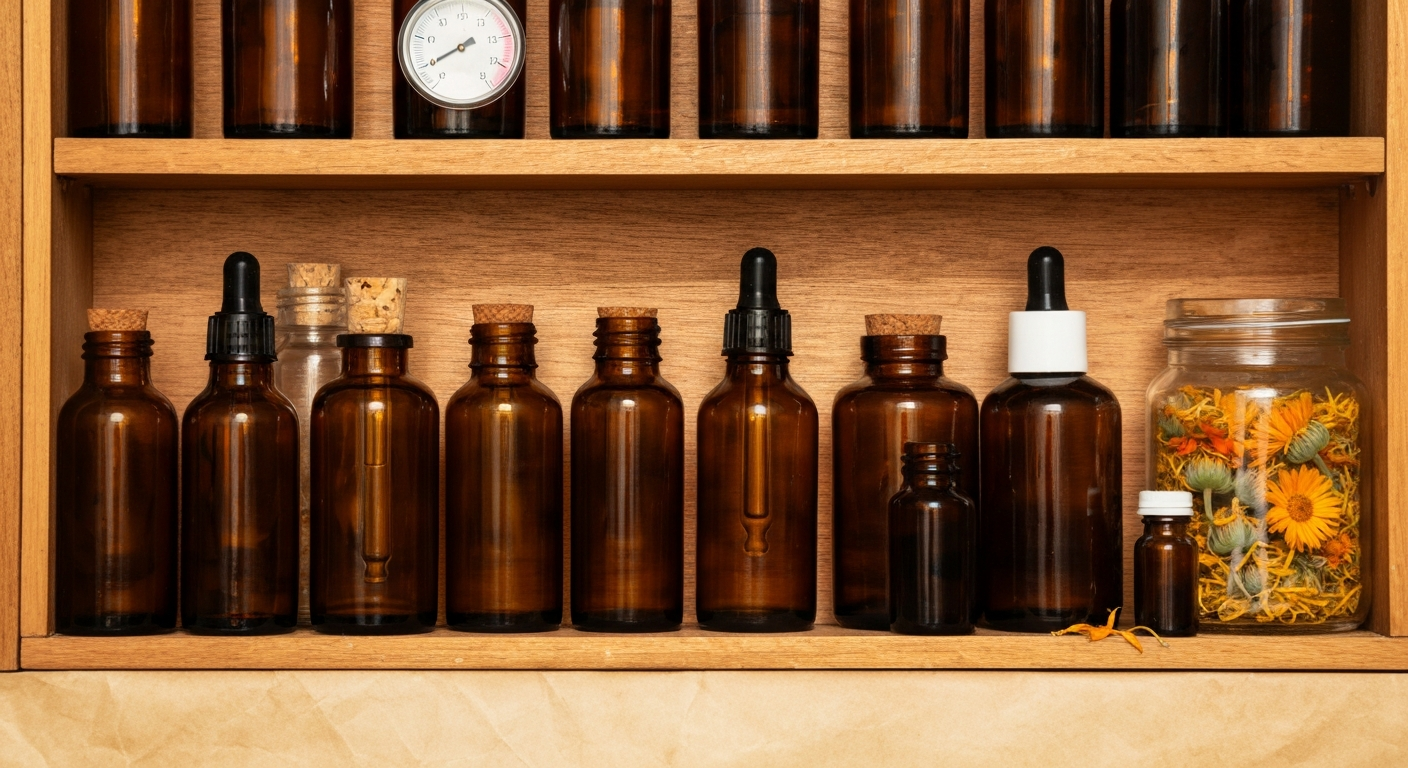
- Keep it dark. A 2026 review of cold-pressed oils says dark glass protects oils from light, a driver of oxidation, and recommends dry, cool places away from heat (Dash et al., Frontiers in Nutrition, 2026). Our bottles are glass in every size. We found no head-to-head test of amber versus clear glass for calendula oil, so treat the cupboard as the main protection and the glass as a help.
- Keep the cap on and water out. Air is one of the initiators above, so close the bottle after each use. Water is a separate problem: the supplier data sheet sets microbial limits of 1,000 CFU/g for total aerobic count and for yeasts and moulds, which is why you should not let water, wet fingers or wet droppers into the bottle. That limit is for one product; it is a reason for caution, not a rule for yours.
- Do not decant into clear containers, and do not top up an old bottle with a new one. Reasoning from the light and oxygen points above, a clear container exposes the oil to light, and a mixed oil is only as fresh as its older part.
On refrigerating a sealed, finished oil: none of the sources we reviewed recommends it, and we are not going to invent a rule. The supplier sheet above gives a cool-room range.
Why you will not find a months figure here for our oil
Shelf-life numbers vary because they come from different situations. That calendula macerate data sheet states 36 months for a sealed container stored as above, and it also lists 0.2% added tocopherol and a peroxide-value limit of 40 meq O2/kg (same data sheet). Our oil has no added tocopherol, synthetic preservatives or stabilizers, and we do not have shelf-life test data we can publish for it, so quoting 36 months would borrow someone else's number. What we can tell you is that every bottle is dated and lot-numbered, so you can ask us about a specific lot, and that each batch is tested by independent third-party labs, with documentation on request.
The review table in Gharby et al. shows how far such numbers spread: values from 6 to 24 months for different argan oils, and 9 to 17 months for two virgin olive oils (the olive figures derived from accelerated testing). Supplier sheets of 24-36 months are for sealed product under ideal conditions; the models are for specific oils under stress. An opened bottle of a polyunsaturated oil can go off sooner than either.
How to check a bottle you are not sure about
Your nose is the first test but not a complete one. Aldehydes from late-stage oxidation produce the characteristic rancid odor, and oil that smells that way should be discarded. The trouble is the stage before that. Peroxide value tracks early oxidation and anisidine value tracks the later aldehydes that cause the rancid smell, and a low peroxide value alone can mislead in an oil that is already rancid (Cawood Scientific, 2020). So a clean smell means probably fine, not proven fine.
If you buy oil in volume, ask for the numbers and read them in context. Fresh oleic-rich or saturated cold-pressed oils typically show peroxide values of about 1-8 meq O2/kg and polyunsaturated oils such as grapeseed about 6-15 (Dash et al., above); the data sheet limit of 40 is a ceiling, not a target. Our shop page links the certificate of analysis, and you can request batch documentation for any lot.
Homemade oil is a different problem
If you made the oil yourself, the clock depends on what you put in it. University of Maine Cooperative Extension calls dried herbs the safest choice for infused oils because dried material lacks the moisture that Clostridium botulinum needs, and its bulletin advises against fresh plant material without food-processing review (UMaine Extension, Bulletin 4385). That bulletin is written for culinary oils, so extending it to a cosmetic oil is an inference, but a cautious one. For fresh herbs, CDC advises refrigerating homemade garlic or herb oils and discarding them after 4 days, and Health Canada says use the oil within one week; the two figures differ and are for fresh material (CDC, Botulism prevention; Health Canada). Do not apply either number to a dried-flower oil. Our home infusion guide covers making it, and the expiry FAQ answers shorter questions.
The storage rules above also apply to salves and balms made from the oil, which contain no water if you make them properly. If you add water, that product is an emulsion and needs a real preservation system, not just good storage.
When to throw it out
Discard oil that smells rancid or that has had water introduced. If a bottle is of uncertain age, check the lot and date on the label first. If you get a rash, redness or burning after using any cosmetic oil, the FDA advises stopping it, contacting a healthcare provider and reporting the reaction (FDA, Using Cosmetics Safely).
Calendula Oil
Nature's Golden Botanical, bottled: small-batch calendula oil in sizes from 0.5 oz to bulk.
From $13.99
Shop Calendula Oil →Sources & Further Reading
- Gharby S et al., 2025. Vegetable oil oxidation: mechanisms, impacts on quality, and approaches to enhance shelf life. Food Chemistry X 28:102541. PMC12146556
- Fagoaga et al., 2026. Oxidative stability of rosehip, sunflower, olive and jojoba oils. Antioxidants 15(5):646. doi.org/10.3390/antiox15050646
- Golgemma/Biolandes, 2025. Technical data sheet, Calendula Org Macerate/Oil, FB026. biolandes.com/FB026
- Dash B et al., 2026. Cold pressed oils: a systematic review. Frontiers in Nutrition 13:1747029. PMC13371722
- Cawood Scientific, 2020. Peroxide Value, Anisidine Value and Total Oxidation Value. cawood.co.uk
- University of Maine Cooperative Extension. Safe Homemade Flavored and Infused Oils, Bulletin 4385. extension.umaine.edu/publications/4385e
- FDA. Using Cosmetics Safely. fda.gov
- CDC. Botulism: Prevention. cdc.gov/botulism/prevention
- Health Canada. Food safety tips for vegetables and herbs in oil. canada.ca