Calendula Oil Around the Eyes: What to Know First
Dark circles and puffiness are two of the most common reasons people go looking for an eye cream, and also two of the least straightforward. The word "cream" is where a home recipe tends to go astray, because a cream contains water, and water changes what it takes to make a product safe near the eyes. So here is how we think about the eye area, and where calendula oil fits around it.

Calendula Oil
Our own small-batch calendula oil, in sizes from 0.5 oz to bulk.
From $13.99
Shop Calendula Oil →Why do dark circles have different causes?
A comprehensive dermatology review of periorbital hyperpigmentation lists several different contributors: heredity, extra pigment, pigment left behind after allergic or atopic skin inflammation, swelling around the eyes, prominent blood vessels, and the shadow cast by the hollow along the lower lid. The authors also note that there is little hard science on how these arise and that care should follow the main cause.
That is useful, because it explains why no single product suits everyone. Circles that run in your family or look more like a shadow than a color come from structure, and no oil changes that. Puffiness that comes and goes is different from swelling that stays or affects only one eye; the second kind is a question for a physician. We can tell you about the flower and the infusion. What is behind your own circles is a question for someone who can examine you.
Water-based eye cream recipes need preservatives
Home cream recipes usually blend an oil with aloe gel, a hydrosol or a flower tea. A review of cosmetics preservation states that cosmetics containing water require preservation against microbial contamination, verified for example by challenge testing. No kitchen test can show that a water-based mixture is safe to leave on the shelf and then put near an eye.
FDA's page on microbiological safety says injuries from contaminated cosmetics are not common but can be serious, and it names eye-area cosmetic products among those that have caused serious infections. That is the reason we keep this conversation about oils. A calendula oil is water-free, which is the simplest way to sidestep the whole question.
Calendula in cosmetics: Cosmetic Ingredient Review findings
Calendula has a long record in cosmetics. The Cosmetic Ingredient Review panel concluded in 2010 that calendula-derived cosmetic ingredients are safe as used in the concentrations it reviewed, and that they were not irritating or sensitizing in animal or clinical tests. The same summary adds that they may be mild ocular irritants. We take that literally: keep the oil away from the eyelid and the lash line, and use it on the skin of the cheek and temple instead, with a thin layer and a clean fingertip.
Calendula belongs to the Asteraceae family, and the European herbal monograph lists hypersensitivity to that family as a contraindication. In an Austrian clinic series of 443 patients with contact dermatitis, about 2% reacted to marigold. These were patients already under investigation for skin allergy, so it is not a general rate, but it is a reminder that thin facial skin deserves a patch test first. Reasoning from the review above, where pigment left after allergic inflammation is one of the listed causes, you would not want to cause a reaction in that area. Our patch test guide shows how to go about it.
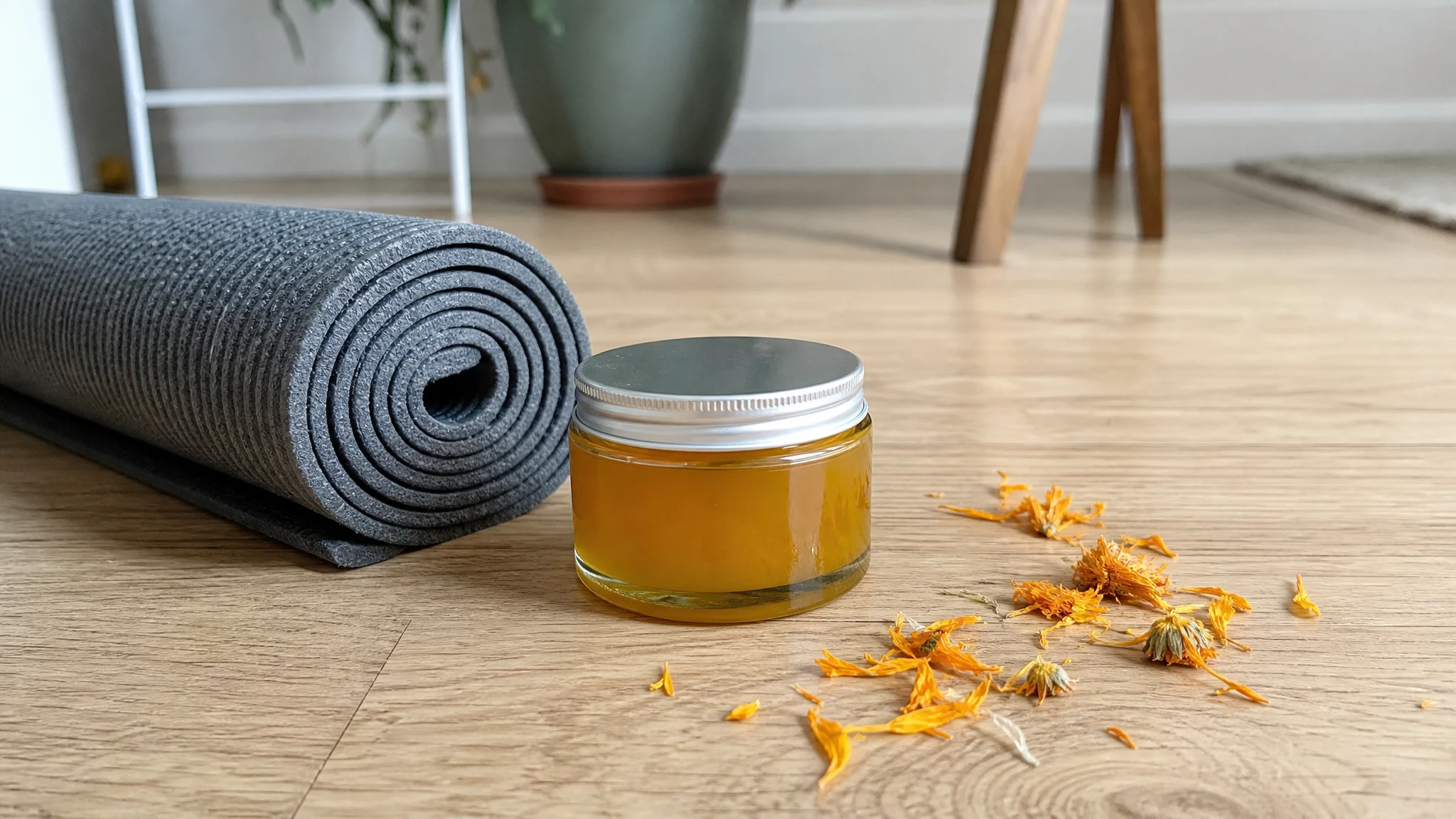
As for the claim that calendula lightens dark circles, we did not find a human trial that tested it, so we do not make that claim. What we can say is that our oil is a finished, nothing-added infused oil that leaves skin feeling soft and smooth.
Applying calendula oil near the eyes, not on them
If you decide to use the oil on the face near the eyes, the technique matters more than the product. Use a clean fingertip and warm a single drop between your fingers. Dot it onto the cheekbone and the temple, then pat outward, away from the eye, stopping at the bony ridge beneath it. Leave the eyelid and the lash line alone.
If any oil drifts into the eye, close the eye, blot the area with a clean tissue, and rinse with clean water. If it stings or stays uncomfortable, stop using the oil there.
Is evening or morning better for eye-area oil?
Oil slides, and the skin around the eyes is thin and mobile. Applied just before you lie down, a drop can wander, so give it a few minutes to settle and blot gently with a tissue. In the morning, you may find that oil under concealer or makeup makes it slip. That is a matter of taste, and many people simply keep oil for the evening and leave the mornings to a plain, fragrance-free routine.
Gentle routine for tired eyes: sleep, water, cleansing
- Sleep, water and gentle cleansing are the basics for how eyes look in the morning. They cost nothing.
- A drop of oil on the cheekbone, patted outward, adds softness without going near the eye.
- A cool, clean washcloth held on the closed eye can feel refreshing; keep the oil off it.
- Persistent or one-sided swelling is worth a call to a doctor, not a new product.
For the rest of the face, our face routine guide shows where a few drops of calendula oil fit, and the jojoba comparison helps if you want to compare facial oils.
The best eye-area routine is a modest one. A good night's sleep, a gentle touch and the right place for each product go a long way.
Calendula Oil
Nature's Golden Botanical, bottled: small-batch calendula oil in sizes from 0.5 oz to bulk.
From $13.99
Shop Calendula Oil →Sources & Further Reading
- Periorbital Hyperpigmentation: A Comprehensive Review, J Clin Aesthet Dermatol, 2016
- Cosmetics Preservation: A Review on Present Strategies, Molecules, 2018
- Microbiological Safety and Cosmetics, FDA
- Final report of the Cosmetic Ingredient Review Expert Panel amended safety assessment of Calendula officinalis-derived cosmetic ingredients, Int J Toxicol, 2010
- The seamy side of natural medicines: contact sensitization to arnica (Arnica montana L.) and marigold (Calendula officinalis L.), Contact Dermatitis, 2001
- European Union herbal monograph on Calendula officinalis L., flos, European Medicines Agency