Calendula for Hemorrhoids? What to Know Before You Try
Hemorrhoids are the kind of problem people research quietly at midnight, and calendula tends to turn up in the results with a reassuring golden photo. We make a calendula oil, so we would like to be useful here, which means starting with the thing that matters more than any plant: working out what you are actually dealing with.

Calendula Oil
Our own small-batch calendula oil, in sizes from 0.5 oz to bulk.
From $13.99
Shop Calendula Oil →External versus internal hemorrhoids explained
The National Institute of Diabetes and Digestive and Kidney Diseases separates two kinds. External hemorrhoids usually show up as itching around the anus, one or more tender lumps, and an ache when sitting. Internal ones are mostly painless unless they prolapse, and their main sign is bright red blood on stool or toilet paper. NIDDK also points out that rectal bleeding can come from other bowel conditions, including Crohn's disease, ulcerative colitis and cancer of the colon or rectum, and says to see a doctor for any bleeding or for symptoms that last beyond a week of home care.
That is why we put the doctor first. A botanical oil is not the right tool for bleeding, and nothing we say here replaces a proper look from a clinician.
Many people put off the doctor visit because the subject is embarrassing. It is also very common, and clinicians hear about it all the time. It may help to write down your symptoms, how long they have lasted and what you have already tried, so the conversation is short and to the point.
What does NIDDK home care for hemorrhoids include?
NIDDK's home-care list is refreshingly practical: high-fiber food, plenty of fluids, a stool softener or fiber supplement, no straining, no long sits on the toilet, over-the-counter pain relievers, and warm sitz baths several times a day. It adds that over-the-counter creams, ointments or suppositories may ease mild pain, swelling and itching from external hemorrhoids, usually for about a week, and that a rash or dry skin around the anus from a product is a reason to follow up. Nothing botanical is on that list.
What does research say about calendula for hemorrhoids?
Calendula has a real clinical record, but it lives elsewhere. European regulators list calendula flower preparations as traditional herbal medicines for minor skin inflammation, such as sunburn, and for minor wounds, based on long-standing use. Anal complaints are not among the listed uses, and the monograph advises seeing a practitioner if symptoms last longer than a week (EMA/HMPC monograph, 2018). The studies behind it are mostly small, and the assessment report found the evidence insufficient for a well-established use (EMA assessment report, 2018).
Hemorrhoids are not among the conditions in calendula's clinical trial record that we could find; the trials people point to tested ointments and extracts on other kinds of skin damage. In a 2005 study of 34 people with venous leg ulcers, ulcer area fell 41.7% with a marigold-extract ointment and 14.5% with saline dressings over three weeks, and the authors called the results preliminary (Duran et al., 2005). A systematic review of six randomized trials of topical calendula on wounds found only one of good quality and described the support as weak (Leach, 2008). Leg ulcers are a different tissue and a different problem, so carrying those results over to hemorrhoids is a leap. Our wound studies article walks through that research in more detail.
Calendula oil and daisy-family allergy near the anus
Calendula is a daisy-family plant, and the same monograph lists sensitivity to that family as a contraindication. In an Austrian patch-test series of 443 people with dermatitis, nine reacted to marigold, about 2%, though clinic patients are not the general population (Reider et al., 2001). Already irritated skin is a poor place to discover an allergy, which is why a forearm test comes first in our patch test guide.
Pregnancy deserves its own line, since NIDDK lists it among the causes of hemorrhoids. The EU monograph says safety in pregnancy and breastfeeding has not been established and use is not recommended without sufficient data. That reflects missing data rather than documented harm, and an OB/GYN or midwife is the right person to ask. We cover how the sources word it in our pregnancy article.
If you do talk with a clinician, ask them directly whether they would be comfortable with a plant-based product near the area, and show them the label. Plenty of people assume that "natural" means harmless for skin that is already sore, and a quick question can save a week of discomfort. The same goes for anything scented, which is why the plainest products are usually the ones worth asking about.
Calendula oil as an external cosmetic only
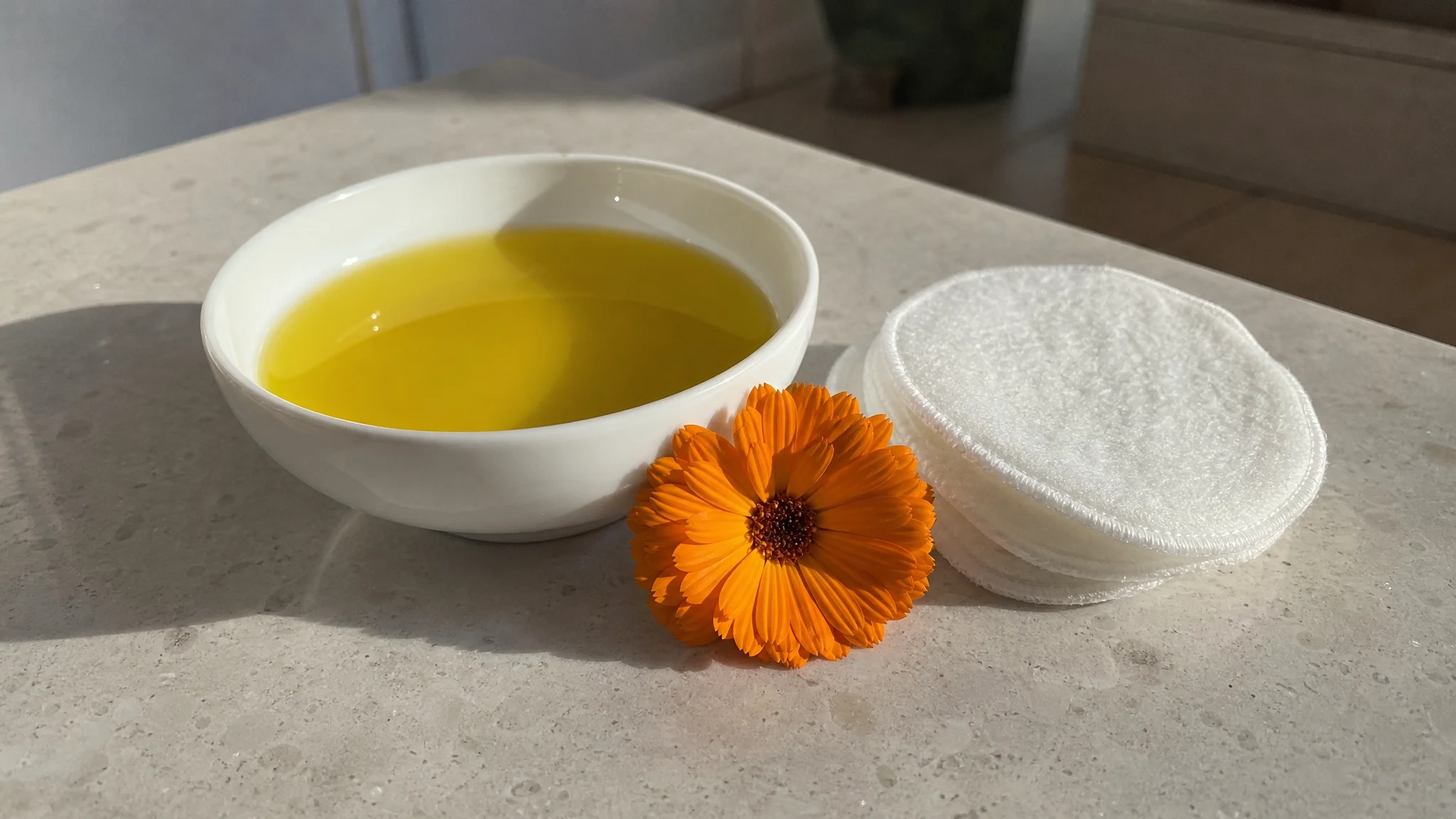
Ours is a cosmetic oil for external skin, and we do not make it for use inside the body or for any medical purpose. What we can speak to is how it is made: organically grown flowers, calendula extracted on its own and brought into a carrier oil, nothing else added, with independent lab testing on every batch and the paperwork available when you email us the lot number.
If your symptoms are mild, a few days of fiber, water and warm baths may be all that is needed; if they are not settling, or there is any blood, the quickest route to relief is a short conversation with a doctor.
Be patient with yourself while you sort it out, and let the symptoms, not the marketing, tell you when it is time to get help.
Calendula Oil
Nature's Golden Botanical, bottled: small-batch calendula oil in sizes from 0.5 oz to bulk.
From $13.99
Shop Calendula Oil →Sources & Further Reading
- National Institute of Diabetes and Digestive and Kidney Diseases. Symptoms & Causes of Hemorrhoids - NIDDK. niddk.nih.gov
- National Institute of Diabetes and Digestive and Kidney Diseases. Treatment of Hemorrhoids - NIDDK. niddk.nih.gov
- European Medicines Agency, HMPC, 2018. European Union herbal monograph on Calendula officinalis L., flos. ema.europa.eu
- European Medicines Agency, HMPC, 2018. Assessment report on Calendula officinalis L., flos. ema.europa.eu
- Duran V et al., 2005. Results of the clinical examination of an ointment with marigold (Calendula officinalis) extract in the treatment of venous leg ulcers. PubMed 16372475
- Leach MJ, 2008. Calendula officinalis and Wound Healing: A Systematic Review. PubMed 25941793
- Reider N et al., 2001. The seamy side of natural medicines: contact sensitization to arnica (Arnica montana L.) and marigold (Calendula officinalis L.). PubMed 11722485