Calendula Oil Soap: Lye Math and Melt-and-Pour Tips
The most important number in soapmaking is not on any recipe card. It is the amount of lye your particular oils need, and it changes with every oil you use. That is why we do not hand out a fixed calendula soap recipe, and why the best way to make a calendula bar is to understand what goes into it.

Calendula Oil
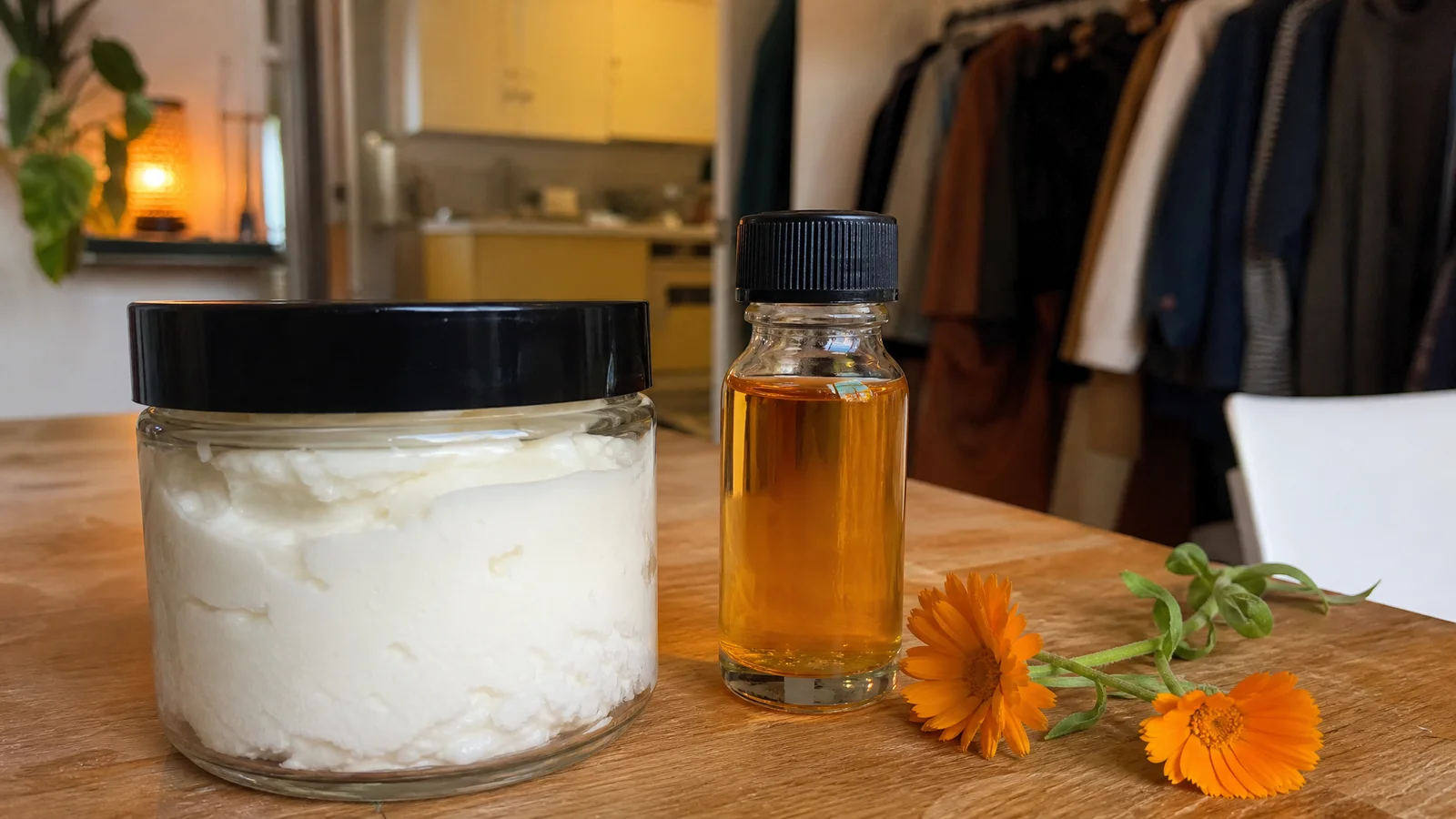
Our own small-batch calendula oil, in sizes from 0.5 oz to bulk.
From $13.99
Shop Calendula Oil →Why does each soaping oil need its own lye amount?
Cold process soap forms when oils react with lye (sodium hydroxide), and each oil needs its own amount. Soap Queen, the Bramble Berry blog, builds its recipes by weight and points makers to a lye calculator: enter your oil weights or percentages and it returns the lye and liquid amounts and the superfat level (Free Beginner's Guide to Soapmaking: Cold Process).
Our calendula oil is dried flowers extracted first and then brought into a carrier oil, so most of what reacts with lye is the carrier. Reasoning from how the calculation works, you would enter the carrier as the oil. We list the carrier on the batch paperwork, so ask us for it before you calculate anything. If you cannot find out what the carrier is, skip cold process for now and try melt-and-pour. In the finished bar, calendula oil is a named ingredient with a golden tint; we would not promise more than that.
Cold process soap steps and lye safety
- Suit up. The Poison Control center says to wear masks, goggles and gloves when working with lye, and calls pre-made melt-and-pour bases a safer option for home soapmakers (Is it safe to make soap at home?). Work in a ventilated space and keep kids and pets away.
- Calculate. Enter every oil, including the carrier from your calendula oil, and choose your superfat.
- Weigh everything. Oils, lye and water all go on a scale.
- Mix to trace and pour. Trace is the point where oils and lye water have emulsified into a thickened batter.
- Expect warmth. Soap Queen says soap can reach 180 F in the gel phase, so do not handle it bare-handed.
- Cure. Soap Queen notes cold process soap is technically safe to use after a few days but recommends curing 4 to 6 weeks in a cool, dry place with good airflow. Evaporating water makes harder, milder bars that last longer.
Melt-and-pour soap with calendula oil
Melt-and-pour starts from a premade base, so you skip the lye entirely, which is the whole charm. How much oil a base will take is the base maker's call, and we do not know a published figure, so read the instruction sheet that comes with your base and ask the supplier. The reasoning is simple: a base is formulated to a certain hardness, and extra liquid oil makes bars softer.
- Melt the base following its directions.
- Stir in a very small amount of calendula oil, changing one variable per test.
- Pour into a clean, dry mold and let it set fully.
- Wrap the bars and keep them dry.
Make one test bar first and see whether it unmolds cleanly and holds its shape for a week. Date the bars; you can judge older ones by sight and smell.
Setting up a soapmaking workspace safely
A calm soapmaking day starts before any oil is poured. Clear the counter, cover it with newspaper, and lay out your scale, molds, spatulas and measuring jugs. Put your gloves and goggles within reach, and keep a bottle of vinegar and a good supply of paper towels nearby for spills. Tie back your hair, wear long sleeves, and close the door on pets.
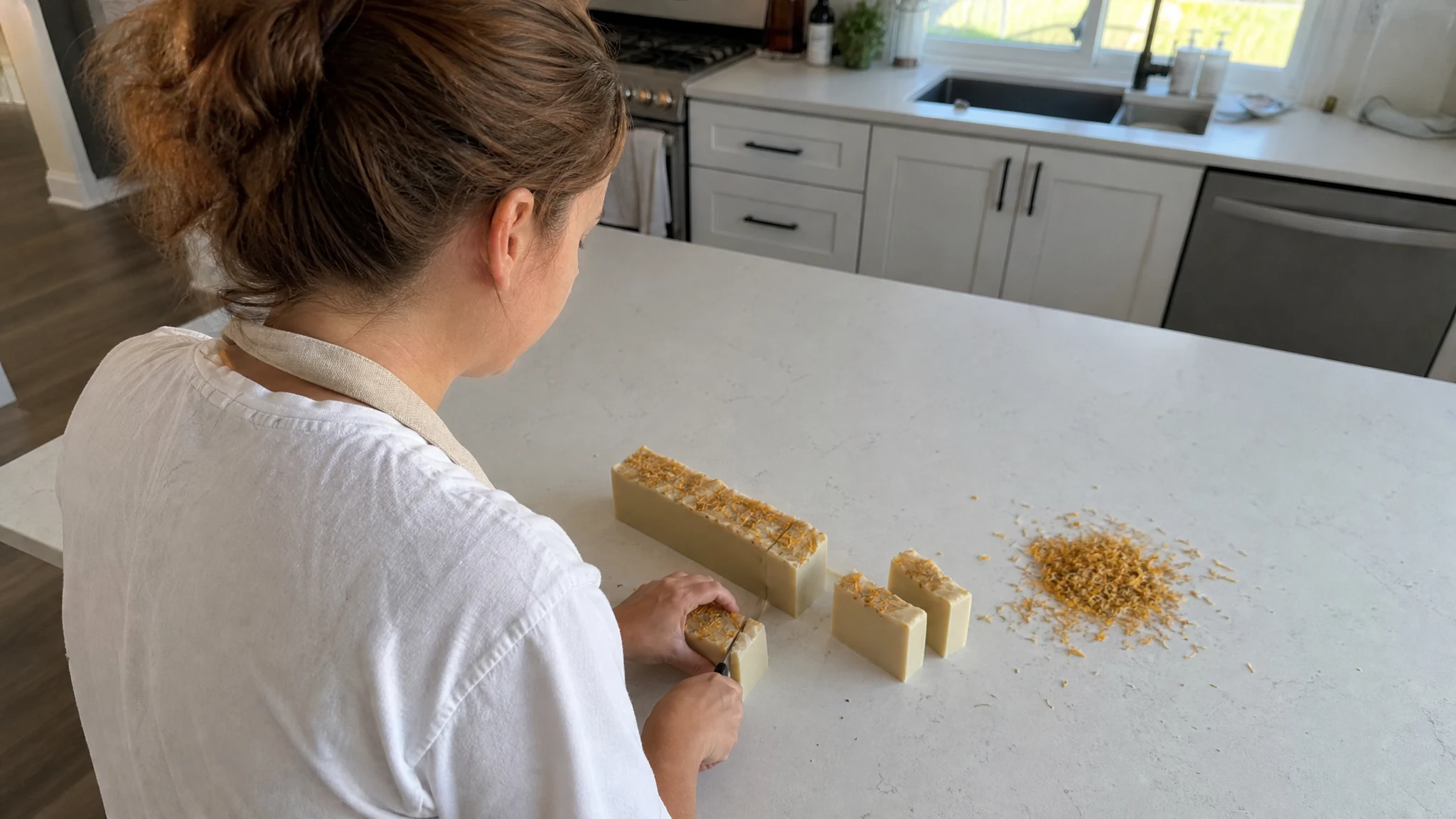
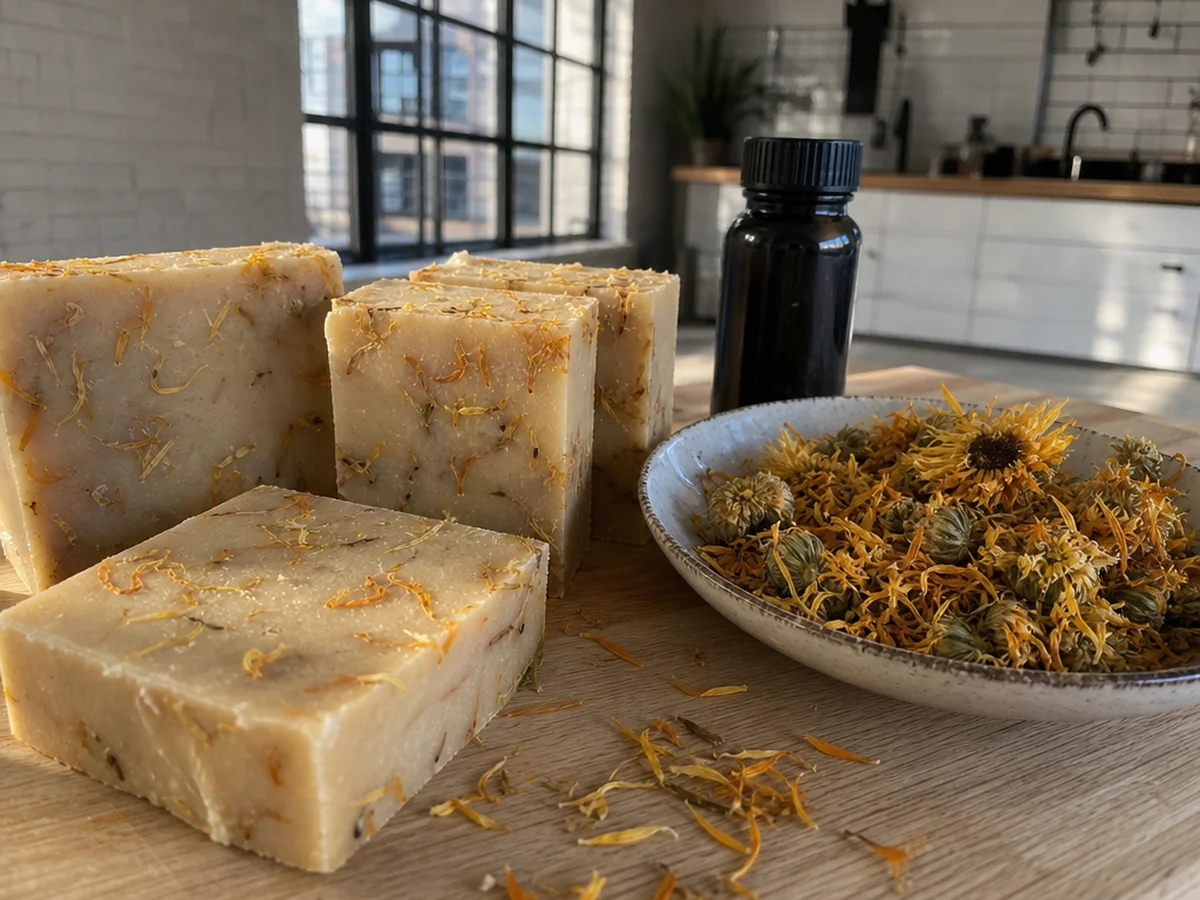
Take your time with the weighing. Soapmaking forgives a slow pace and punishes rushing. Read your recipe from start to finish once before you begin, and again when you are halfway through. When the bars come out of the mold, you will notice the golden tint, and a faint, mild aroma. It is a satisfying moment.
What belongs on a handmade soap label?
The FDA draws a line here that surprises many makers. A product counts as soap only if it is mostly alkali salts of fatty acids and is labeled, sold and represented solely as soap; such products fall under the Consumer Product Safety Commission. Once you add a moisturizing or fragrance claim, it is regulated as a cosmetic, and claims about treating conditions make it a drug (Is It a Cosmetic, a Drug, or Both? (Or Is It Soap?)). So for gifts and sales, "made with calendula-infused oil" is a clean, accurate line, and anything more should be checked against the rules.
Does calendula oil in soap replace leave-on care?
Soap is rinsed away, so a bar is a pleasant, golden way to wash and not a substitute for leave-on care. If you want calendula oil to stay on skin, a lotion bar or a drop of oil after the shower does the job better. Our pH article explains why an oil sits differently from soap.
Daisy-family allergy: who should skip calendula soap
Calendula is a daisy-family plant, and the EU herbal monograph lists hypersensitivity to Asteraceae plants as a contraindication (European Union herbal monograph on Calendula officinalis L., flos). If you give soap away, name calendula on the label, and if someone reacts, they should stop using it and see a dermatologist. Lye deserves real respect for first-timers, so melt-and-pour is a lovely place to begin.
Soapmaking rewards patience and careful measuring, and a golden bar of your own is worth the wait.
Calendula Oil
Nature's Golden Botanical, bottled: small-batch calendula oil in sizes from 0.5 oz to bulk.
From $13.99
Shop Calendula Oil →Sources & Further Reading
- Soap Queen (Bramble Berry). Free Beginner's Guide to Soapmaking: Cold Process. soapqueen.com
- Poison Control (National Capital Poison Center). Is it safe to make soap at home? poison.org
- U.S. Food and Drug Administration. Is It a Cosmetic, a Drug, or Both? (Or Is It Soap?) fda.gov
- European Medicines Agency, HMPC. European Union herbal monograph on Calendula officinalis L., flos. ema.europa.eu