The Sunmeadow Blend: Calendula Oil with Sweet Orange
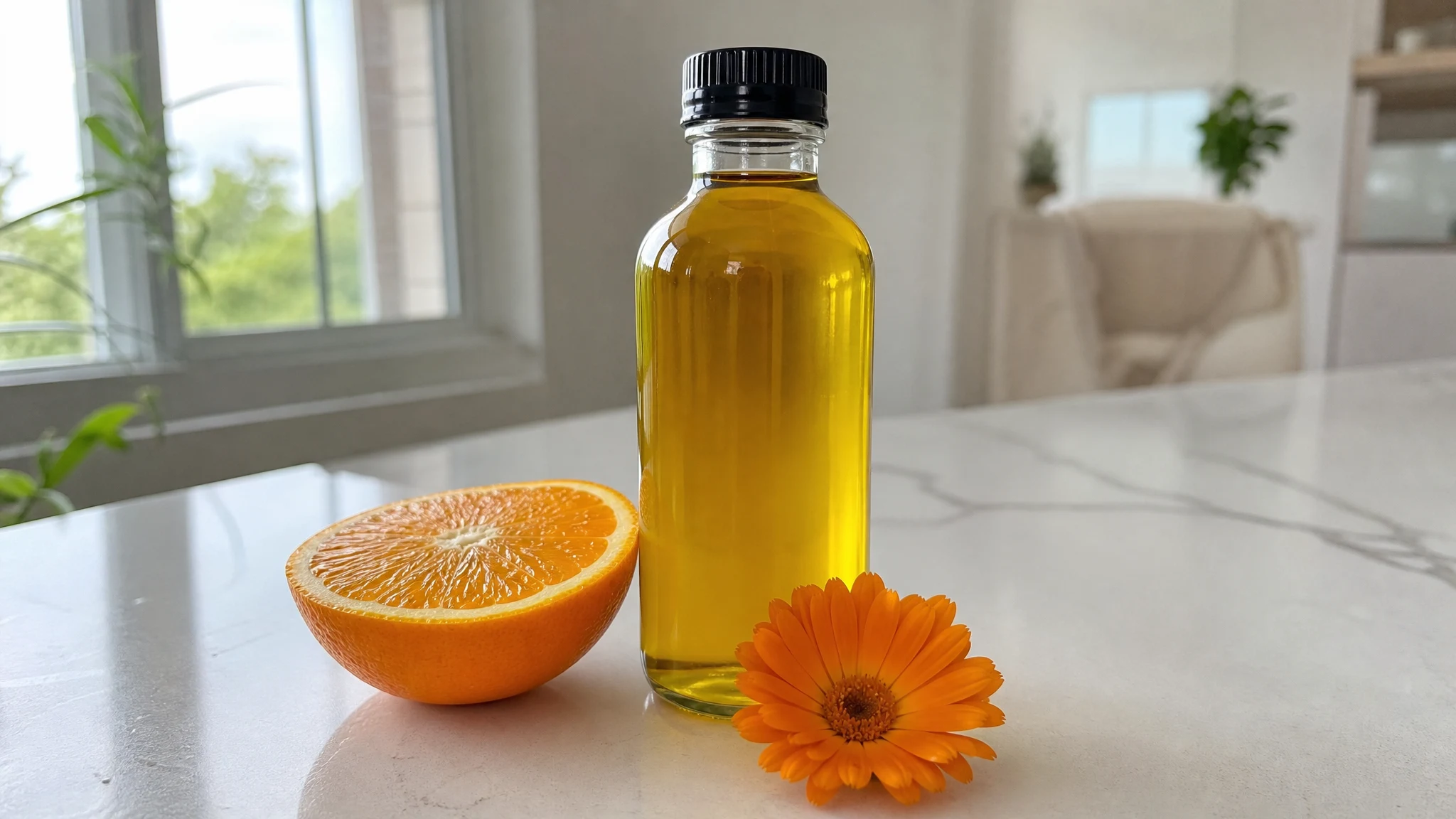
The Sunmeadow Blend is calendula oil with a hint of sweet orange, and the whole idea is restraint: the orange is a bright note on top of the calendula base, never the main event. If you have seen the blend described as 3:1, read that as a feel rather than a measuring spoon. Three parts oil to one part orange essential oil would be a 25% blend, and the arithmetic below shows why a few drops are all it takes.

Calendula Oil
Our own small-batch calendula oil, in sizes from 0.5 oz to bulk.
From $13.99
Shop Calendula Oil →How are essential oil dilutions calculated for drops?
Essential oil dilution is a percentage game. The Tisserand Institute publishes three working ranges: 0.2 to 1% for reactive or compromised skin, 0.5 to 1.2% for facial products, and 1 to 3% for body oils and lotions. The same page points out that "1 in 4" means 25%, which is much too concentrated for almost any use (Tisserand Institute, Dilution for essential oils). These ranges cover essential oils in general rather than orange in particular, and they are guidance, not law, but they are the clearest map we know of.
Here is how the percentages turn into drops. A 30 ml (1 oz) dropper bottle holds roughly 600 drops if you assume about 20 drops per milliliter, which shifts with the dropper and the oil, so treat every count as approximate. That makes 1% about 6 drops of sweet orange, and the rest of the bottle is calendula oil. These are our arithmetic, not results from a trial.
- Reactive skin, or a first try: 1 to 3 drops (about 0.2 to 0.5%).
- Face: 3 to 7 drops (about 0.5 to 1.2%).
- Body: 6 to 18 drops (about 1 to 3%).
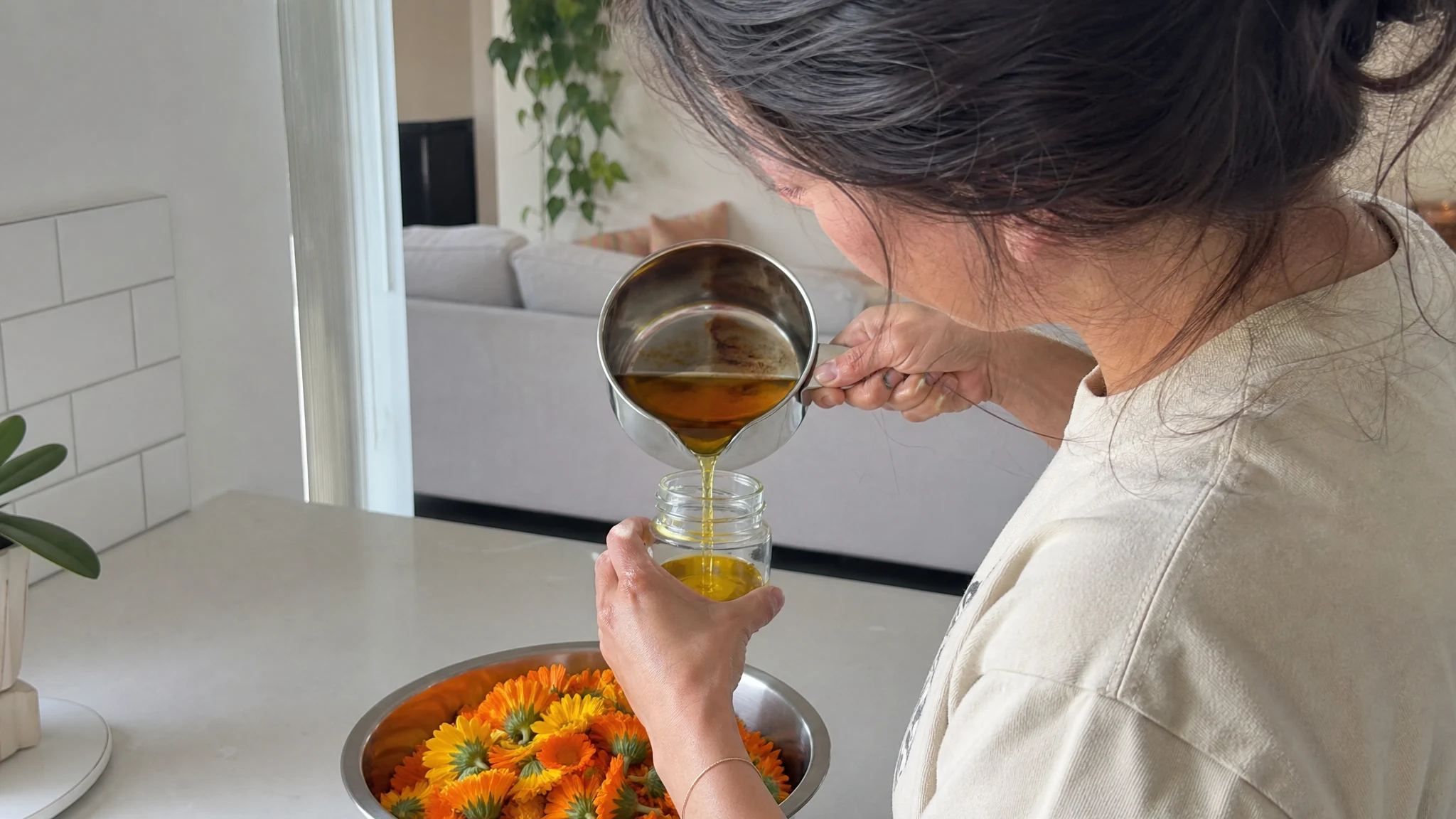
Citrus is the kind of aroma you notice the moment a bottle opens, so the low end of any row usually carries the scent comfortably. Add the drops to the bottle first, top it up with calendula oil, roll it gently between your palms, and write the date on the label.
Sweet orange essential oil: limonene and oxidation
Sweet orange oil is mostly limonene; one hydro-distilled sample came in at 96% (Antimycotic Activity and Genotoxic Evaluation of Citrus sinensis and Citrus latifolia Essential Oils). Fresh limonene is a weak allergen, but once it meets air it forms hydroperoxides, which are far stronger sensitizers (Limonene Hydroperoxides). In a patch-test study, unoxidized R-limonene was non-irritating at every concentration tried, while the oxidized form was more irritating (Air oxidation increases skin irritation from fragrance terpenes).
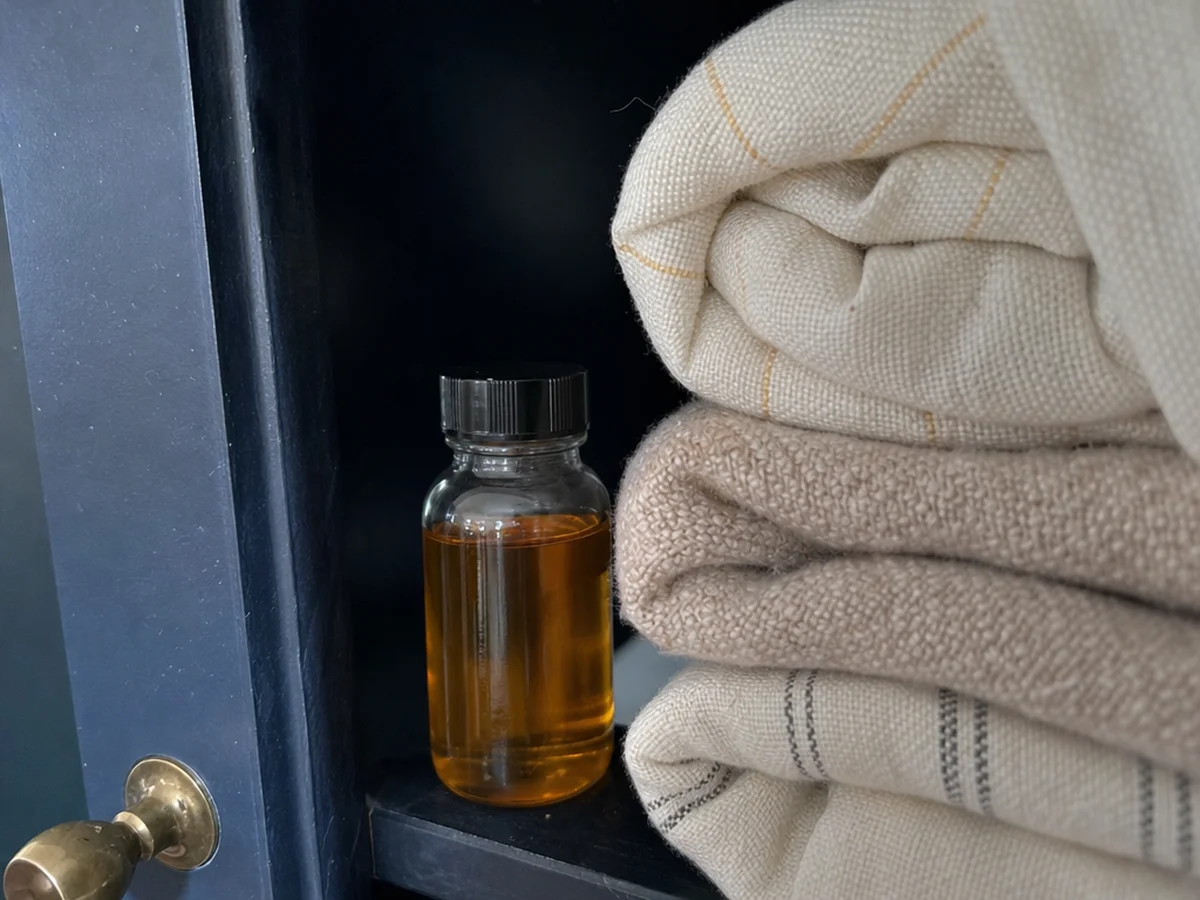
The practical lesson, reasoning from those studies, is that freshness matters more than the drop count. Buy a small bottle of orange oil, keep it capped in a cool, dark place, and retire it when the scent turns sharp or flat.
It also helps to know whether your orange oil is pressed from the rind or distilled. The Tisserand Institute explains that phototoxic citrus oils are expressed from the fruit rind because of furanocoumarins, and that sweet orange is generally thought not to be phototoxic even when expressed. Expressed grapefruit, by contrast, is slightly phototoxic (Citruses: a comparison of different oils). So this is a recipe for sweet orange, not a template for swapping in other citrus oils.
Calendula oil in the Sunmeadow blend: small batches
Our calendula oil has nothing added: no synthetic preservatives, no added tocopherol, no stabilizers. That is exactly what we want in a straight oil, and it is also a good reason to mix this blend in small amounts that you will use up, keep it closed, and keep it out of the light. Every bottle we sell is dated and lot-numbered, and if you would like the batch documentation, email the lot number to [email protected]. Our storage article covers keeping the base oil at its best.
What does the Sunmeadow blend smell like?
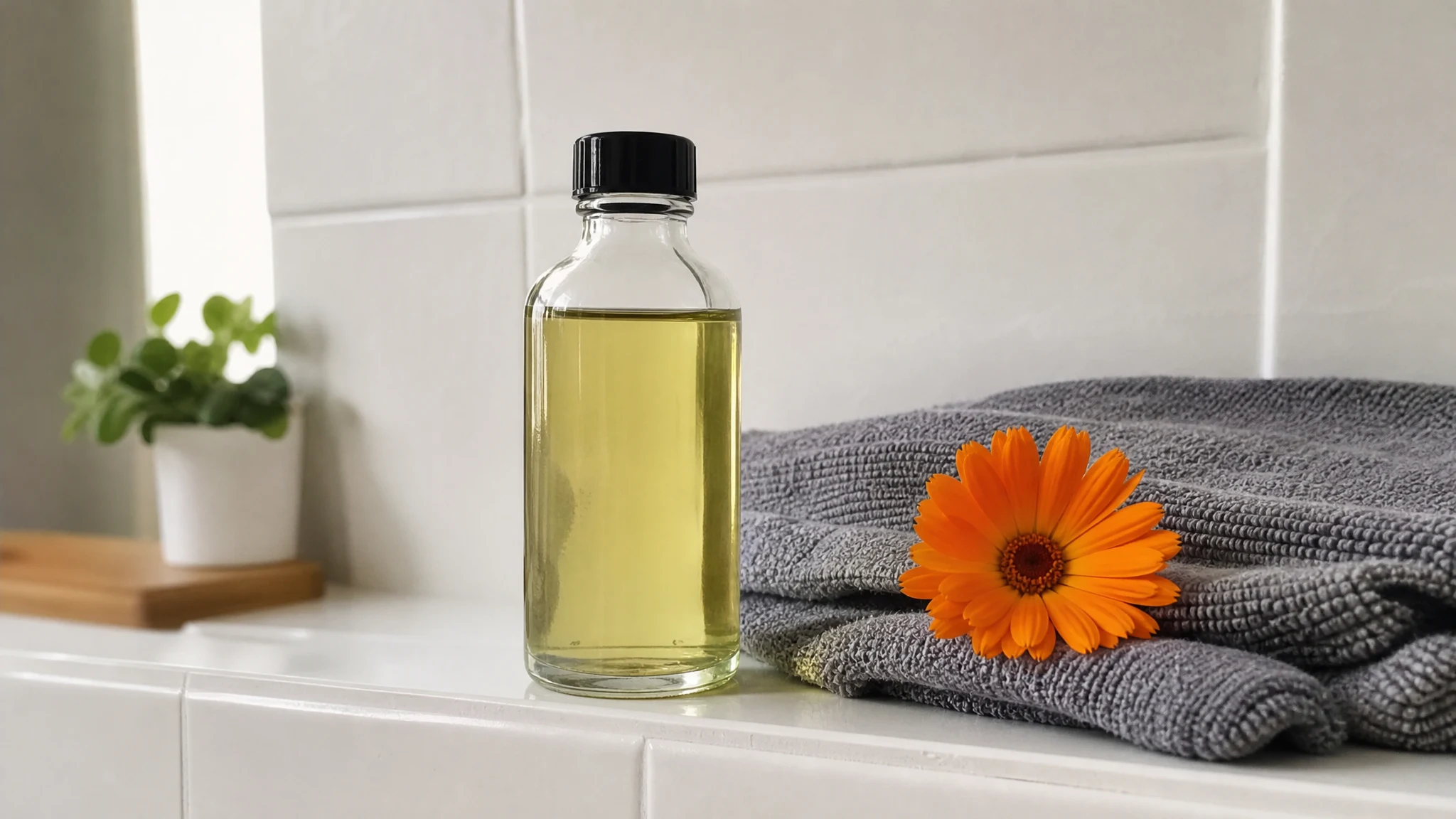
Open a bottle of the finished blend and the orange is the first thing you will notice, bright and sweet, with the calendula's soft herbal note settling in underneath. The oil keeps its golden color, perhaps a shade brighter than plain calendula in the light. It is a cheerful smell, but a small one, and it should stay that way.
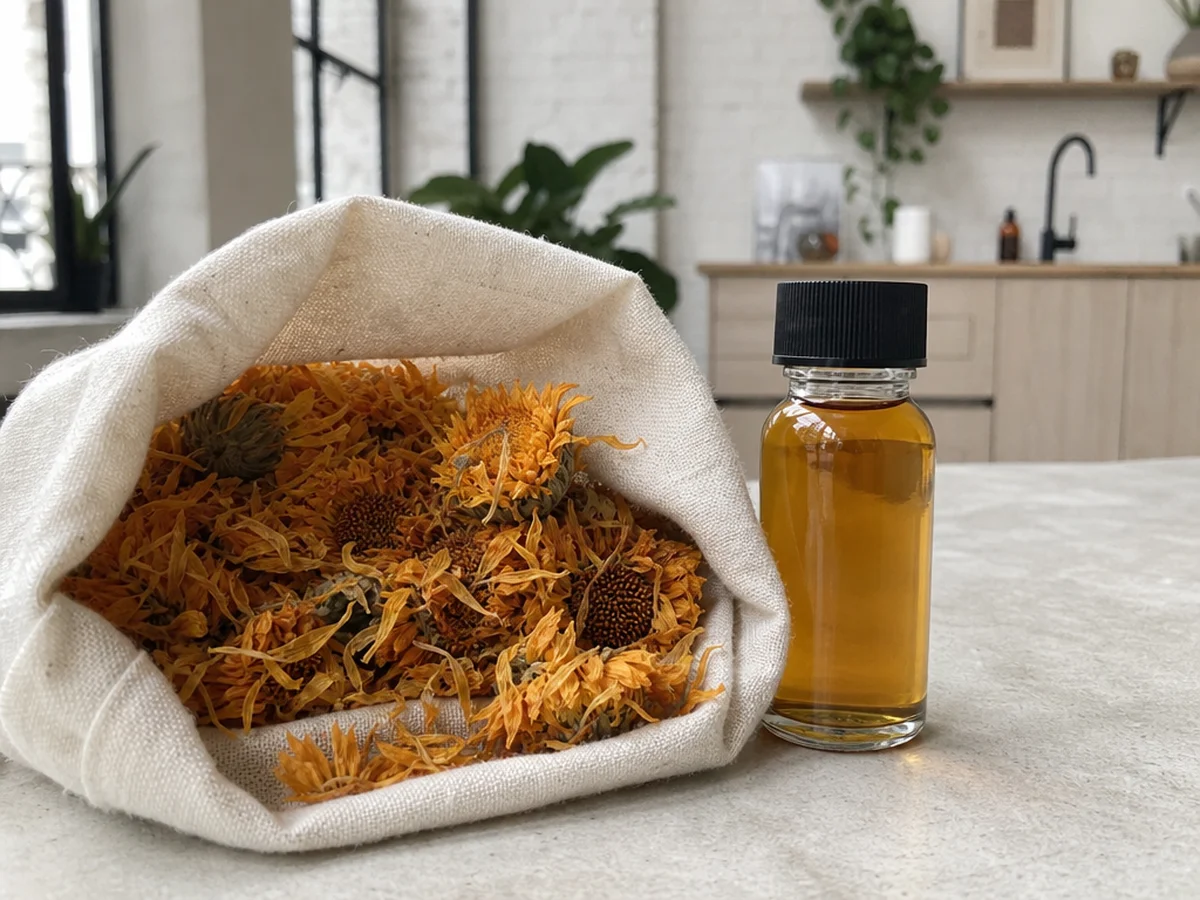
If you are making it as a gift, write the date and the approximate drop count on a label, so the person you give it to knows what is inside. Make a small bottle, enjoy it while it is fresh, and make another when it is gone.
Calendula officinalis and orange: patch test the blend
This blend stacks two things worth checking. Calendula belongs to the daisy family, and the European herbal monograph lists hypersensitivity to Asteraceae plants as a contraindication (European Union herbal monograph on Calendula officinalis L., flos). Orange adds a fragrance terpene on top. So test the finished blend rather than just the base oil. Among dermatologists who use the repeated open application test for leave-on products, twice daily on the forearm is the most common routine, and most continue for one or two weeks (Clinical Utilization of Repeated Open Application Test Among American Contact Dermatitis Society Members). Our patch test walkthrough shows how.
A few people are better off with plain oil. The same monograph does not recommend use during pregnancy or breastfeeding, or on skin under age 6, because the data are not sufficient, so an OB/GYN, midwife or pediatrician is the right person to ask. If you have eczema, broken skin or a history of fragrance reactions, unscented calendula oil removes a variable. And a scented human blend should not be shared with pets; ask a veterinarian.
If you would like to explore scenting further, our guide to blending calendula oil with essential oils covers the wider options. Think of the Sunmeadow Blend as a few drops of sunshine in a golden oil, and know that plain calendula oil is always a lovely answer too.
Calendula Oil
Nature's Golden Botanical, bottled: small-batch calendula oil in sizes from 0.5 oz to bulk.
From $13.99
Shop Calendula Oil →Sources & Further Reading
- Tisserand Institute. Dilution for essential oils.
- Tisserand Institute. Citruses: a comparison of different oils.
- Ruiz-Perez NJ et al., 2016. Antimycotic Activity and Genotoxic Evaluation of Citrus sinensis and Citrus latifolia Essential Oils.
- de Groot A, 2019. Limonene Hydroperoxides. Dermatitis.
- Bråred Christensson J et al., 2009. Air oxidation increases skin irritation from fragrance terpenes. Contact Dermatitis.
- Brown GE et al., 2015. Clinical Utilization of Repeated Open Application Test Among American Contact Dermatitis Society Members. Dermatitis.
- European Medicines Agency, 2018. European Union herbal monograph on Calendula officinalis L., flos.