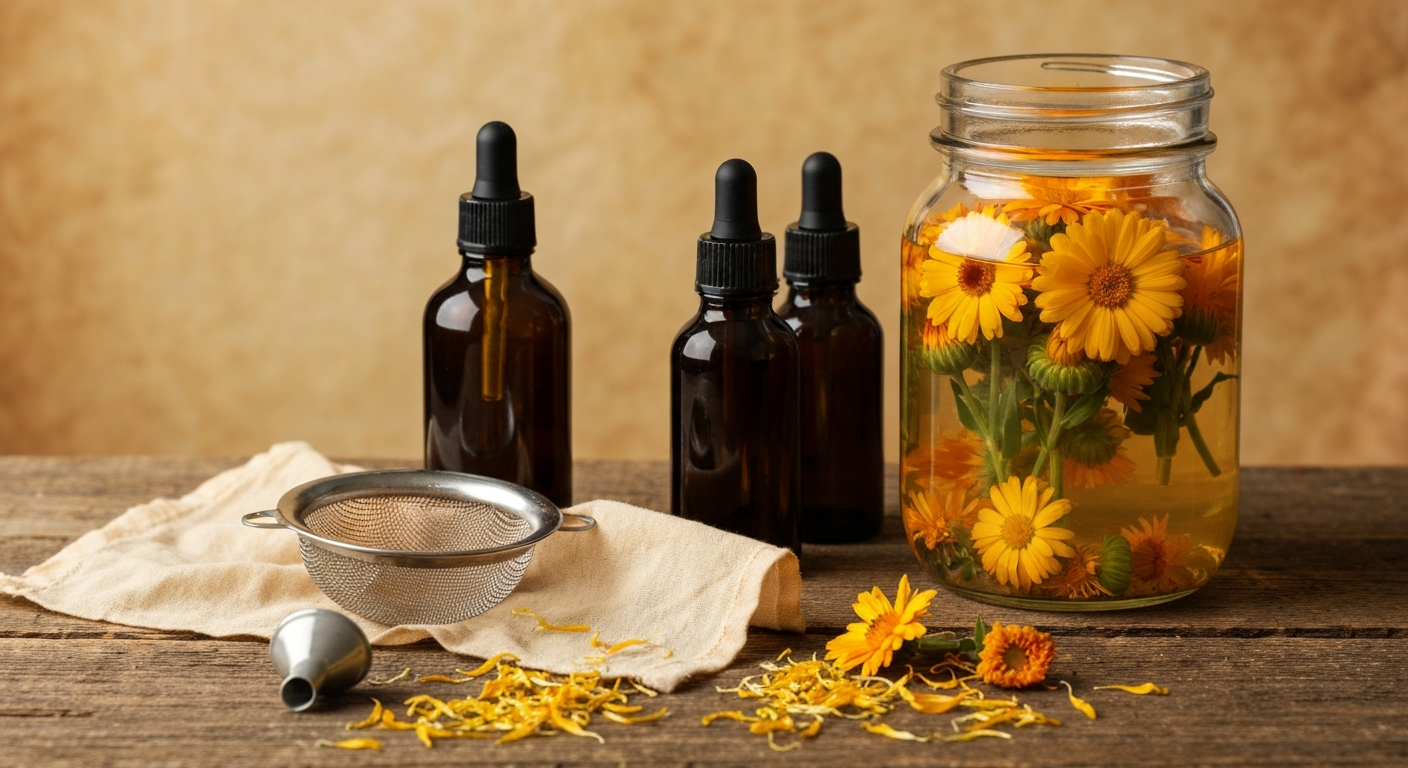
Calendula Tincture vs Calendula Oil: What You Can Make
"Calendula oil tincture" mixes up two different preparations, and the difference decides what you can safely make. A tincture is calendula flowers extracted in strong alcohol; calendula oil, the kind we make, is flowers extracted into a carrier oil. They are not interchangeable, and our oil is a skin oil, not an ingredient for a drinkable tincture. Here is what each one is, what is sourced about making them, and where the sources stop.

Calendula Oil
Our own small-batch calendula oil, in sizes from 0.5 oz to bulk.
From $13.99
Shop Calendula Oil →Step one: decide which product you actually want
Three questions sort this out quickly.
- Do you want something for the skin? Then you want an oil infusion, and you can buy one or make one. Skip to the oil section.
- Do you want an alcohol extract for a rinse, a compress or your own formulating? Then you want a tincture, and the one sourced definition is below.
- Do you want to swallow it? Then no recipe on this page is for you, for reasons in the internal-use section. Talk to a pharmacist or physician.
What a tincture is, by an actual regulator's definition
The EU herbal monograph for calendula flower lists the preparations that count as traditional herbal medicines. A tincture is listed at a drug-to-extract ratio of 1:5, with the extraction solvent ethanol at 70-90% (V/V). Liquid extracts at 1:1 and about 1:2 use ethanol at 40-50%. A separate entry, "liquid extract (1:10)," uses a fatty vegetable oil such as olive oil as the solvent (EMA/HMPC, 2018). So even in the regulator's vocabulary, oil and ethanol are separate extracts, not one product. If you see a 1:5 tincture quoted at 40-60% ethanol elsewhere, that is not what this monograph says: its 1:5 tincture is at 70-90%.
Two cautions about that source. First, it describes licensed traditional medicines, not instructions for home use. Second, the EMA bases those products only on long-standing use: its 2018 assessment judged most calendula skin studies small and methodologically weak, and concluded the evidence did not support a "well-established use" claim (EMA/HMPC assessment report, 2018).
Making an alcohol tincture, and what is missing from the sources
If you want a tincture for external formulating, the sourced parts are: use dried flowers, weigh them, and combine them with ethanol at 1 part flowers to 5 parts extract solvent, with the alcohol at 70-90%. Strain once the extraction is done and store it in a closed bottle away from light and heat. The monograph also lists a 2% solution of the tincture for mouth and throat use (age 12 and up), which is a medicinal use and not something to improvise at home.
What we could not source: how long to steep, what shaking schedule to use, and how long a finished tincture keeps. We found no authoritative document in our library that states them, and we would rather leave the gap visible than hand you a number from a blog. If you are making a tincture to sell or to formulate into a product, the steeping time is a decision the maker has to test and document, not copy.
Ethanol at those strengths is flammable, so work away from open flame and keep the bottle away from children. We have not written a step on "adding calendula oil to a tincture," because oil and a 70-90% alcohol do not form a single stable liquid. That is reasoning from basic solvent behavior, not a tested result, so if you need a combined product, ask a formulator.
Making the oil infusion instead
This is a different route from the one in this article's title, and it is the one that fits skin use. The EU monograph lists the oil extract at 1:10 in a fatty vegetable oil, olive oil being the example, and the EMA assessment report says peanut oil, also cited in the literature, is not recommended because of a higher probability of adverse reactions (EMA/HMPC assessment report). Home methods are covered in detail in our home infusion guide and the three-method comparison; the key safety point is to use dried flowers. University of Maine Cooperative Extension calls dried herbs the safest choice for infused oils because they lack the moisture Clostridium botulinum needs, and advises against fresh plant material without food-processing review (UMaine Extension, Bulletin 4385). That bulletin is written for culinary oils, so applying it to cosmetic oils is an extrapolation, but it is the cautious one.
When we make our own oil, we do it in two stages: calendula alone is extracted first, with nothing else in that extraction, and that extract is then brought into a carrier oil. We buy dried flowers, separate the petals by hand from sound, whole-dried heads, and make the oil in-house from dried flower to sealed bottle. Nothing is added afterward. We mention the process only so you can compare it to a home batch: the basic idea is the same, dried material in oil, with the addition of batch documentation (email the lot number to [email protected]).
Internal use: what the sources say, and why we stop here
This is where the title promises more than the evidence can carry. Here is what exists:
- The EU monograph's skin use is not recommended under age 6, and for pregnancy and lactation it says safety has not been established and use is not recommended. It lists hypersensitivity to Asteraceae plants as a contraindication (EMA/HMPC, 2018).
- Memorial Sloan Kettering's herb page says it is generally safe in food and tea, advises talking to a healthcare provider before taking supplements, and advises against it during pregnancy or breastfeeding (MSK, About Herbs, 2023).
- NIH's LactMed states that no information is available on oral calendula during breastfeeding and that calendula is generally recognized as safe as a food seasoning or flavoring (LactMed, 2021).
None of those gives an oral dose for a homemade tincture. We found no source that does, and we do not make internal-use claims for our oil, which is sold for skin. The FDA also draws the line by intended use: a cosmetic is applied to the body for cleansing or beautifying, and products intended to affect the body's structure or function are regulated differently (FDA, Cosmetics & U.S. Law). If someone offers you a calendula "internal" product, check what the label claims and who made it. Our internal-use FAQ goes through the same question from the buyer's side.
A short safety list
- Allergic to ragweed, chamomile, daisies or chrysanthemums? Skip calendula, or see an allergist first. Reider and colleagues found about 2% of 443 patch-tested dermatitis patients (clinic patients, not the general public) reacted to marigold (Reider et al., 2001). See our allergy FAQ.
- Pregnant, breastfeeding, or giving anything to a child: ask an OB/GYN, midwife or pediatrician first.
- On medication or managing a medical condition: ask a pharmacist before taking any herbal product.
If what you really wanted was a skin oil, the sourced route is the infusion, or a bottle of ours. Details on sizes are on the shop page.
Calendula Oil
Nature's Golden Botanical, bottled: small-batch calendula oil in sizes from 0.5 oz to bulk.
From $13.99
Shop Calendula Oil →Sources & Further Reading
- EMA/HMPC, 2018. European Union herbal monograph on Calendula officinalis L., flos. ema.europa.eu
- EMA/HMPC, 2018. Assessment report on Calendula officinalis L., flos. ema.europa.eu
- University of Maine Cooperative Extension. Safe Homemade Flavored and Infused Oils, Bulletin 4385. extension.umaine.edu/publications/4385e
- Memorial Sloan Kettering Cancer Center, 2023. Calendula (About Herbs). mskcc.org
- Drugs and Lactation Database (LactMed), 2021. Calendula. pubmed.ncbi.nlm.nih.gov/30000917
- FDA. Cosmetics & U.S. Law. fda.gov
- Reider N et al., 2001. The seamy side of natural medicines. pubmed.ncbi.nlm.nih.gov/11722485