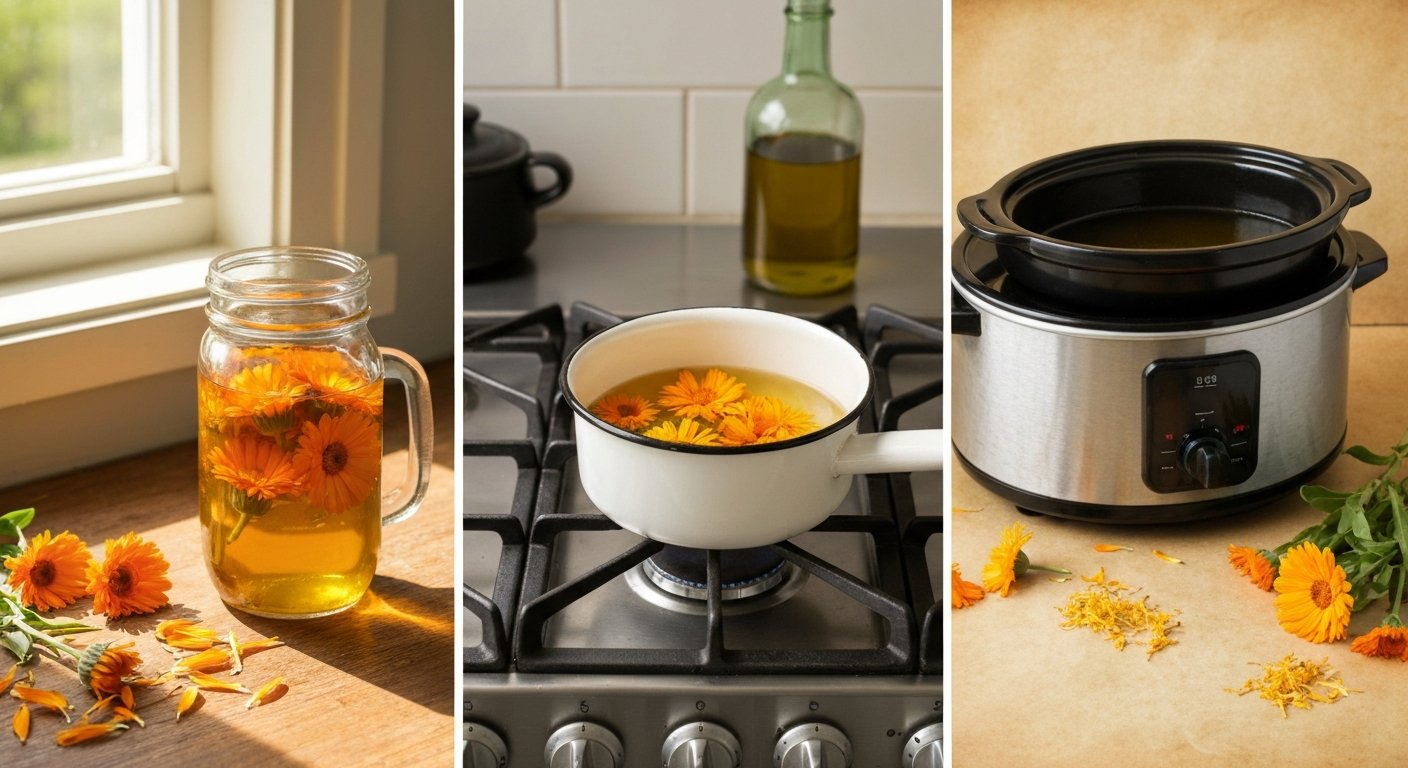
How to Make Calendula-Infused Carrier Oil in 3 Methods
The three common ways to infuse calendula into a carrier oil are a room-temperature jar, a long warm infusion in a double boiler, and a short lab-style maceration at a fixed ratio. They do not differ much in what ends up in the bottle; they differ in time, how much you have to trust your own judgment about heat, and what can go wrong. Reasoning from the published numbers, the weighed, cool, short version is the easiest to repeat at home, and the warm double boiler is the easiest to get wrong.

Calendula Oil
Our own small-batch calendula oil, in sizes from 0.5 oz to bulk.
From $13.99
Shop Calendula Oil →What the three have in common, and what to settle first
All three need dried flowers and a clean, dry jar. University of Maine extension calls dried herbs the safest way to make infused oils because dryness leaves bacteria little to grow on (University of Maine Cooperative Extension, Bulletin 4385). That guidance is for food oils, so for a cosmetic oil it is an extension of the principle, not a calendula-specific finding. We build our own oil from dried flowers, and we use petals separated by hand from sound, whole-dried flower heads rather than broken florets. Petals are where the pigment is: in one orange cultivar, carotenoids measured 103.8 mg/100 g fresh weight in petals against 8 mg/100 g in the tubular centre (Pintea et al., Acta Biologica Szegediensis, 2003). If you are starting from whole heads, expect to be buying a lot of low-pigment centre.
Carrier choice is a separate decision, covered in the carrier oil comparison. For all three methods the EU monograph's example solvent is olive oil (EMA/HMPC, 2018).
Method 1: the jar on the shelf (4-6 weeks, no added heat)
Fill a glass jar two-thirds with dried flowers, cover with oil by at least an inch, cap it, shake daily, and strain after 4 to 6 weeks (Mountain Rose Herbs). It is forgiving, because nothing is hot, and it is the method most likely to give the same result twice. The costs are time and flower: reasoning from the weights in Method 3, a two-thirds-full jar is far more flower per gram of oil than the EU's 1:10, so you are paying in flower for speed and depth of colour. And the sources conflict on windowsills: Mountain Rose recommends a warm sunny one, while light is a recognised driver of oil oxidation (Gharby et al., Food Chemistry X, 2025). Reasoning from both, warmth without direct sun is the better compromise, but nobody has tested that for calendula.
Method 2: the double boiler (hours, low-to-medium heat)
Soap-making educators describe low-to-medium heat in a double boiler for at least 4 hours and up to 2 days, with the oil just covering the petals, the stove off whenever you are away, then straining through cheesecloth or a coffee filter (Soap Queen, Bramble Berry). The source gives no temperature, and we could not find a verified temperature for slow-cooker or oven versions, so we will not give you one. What we can say is that heat has a cost: carotenoids in oil degrade faster as temperature rises, though the study ran at 120-180 C, nothing like an infusion (Achir et al., Eur J Lipid Sci Technol, 2010). The EU assessment report describes warm digestion on a water bath, for up to 16 hours, for fat-based ointment extracts, again without a temperature (EMA/HMPC, 2008, superseded). Our practice is the opposite end: the flowers we buy are dried naturally by traditional methods, with no industrial heat or forced air, and we extract calendula alone before bringing the extract into a carrier. We do not publish the infusion conditions here.
The hazard of this method is yours to manage: hot oil, a pan left on a burner, and a long unattended heating time. Treat it as a kitchen task requiring attention, not a set-and-forget one.
Method 3: weigh it and keep it short (the lab-style version)
This is the one with the best numbers behind it, and the least romance. A 2005 comparison of marigold oil extracts reported the highest carotene content, 57.5 mg/kg as beta-carotene, from a 72-hour room-temperature maceration of flowers in olive oil at 1:5 by weight (Novkovic et al., Hemijska industrija, 2005). Only the abstract is available to us, so the other conditions (including the 70 C maceration and percolation it also tested) are not something we can quote. Our translation of that into a home batch, not a protocol the paper states: 40 g of dried flowers to 200 g of oil, stirred or shaken now and then for 3 days, then strained. For comparison, the EU monograph lists oil extracts at 1:10 (20 g per 200 g). These ratios are weights; the monograph states no time or temperature for the oil extract.
A second lab-scale result points the same direction on carrier choice: a Chilean agronomy thesis found 30-day uptake of carotenoids from dried petals differed by oil, with rosehip and avocado highest of four tested (Molina Garcia, Universidad de Concepcion, 2024). It is one undergraduate thesis, not peer reviewed, so the practical reading is only that the carrier changes the colour you get, not which carrier to pick.
Which one to choose
| If you... | Choose | Why |
|---|---|---|
| want a repeatable result with minimal risk | Method 3, then strain and bottle | Fixed ratio by weight and a short, cool steep |
| have flower to spare and patience | Method 1 | No added heat; most forgiving |
| need it faster than a few days | Method 2, with attention | Hours, but you manage the heat and the burner |
After any method: strain, label, store, and know the limits
Strain, let the oil settle, bottle it in a clean dry container, and write the date on it. University of Maine says to use homemade infused oils within three months; Soap Queen says 6 months to a year depending on the carrier. They cover different materials, so take the short number unless you can test the oil. Cloudiness, water droplets or mould mean moisture got in; discard the batch.
None of these is a tested product. Ours is: every batch goes to independent third-party labs, and the documentation is available on request (email the lot number to [email protected]). And no method makes the oil safe for someone who is allergic: calendula is in the daisy family, and the EU monograph lists hypersensitivity to Asteraceae as a contraindication and says safety in pregnancy and breastfeeding is not established (EMA/HMPC, 2018). Patch test first, and ask a dermatologist about anything persistent.
For the start-to-finish version with storage and safety detail, see how to make calendula oil at home. If you would rather not make it, our calendula oil is the product of the process described on where it comes from.
Calendula Oil
Nature's Golden Botanical, bottled: small-batch calendula oil in sizes from 0.5 oz to bulk.
From $13.99
Shop Calendula Oil →Sources & Further Reading
- University of Maine Cooperative Extension, n.d. Safe Homemade Flavored and Infused Oils (Bulletin 4385). extension.umaine.edu/publications/4385e
- Pintea et al., 2003. HPLC analysis of carotenoids in four varieties of Calendula officinalis L. flowers. Acta Biologica Szegediensis. abs.bibl.u-szeged.hu
- EMA/HMPC, 2018. European Union herbal monograph on Calendula officinalis L., flos. ema.europa.eu
- EMA/HMPC, 2008. Assessment report on Calendula officinalis L., flos (superseded version). ema.europa.eu/herbal-report
- Mountain Rose Herbs. Calendula Uses + Infused Olive Oil Recipe. blog.mountainroseherbs.com
- Soap Queen (Bramble Berry). Infusing Oil. soapqueen.com
- Gharby et al., 2025. Vegetable oil oxidation: mechanisms, impacts on quality, and approaches to enhance shelf life. Food Chemistry X. PMC12146556
- Achir et al., 2010. Kinetic study of beta-carotene and lutein degradation in oils during heat treatment. Eur J Lipid Sci Technol. doi.org/10.1002/ejlt.200900165
- Molina Garcia FJ, 2024. Extraccion de carotenoides y polifenoles totales de petalos de Calendula officinalis L. mediante oleo maceracion. Undergraduate thesis, Universidad de Concepcion. repositorio.udec.cl
- Novkovic et al., 2005. Determination of total lipids and characterization of marigold flower extracts. Hemijska industrija. doi.org/10.2298/HEMIND0510254N