Calendula for Wound Healing: What Clinical Studies Show
Few botanicals have earned as long a place in traditional skin care as calendula. The cheerful orange flower is pressed into oils, infused into salves, and woven into folk practice across centuries. It has recently attracted genuine scientific curiosity. Researchers are beginning to examine what calendula actually contains, how those compounds behave in laboratory and clinical settings, and what that might mean for everyday skin support.
This article takes a careful, evidence-informed look at calendula clinical studies, unpacks the relevant phytochemistry, and situates the findings honestly within their limitations. The goal is clarity, not hype.
A Brief Portrait of the Plant
Calendula officinalis, commonly called pot marigold, belongs to the Asteraceae family. It has been cultivated across Europe, North Africa, and western Asia for well over five hundred years. Traditional European herbalism used calendula preparations topically for all manner of skin concerns, a practice documented in texts reaching back to the twelfth century.
What makes calendula botanically distinctive is the density of bioactive constituents concentrated in its flower heads. These include triterpenoid saponins (most notably oleanolic acid glycosides), flavonoids such as isorhamnetin and quercetin, carotenoids that give the petals their signature golden-orange color, polysaccharides, and a modest collection of essential oil compounds. Each class of compound has attracted researchers for different reasons.
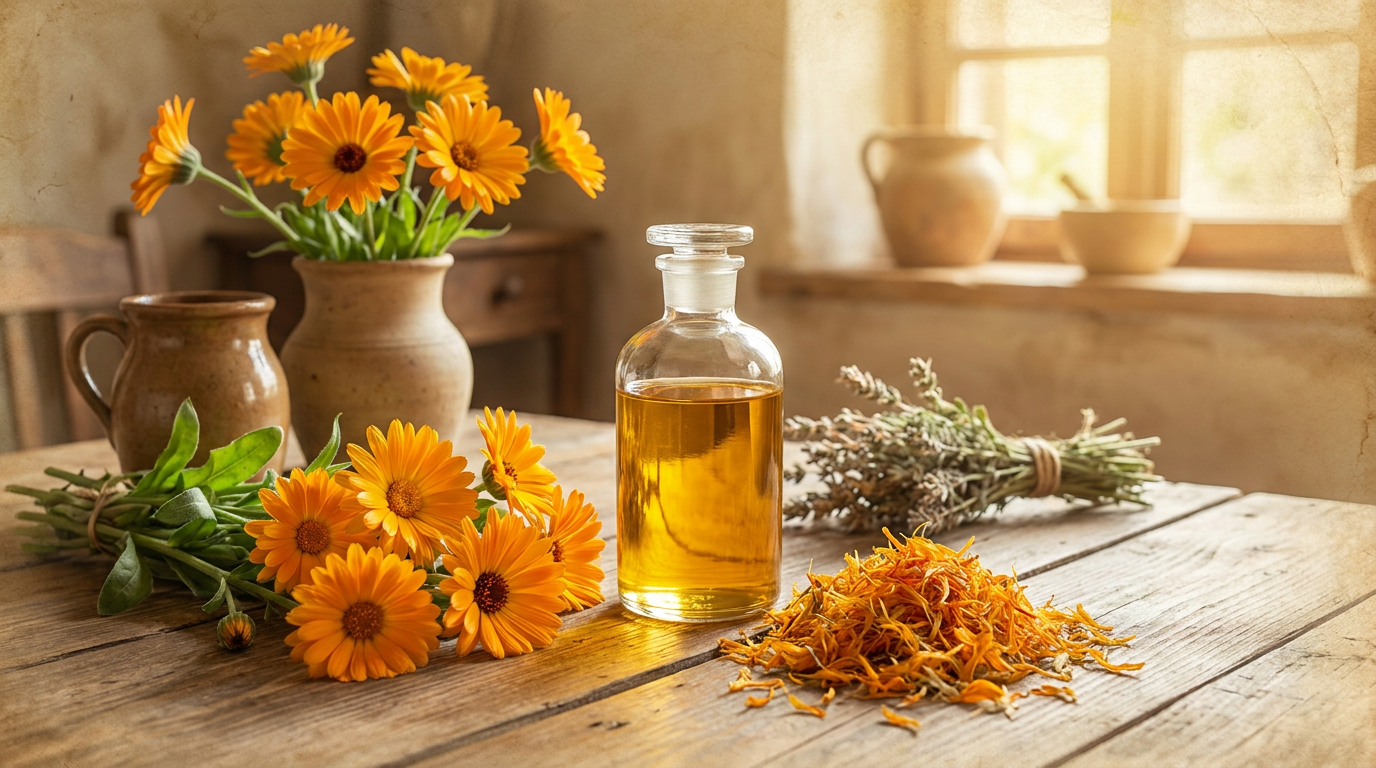
Calendula oil, as used in skin care, is typically a carrier oil infusion rather than a steam-distilled essential oil. Dried or fresh petals are macerated in a base oil (sunflower, olive, or jojoba are common choices), which draws the fat-soluble constituents, particularly the carotenoids and triterpenoids, into suspension. The resulting oil carries a warm, faintly herbaceous scent and a golden hue that reflects its carotenoid content.
What Laboratory Research Has Explored
Before reaching human clinical work, calendula has been studied extensively in in-vitro (cell-based) and in-vivo (animal model) settings. These studies help researchers form hypotheses and identify the most promising constituent pathways to investigate further.
Triterpenoids and Tissue Response
Several laboratory studies have focused on the triterpenoid fraction of calendula extracts. Triterpenoids are a large class of compounds found across the plant kingdom, and calendula's specific profile has been associated in cell studies with modulation of certain biological signaling pathways. Some researchers have proposed that these compounds may influence how skin cells behave during the early stages of a surface wound response, though the mechanisms remain an active area of inquiry.
A study published in the Journal of Ethnopharmacology examined calendula extract on keratinocyte (skin cell) migration in vitro. The researchers observed that cells exposed to the extract migrated more quickly across a simulated wound gap compared to the control group. The authors noted this as a preliminary finding warranting further investigation in clinical models. It is worth emphasizing that in-vitro results do not automatically translate to equivalent outcomes in living human skin.
Carotenoids and Skin Environment
The carotenoid content of calendula, including lutein and beta-carotene precursors, has attracted attention in the context of oxidative stress on skin tissue. Some research suggests that carotenoid-rich botanical preparations may support the skin's surface environment by interacting with free radicals, which are generated during normal cellular activity and in greater quantities when skin is under stress. Again, these are observations from controlled laboratory conditions, and their real-world significance requires more study.
Polysaccharides and Moisture Support
Calendula's water-soluble polysaccharides, which do not transfer readily into oil infusions but appear in aqueous extracts and hydrosols, have been studied for their potential influence on skin hydration and surface barrier function. Some researchers have suggested these compounds may interact with surface receptors involved in moisture regulation. This line of research is still early-stage.
Human Clinical Studies: What the Evidence Suggests
Moving from laboratory work to human clinical trials introduces much greater complexity. Studies on calendula wound healing in human subjects are relatively limited in number, often small in scale, and vary considerably in methodology. With that context clearly in place, here is a fair summary of what has been published.
Post-Surgical Skin Recovery
One of the more frequently cited clinical investigations compared calendula ointment against a conventional preparation in patients recovering from surgical incisions. The study, conducted across a defined post-operative period, found that participants using the calendula formulation showed measurable differences in the rate of surface tissue closure compared to the control group. The researchers described the difference as statistically notable, though they appropriately called for larger-scale replication before drawing firm conclusions.
It is important to note what studies like this measure: surface tissue behavior under observation. They do not establish that calendula alone caused a specific outcome, particularly when formulations contain multiple ingredients alongside the botanical extract.
Calendula in Radiation Skin Support
A notable clinical trial, published in the Journal of Clinical Oncology, examined skin responses in patients receiving radiation as part of breast cancer care. Participants were assigned either a calendula-based preparation or a standard moisturizing product. The calendula group reported lower levels of acute skin discomfort, and observers recorded differences in the appearance of the treated skin area. This study received substantial attention in botanical research circles, though commentators have noted limitations including differences in application method between the two groups.
This research is often referenced when discussing calendula clinical studies, and it is genuinely significant as a piece of preliminary evidence. It is not, however, a definitive proof of efficacy. The authors themselves framed it as supportive of further research.
Calendula for Cuts and Minor Surface Abrasions
Smaller observational studies and case series have explored calendula preparations applied to minor surface abrasions and cuts. These reports generally describe positive user experiences and observed changes in surface appearance over the application period. Because observational studies lack control groups, it is not possible to determine from them alone how much of any observed change is attributable to the calendula preparation versus time, basic moisture, or other factors.
The honest summary is this: current human clinical evidence is promising enough to justify continued research, but not yet robust enough to support strong efficacy claims. Researchers working in this space consistently call for larger, better-controlled randomized trials.
How Calendula Oil Fits Into a Skin Care Routine
Given the research landscape, how might a person thoughtfully incorporate calendula oil into their everyday skin care practice? The key is framing it correctly: as a botanical skin support, not as a substitute for medical attention when that is warranted.
Calendula oil is well-suited to a gentle daily ritual. Its texture is generally light to medium depending on the carrier base, and it absorbs without a heavy residue in most formulations. Many people include it in their post-cleansing routine, applying a few drops to slightly damp skin to help the oil distribute evenly.
For anyone interested in using calendula oil to support the appearance of skin around minor surface irritations or small cuts that are already on the mend, there are a few practical considerations worth keeping in mind.
Practical Guidance and Safety Notes
- Patch test first. Calendula belongs to the Asteraceae family. People with known sensitivities to plants in this family (including ragweed, chrysanthemums, or daisies) may experience a skin response. Apply a small amount to the inner forearm and wait 24 hours before broader use.
- Use only on minor, superficial skin concerns. Calendula oil is not appropriate for deep wounds, puncture injuries, infected-appearing skin, or any skin issue that has not been assessed by a qualified healthcare provider. When in doubt, consult a professional.
- Check your formulation. If you are using a calendula-infused carrier oil rather than a pure essential oil, the dilution is typically built in. If you are blending your own preparation using highly concentrated extracts, follow formulation guidelines carefully and keep concentrations appropriate for topical use (generally 1 to 3 percent for sensitive skin applications).
- Store correctly. Calendula oil is susceptible to oxidation. Store it in a dark glass bottle, away from heat and light, and note the recommended use-by period from your supplier.
- Consult a healthcare provider. If you have a skin condition under medical supervision, or if you are taking any medications, discuss new topical preparations with your provider before adding them to your routine.
Sourcing and Quality: Why It Matters for Research Relevance
One underappreciated point in interpreting calendula clinical studies is that formulation quality varies enormously. The concentration of active constituents in a calendula preparation depends on the growing conditions of the flowers, the extraction method, the carrier oil used, and the manufacturing standards of the producer. A study conducted with a standardized, high-triterpenoid extract may not reflect what a randomly selected commercial product delivers.
When selecting a calendula oil for personal use, look for producers who provide information about their botanical sourcing, extraction process, and ideally some form of third-party quality verification. Organically grown calendula reduces the likelihood of pesticide residues in the finished oil. Cold maceration in a high-quality base oil generally preserves more of the heat-sensitive constituents than methods using elevated temperatures.
You can read more about what distinguishes a high-quality calendula infusion in our guide to how calendula oil is made, and explore the full range of its traditional and contemporary uses in our overview of calendula oil benefits and uses.
Reading the Research Landscape Honestly
Scientific inquiry into botanicals like calendula occupies a fascinating middle ground. The plant has a documented history of traditional use spanning centuries. Laboratory research has identified plausible biological mechanisms worth investigating. A modest but growing number of human clinical studies suggest that the traditional reputation may have a foundation worth pursuing scientifically.
At the same time, the evidence base is not mature. Study sizes are often small. Methodologies are inconsistent. Formulations tested in clinical settings may differ substantially from commercially available products. And as with any botanical, individual responses vary.
The appropriate response to this kind of evidence is neither dismissal nor overclaiming. Calendula has earned its place in botanical skin care through a combination of rich traditional use and a genuinely intriguing early research profile. What it has not yet earned, based on current published science, is the kind of definitive clinical endorsement that would require years of large-scale, rigorously controlled study.
For those drawn to botanical skin care, calendula oil remains one of the most studied and historically grounded options available. Approaching it with informed curiosity, realistic expectations, and appropriate safety awareness is both the honest and the practical path forward.
Explore how calendula compares to other popular botanical oils in our comparison of calendula oil and rosehip oil, or learn about incorporating it into a complete skin care ritual in our guide to building a botanical skin care routine.