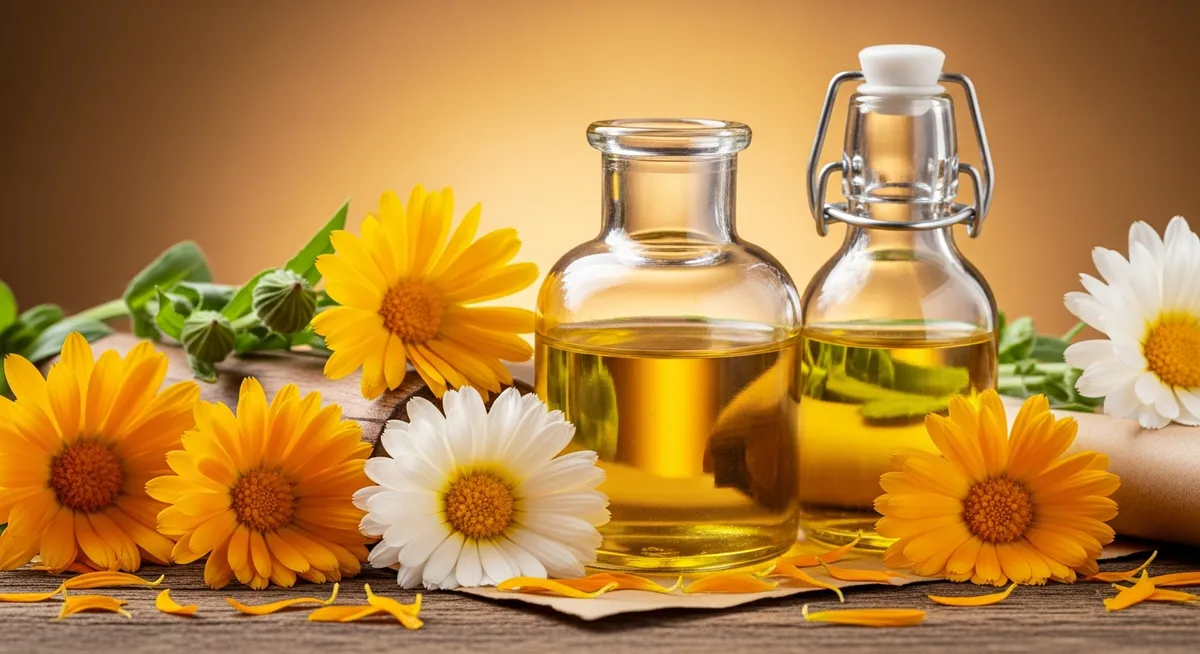
Can You Be Allergic to Calendula Oil? The Ragweed Connection
Yes, you can be allergic to calendula oil, and the ragweed connection is real but narrower than most pages make it sound. Ragweed hay fever does not reliably predict a skin reaction to calendula, and a clear skin test for the family does not reliably clear you. We make an infused calendula oil from Calendula officinalis, a member of the daisy family, and our own stated limit is the same as the dermatologists': patch test first, and skip it if you react.

Calendula Oil
Our own small-batch calendula oil, in sizes from 0.5 oz to bulk.
From $13.99
Shop Calendula Oil →Two different allergies hide behind one question
People asking about ragweed usually mean pollen allergy, the sneezing kind. A skin reaction to a plant product is a different mechanism, usually delayed. The American Academy of Dermatology notes that an allergic skin rash "tends to appear hours or days after your skin touches what you're allergic to" (AAD, contact dermatitis). In dermatology reviews, the main contact allergens of the Asteraceae (Compositae) family are sesquiterpene lactones (Gordon, Australas J Dermatol, 1999), while the pollen cross-reactions between ragweed and mugwort involve different proteins; a 2025 review says those pollen panallergens "contribute to cross-reactivity phenomena" and that "numerous uncertainties persist" (Kljucevsek and Kreft, Health Sci Rep, 2025). Reasoning from that, a pollen allergy and a contact allergy to calendula can overlap, but one does not imply the other.
The strongest sourced support for the ragweed idea is hedged. A 2024 allergy review says that "some people with respiratory allergies to weed pollen may also suffer hypersensitivity reactions to herbal medicines" from Compositae plants such as chamomile, marigold and purple coneflower; the abstract gives no frequency and does not say which marigold genus (Preda et al., Medicina, 2024). We found no study that quantifies ragweed-to-calendula cross-reactivity, by contact or by pollen antibodies.
The numbers, with the setting attached to each
The published figures measure different things, so we state each with where it came from rather than ranking them:
- In a 2001 Austrian patch-test series of 443 dermatitis patients, 9 (about 2.03%) reacted to marigold (Calendula officinalis), and 18 (about 4.06%) to a Compositae mix; patients were referred for dermatitis, so this is not a general-population rate (Reider et al., Contact Dermatitis, 2001). The EU assessor judged that study of limited value because whole aerial parts were tested, not petals alone (EMA/HMPC assessment report, 2018).
- A review cites Compositae contact allergy at about 0.7-1.4% in the general population and up to 4.5% in occupationally exposed groups, without primary references in the abstract (Jovanovic and Poljacki, Med Pregl, 2003).
- A 2002 review put calendula among at least 15 species suspected of sensitization but said epidemiological data exist only for arnica and German chamomile, "the rest of the evidence being anecdotal" (Paulsen, Contact Dermatitis, 2002).
- The cosmetic safety panel's 2010 review reported calendula ingredients "not irritating, sensitizing, or photosensitizing in animal or clinical tests" (Andersen et al., Int J Toxicol, 2010), and NIH's LactMed says allergic reactions "occur rarely" (LactMed).
- EMA's 2025 periodic review found 15 spontaneous reports for calendula ointment (erythema, itching, papules, burning), judged possibly related, with no change to the monograph (EMA/HMPC, 2025). Spontaneous reports have no denominator.
Our reading: calendula is probably an uncommon sensitizer, but it is a documented one, and it is not a safe bet for anyone with a known daisy-family allergy. The EU monograph states the contraindication outright: "hypersensitivity to the active substance and to other plants of the Asteraceae (Compositae) family" (EMA/HMPC, 2018).
Three traps in the evidence
"Marigold" is two genera. The 2025 review notes that Tagetes, also called marigold, is "not closely related to the Calendula genus" and rates it a moderate sensitizer in guinea pig experiments, while describing calendula as a "very weak sensitizer" in one laboratory assay. A "marigold allergy" in a paper or a forum may not be calendula at all.
A clear screening test is not a pass. In one Danish series, 57 patients (2.7%) had Compositae allergy, and 16 of them (28%) were missed by all three standard screening agents; the authors advise testing specific plant extracts when history suggests it (Paulsen and Andersen, Contact Dermatitis, 2019). If you were told you tested negative to a Compositae mix, that is information, not clearance.
Calendula gets blamed unfairly too. A Dutch case report describes a woman with persistent atopic dermatitis and a positive Compositae mix whose past calendula use was suspected first, but whose ongoing dermatitis was traced to a self-devised diet of Compositae-family foods (Wintzen et al., Contact Dermatitis, 2003). A reaction after a product is not proof the product caused it.
Who should not buy a calendula product
- Anyone with a confirmed Compositae or calendula allergy.
- Anyone who has reacted to chamomile or arnica products. In a small Danish study, 8 of 12 chamomile-sensitive patients reacted to chamomile-containing products and 5 of 6 arnica-sensitive patients to arnica products, and the authors advised Compositae-allergic people against topical Compositae products (Paulsen et al., Contact Dermatitis, 2008). That study did not test calendula.
- Anyone with ragweed or mugwort hay fever who wants to try it: not forbidden by the evidence, but worth an allergist's view first, and a careful test.
If you want to test it anyway
A home patch test is a convention, not a standard. We found no dermatology-society source endorsing a 24-48 hour dab at home. The clinical method is the repeated open application test, described in 1986 as applying a substance twice daily for 7 days to the inner forearm, unless dermatitis appears sooner (Hannuksela and Salo, Contact Dermatitis, 1986); in a survey of American Contact Dermatitis Society members, most used one or two weeks, and "standardized methodology has not been established" (Brown et al., Dermatitis, 2015). Because reactions can be delayed by days, a one-day test can miss one. Our patch test walkthrough goes through the practical routine, and the formal route is a dermatologist, who can test with the actual product you plan to use (Johansen et al., ESCD guideline, 2015). If a product causes a rash or burn, FDA's advice is to stop using it, call a healthcare provider and report it (FDA, Using Cosmetics Safely).
What "allergic to calendula oil" might really mean
A reaction to a bottle can come from the flower, the carrier oil or something added. Ours contains calendula extract in a carrier oil with no added preservatives, tocopherol or stabilizers; the carrier is named on the batch paperwork, which you can request by emailing the lot number to [email protected], and that is what an allergist will want to see. We do not call it hypoallergenic, and FDA notes it does not define that word for cosmetics. Related reading: symptoms and what to do, the cross-reactivity explainer, and what batch documentation shows.
If you have no daisy-family allergy and a clean forearm test, our calendula oil is available with batch documentation on request, and if you are unsure, an allergist is a better first stop than we are.
Calendula Oil
Nature's Golden Botanical, bottled: small-batch calendula oil in sizes from 0.5 oz to bulk.
From $13.99
Shop Calendula Oil →Sources & Further Reading
- EMA/HMPC, 2018. Assessment report on Calendula officinalis L., flos, EMA/HMPC/603409/2017. ema.europa.eu
- American Academy of Dermatology, accessed 2026-10-14. Contact dermatitis (patient page). aad.org
- Gordon LA, 1999. Compositae dermatitis. Australas J Dermatol 40(3):123-8. pubmed.ncbi.nlm.nih.gov
- Kljucevsek T, Kreft S, 2025. Allergic potential of medicinal plants from the Asteraceae family. Health Sci Rep 8(2):e70398. pubmed.ncbi.nlm.nih.gov
- Preda M, Smolinska S, Popescu FD, 2024. Diagnostic workup in IgE-mediated allergy to Asteraceae weed pollen and herbal medicine products in Europe. Medicina 60(9):1494. pubmed.ncbi.nlm.nih.gov
- Reider N et al., 2001. The seamy side of natural medicines: contact sensitization to arnica and marigold. Contact Dermatitis 45(5):269-72. pubmed.ncbi.nlm.nih.gov
- Jovanovic M, Poljacki M, 2003. Compositae dermatitis (in Croatian). Med Pregl 56(1-2):43-9. pubmed.ncbi.nlm.nih.gov
- Paulsen E, 2002. Contact sensitization from Compositae-containing herbal remedies and cosmetics. Contact Dermatitis 47(4):189-98. pubmed.ncbi.nlm.nih.gov
- Andersen FA et al., 2010. Final report of the Cosmetic Ingredient Review Expert Panel amended safety assessment of Calendula officinalis-derived cosmetic ingredients. Int J Toxicol 29(6 Suppl). pubmed.ncbi.nlm.nih.gov
- Drugs and Lactation Database (LactMed), 2021 revision. Calendula. NICHD. pubmed.ncbi.nlm.nih.gov
- EMA/HMPC, 2025. Addendum to Assessment report on Calendula officinalis L., flos, EMA/HMPC/12880/2025. ema.europa.eu
- EMA/HMPC, 2018. European Union herbal monograph on Calendula officinalis L., flos (Revision 1), EMA/HMPC/437450/2017. ema.europa.eu
- Paulsen E, Andersen KE, 2019. Screening for Compositae contact sensitization with sesquiterpene lactones and Compositae mix 2.5% pet. Contact Dermatitis 81(5):368-73. pubmed.ncbi.nlm.nih.gov
- Wintzen M, Donker AS, van Zuuren EJ, 2003. Recalcitrant atopic dermatitis due to allergy to Compositae. Contact Dermatitis 48(2):87-8. pubmed.ncbi.nlm.nih.gov
- Paulsen E, Christensen LP, Andersen KE, 2008. Cosmetics and herbal remedies with Compositae plant extracts: are they tolerated by Compositae-allergic patients? Contact Dermatitis 58(1):15-23. pubmed.ncbi.nlm.nih.gov
- Hannuksela M, Salo H, 1986. The repeated open application test (ROAT). Contact Dermatitis 14(4):221-7. pubmed.ncbi.nlm.nih.gov
- Brown GE et al., 2015. Clinical utilization of repeated open application test among American Contact Dermatitis Society members. Dermatitis 26(5):224-9. pubmed.ncbi.nlm.nih.gov
- Johansen JD et al., 2015. European Society of Contact Dermatitis guideline for diagnostic patch testing. Contact Dermatitis 73(4):195-221. pubmed.ncbi.nlm.nih.gov
- FDA, accessed 2026-10-14. Using Cosmetics Safely. fda.gov