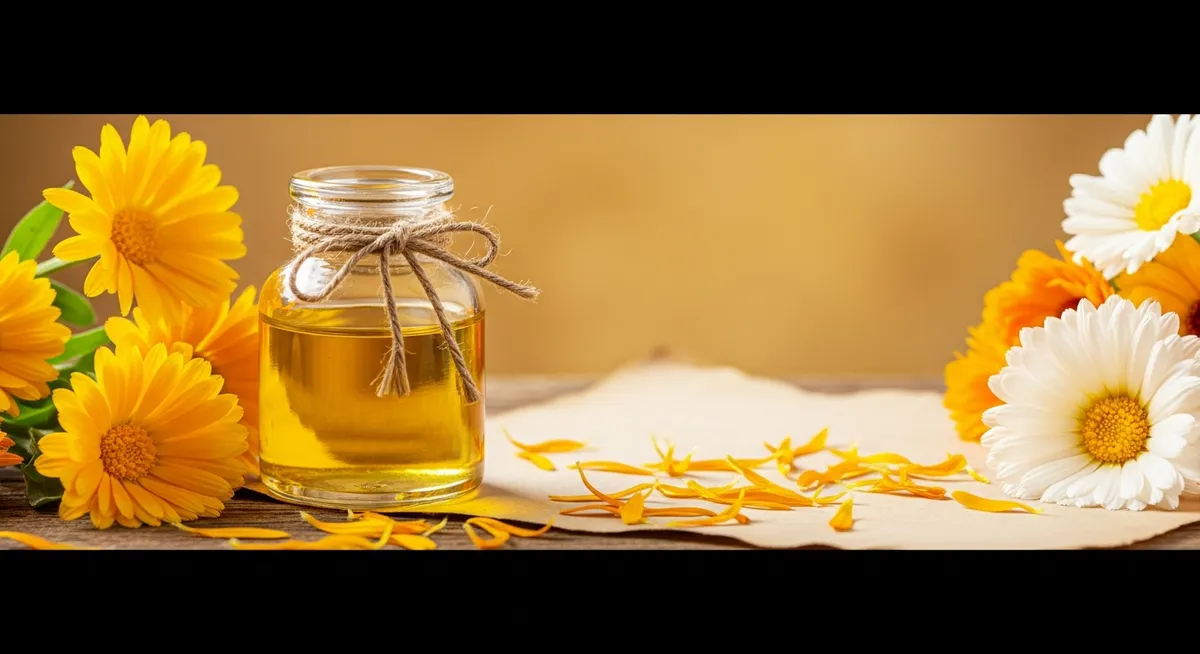
Is All Calendula Oil the Same? Quality Myths Exposed
No, calendula oils are not all the same, but the differences are mostly not the ones the usual advice points at. Colour depth, an "organic" word on the front, a certificate with numbers on it and a long shelf-life claim each tell you less than they seem to. This page goes through five common shortcuts, says what the sources show about each, and ends with the questions that do separate one bottle from another.

Calendula Oil
Our own small-batch calendula oil, in sizes from 0.5 oz to bulk.
From $13.99
Shop Calendula Oil →Shortcut 1: "Darker orange means stronger"
Colour is real information, but about the flower variety first. In a four-variety HPLC study, total carotenoids ranged from 48.2 mg/100 g of fresh flowers in a yellow-orange variety to 276.0 mg/100 g in a dark orange one, and in one cultivar the petals held about 103.8 mg/100 g against 8 mg/100 g in the tubular centre florets (Pintea et al., Acta Biologica Szegediensis, 2003). So the same species gives very different pigment loads depending on cultivar and which part of the flower is used. A dark oil might come from a deep-orange variety, from a high petal fraction, or from something else entirely.
It might come from something else because colour is easy to add. A 2023 forensic review of botanical ingredients notes that fatty oils are among the products where "colorants are added to comply with organoleptic specifications," with the example of beta-carotene added to sunflower oil sold as sea buckthorn oil (Gafner et al., J Nat Prod, 2023). We found no documented case of this for calendula oil, and we are not saying it happens; we are saying colour alone cannot rule it out. There is a naming trap too: commercial "marigold" lutein products are normally made from Tagetes, a different genus from Calendula officinalis (Kurniawan et al., Foods, 2026). See our carotenoid page for the pigment story.
Shortcut 2: "Organic means a more potent oil"
Organic is a statement about how the plant was grown and handled. USDA's National Organic Program covers it for cosmetics only when the growers, handlers and final manufacturer are certified, and FDA itself does not define "organic" for cosmetics (USDA AMS, Organic Cosmetics fact sheet). It does not speak to carotenoid content or freshness. Our flowers are organically grown, meaning no synthetic pesticides or fertilizers, on family farms in Egypt, Hungary, the Balkans and Turkey; we do not claim a certification, because none is documented on our site. If a certification matters to you, our certifications page explains what each label covers, and you can compare it against what we state.
Shortcut 3: "It has a certificate of analysis, so it is verified"
A certificate lists the tests that were run, and the choice of test decides what it can show. One review notes that UV spectrophotometric results are sometimes the only composition data on a certificate and that such assays are non-specific, because any compound absorbing at the measured wavelength is counted (Gafner et al., 2023). A commercial calendula macerate's data sheet lists physical constants, a peroxide value limit of 40 meq O2/kg and microbial counts of at most 1,000 CFU/g for aerobic count and for yeasts and moulds, but no carotenoid or flavonoid assay (Golgemma/Biolandes FB026, 2025). That is a sensible specification, and it shows what a spec of that kind does and does not cover.
So the question to ask is not "do you have a certificate?" but "which tests, by whom, on which lot?" Ours is documented per lot: every batch goes to independent third-party labs for physical assays, chemical assays and contaminant screening, and a Certificate of Analysis PDF is linked on the shop page. Email the lot number to [email protected] for the batch paperwork. We do not print lab numbers in articles, because the paperwork is the proper place for them. Contaminant limits have reference points: the European Pharmacopoeia sets most herbal materials at no more than 5 ppm lead and 1 ppm cadmium (Inada et al., Ther Innov Regul Sci, 2023), but those are medicine standards, not cosmetic ones, so read them as context.
Shortcut 4: "Shelf life is shelf life"
The 36-month figure on that supplier sheet applies to a macerate in sunflower oil with 0.2% added tocopherol, stored at 15-25 C, protected from air and light. Rancimat-based predictions for some oils are much shorter, 6 to 17 months in the entries one review compiled (Gharby et al., Food Chem X, 2025), and those are model estimates, not measured storage. The carrier's fatty acids matter, because linoleic acid oxidises about ten times faster than oleic acid in the pure-acid relative rates the same review reports. We add no tocopherol, preservatives or stabilizers to our oil, so we do not borrow someone else's shelf-life number, and we do not publish one. Our bottles are dated and lot-numbered, in glass, so you can see how old yours is. Storage guidance is in our storage page.
Shortcut 5: "It's all just flowers in oil"
That is the one shortcut that is partly right, and the differences are in the details. Dried material is the safest basis for an infused oil; University of Maine Extension says dried herbs lack the moisture bacteria need (Bulletin 4385, written for food oils). What we do about it is described in process terms, nothing more:
- We buy dried flowers and do the production in-house, from dried flower to sealed bottle.
- Flowers are dried naturally by traditional methods, with no industrial heat or forced air.
- We infuse petals separated by hand from sound, whole-dried flower heads, not broken florets.
- Calendula is extracted alone first, and that extract is then brought into a carrier oil.
- If a season goes badly and the flowers do not meet standard, we sell out rather than lower the bar.
We can attest to these because they are our own process. We cannot say they make our oil better for any particular outcome; that would need evidence we do not have. Be wary of "highest quality" claims from anyone that do not come with a method.
Questions that do separate bottles
- What is the carrier oil, and which type?
- Is anything added, and if so what and how much?
- Dried flower or fresh? Petals or whole heads?
- What did the lab test, who ran it, and is it per lot?
- Is the bottle dated and lot-numbered, in glass?
- Is there any claim about treating a condition? There should not be on a cosmetic oil, and FDA has sent warning letters over calendula product claims about skin conditions (FDA warning letter to Be Natural Organics, 2017).
Our signs of low-quality calendula oil page covers what to look for once you have a bottle in hand. Who should skip calendula oil altogether: anyone allergic to daisy-family plants, since the EU herbal monograph lists Asteraceae hypersensitivity as a contraindication (EMA/HMPC, 2018). Patch test first.
Calendula Oil
Nature's Golden Botanical, bottled: small-batch calendula oil in sizes from 0.5 oz to bulk.
From $13.99
Shop Calendula Oil →Sources & Further Reading
- Pintea A et al., 2003. HPLC analysis of carotenoids in four varieties of Calendula officinalis flowers. Acta Biologica Szegediensis. abs.bibl.u-szeged.hu
- Gafner S et al., 2023. Botanical Ingredient Forensics. J Nat Prod. pmc.ncbi.nlm.nih.gov/PMC9972475
- Kurniawan SB et al., 2026. Advances in Sustainable Lutein Production. Foods. pmc.ncbi.nlm.nih.gov/PMC13206640
- USDA AMS. Cosmetics, Body Care Products, and Personal Care Products (Organic). ams.usda.gov
- Golgemma/Biolandes, 2025. Technical data sheet FB026, Calendula Org Macerate/Oil. biolandes.com
- Inada I et al., 2023. Comparison of regulations for arsenic and heavy metals in herbal medicines using pharmacopoeias of nine countries/regions. Ther Innov Regul Sci. pmc.ncbi.nlm.nih.gov/PMC10400675
- Gharby S et al., 2025. Vegetable oil oxidation. Food Chemistry X. pmc.ncbi.nlm.nih.gov/PMC12146556
- University of Maine Cooperative Extension. Bulletin 4385, Safe Homemade Flavored and Infused Oils. extension.umaine.edu/4385e
- FDA, 2017. Warning letter to Be Natural Organics (MARCS-CMS 523615). fda.gov
- EMA/HMPC, 2018. European Union herbal monograph on Calendula officinalis L., flos. ema.europa.eu