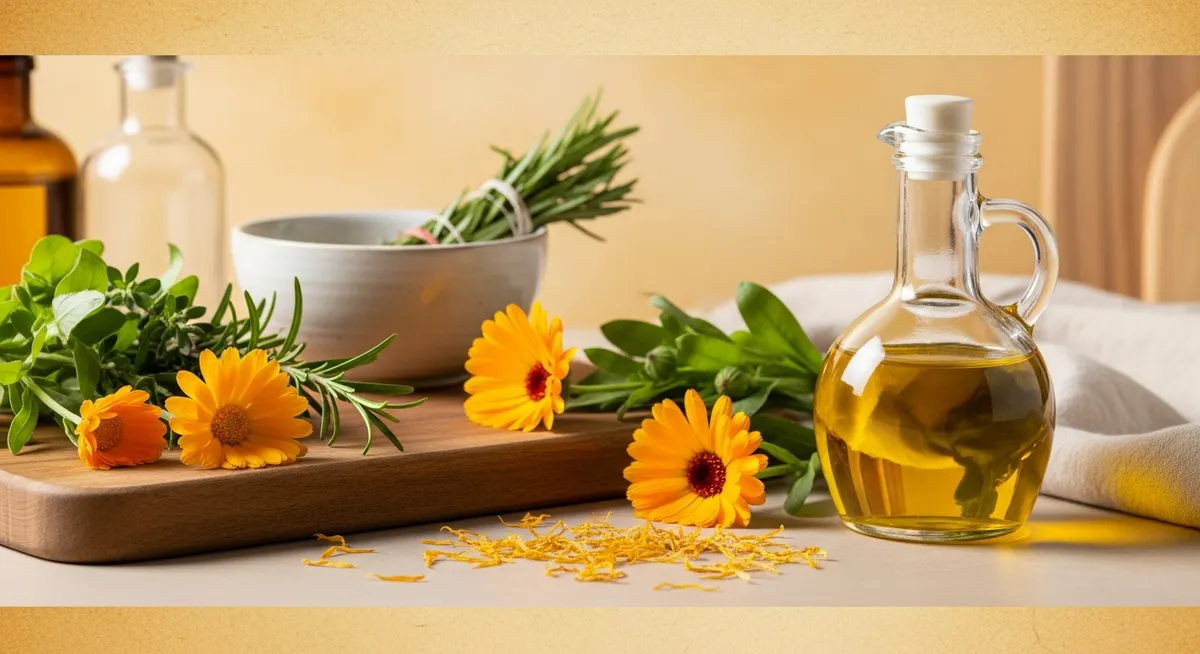
Calendula Oil for Cracked Heels: Why a Soak Is Not the Fix
A foot soak with calendula oil sounds like the obvious thing for cracked heels, and we make the oil. We still would not build your routine around it. The American Academy of Dermatology (AAD) advice for cracked heels points the other way from a long soak, no study we could find tests calendula on heels, and some cracks are a medical question. Here is how we would walk through it, and where our oil honestly fits.

Calendula Oil
Our own small-batch calendula oil, in sizes from 0.5 oz to bulk.
From $13.99
Shop Calendula Oil →What dermatologists actually say about heels
The AAD's page on dry, cracked heels gives a short list:
- Limit baths and showers to 5-10 minutes, pat skin dry gently, and use a fragrance-free cleanser.
- Moisturize soon after bathing while skin is still damp, and again whenever the heels feel dry, using a cream with 10-25% urea, alpha hydroxy acid or salicylic acid.
- Apply plain petroleum jelly before bed, with socks over it so it stays off the bedding.
- Use a liquid bandage over cracks during the day, and avoid open-heeled, worn-down or ill-fitting shoes.
- If the heels are severe or do not improve, see a board-certified dermatologist, since cracked heels can sometimes stem from a medical condition such as diabetes.
That is our starting point, and it shapes our position: the soak is the weakest part of the usual recipe. The AAD's advice on bathing time is to keep it short, and its list contains no soaking step. Reasoning from that, a soak that runs 20 or 30 minutes, with or without oil, runs against the direction the page points. If you soak at all, our reasoning is that it should be short and followed at once by the moisturizing step, since the AAD's technique is to seal water into skin that is still damp.
Where calendula oil fits, and where it does not
We searched PubMed for calendula and cracked heels, dry skin, xerosis and related terms and found no human trial. The nearest studies are about something else: a 2022 randomised trial of 40 patients with acute hand wounds, comparing a standardized calendula extract with mineral oil (Giostri et al., Tissue Barriers, 2022), and a 2025 study of 20 healthy volunteers in which a 1% calendula CO2-extract cream was followed by higher forearm hydration than placebo cream or no treatment after chemical irritation (Crnčević et al., Acta Pharm, 2025). Both used extracts, one on wounds and one on healthy arms, so neither says anything about heel skin or an infused oil.
So here is what we would say if you asked at the point of purchase:
- For the nightly seal, the AAD's pick is petroleum jelly, not an oil. On a different page, about lips, the AAD notes that an ointment seals in water longer than waxes or oils. That page is about lips, so applying the principle to heels is our inference, but it points the same way as the heel advice. Our oil is a liquid oil. Used alone it is unlikely to outlast a plain ointment overnight, and we would not claim otherwise.
- Where we would use it: a few drops on damp heels after a short wash, in the daytime or before the petroleum jelly layer, if you like how it feels. That is a preference, not a studied benefit.
- It does not replace the active ingredient. The AAD's named ingredients for thick, cracked skin are urea, alpha hydroxy acids and salicylic acid. We make none of these and our oil is not one.
If you still want a soak
This is reasoning from the AAD advice and from how oil behaves, not a tested recipe. We give no ratios because we have no sourced amounts to offer.
- Keep it short, in line with the 5-10 minute guidance, and use warm rather than hot water.
- Oil floats on water. It does not dissolve, so it ends up on the surface and on the tub floor. A wet, oily floor is a slipping hazard; drying off and moisturizing after is where the oil does its job, not in the basin.
- Do not store a water-based mix. Anything with water in it needs preservation if kept; a 2018 review states that water-containing cosmetics require preservation against microbial contamination (Halla et al., Molecules, 2018). Make it fresh, use it once, pour it out.
- Do not soak open cracks. If cracks are bleeding or look infected, skip the soak and see a clinician.
When to stop reading and call someone
The AAD's diabetes skin-care page says cracks in skin can develop, grow deep and bleed, and that deep cracks raise the risk of serious infection. It advises checking your feet every day and getting medical care for thick skin on the foot that is breaking down, and immediate care for infection signs such as swelling, pus or a lifting nail. If you have diabetes, a foot-care routine is a conversation with your doctor, dermatologist or podiatrist before it is a kitchen project. The same goes for heels that are severe or not improving.
Calendula adds one more reason to be careful. It is a daisy-family (Asteraceae) plant, and the EU herbal monograph lists hypersensitivity to Asteraceae plants as a contraindication and notes that skin sensitization has been reported (EMA/HMPC, 2018). In a patch-test series of 443 dermatitis patients, about 2% reacted to marigold (Reider et al., Contact Dermatitis, 2001). Cracked skin is an open door for a reaction, so patch test on your forearm first; our patch test guide shows how.
For the how-to version of using the oil on rough feet, see calendula oil for cracked heels and rough feet; for the broader dry-skin picture, calendula oil vs shea butter compares it with a heavier base.
What we can tell you about the oil
We buy dried Calendula officinalis flowers, organically grown on family farms, and make the oil in-house. Calendula is extracted on its own, then brought into a carrier oil; the carrier is not named on our site, so email us for it on the batch paperwork. We add no preservatives, tocopherol or stabilizers. Every batch is tested by independent third-party labs, bottles are dated and lot-numbered, and the batch documentation is available when you email the lot number to [email protected]. How it performs on heels is outside what we can claim, since we have no outcome data.
Calendula Oil
Nature's Golden Botanical, bottled: small-batch calendula oil in sizes from 0.5 oz to bulk.
From $13.99
Shop Calendula Oil →Sources & Further Reading
- American Academy of Dermatology. How to care for dry, cracked heels. aad.org, dry heels page
- American Academy of Dermatology. 7 dermatologists' tips for healing dry, chapped lips. aad.org, chapped lips page
- American Academy of Dermatology. Dermatologist-recommended skin care for people with diabetes. aad.org, diabetes skin care page
- Giostri GS et al., 2022. Treatment of acute wounds in hand with Calendula officinalis L.: a randomized trial. Tissue Barriers 10(3):1994822. pubmed.ncbi.nlm.nih.gov/34674610
- Crnčević MŠ et al., 2025. Double-blind randomised controlled trial of an emollient cream with and without 1% supercritical CO2 extract of Calendula officinalis in contact dermatitis. Acta Pharm 75(4):699-708. pubmed.ncbi.nlm.nih.gov/41527980
- Halla N et al., 2018. Cosmetics preservation: a review on present strategies. Molecules 23(7):1571. pubmed.ncbi.nlm.nih.gov/29958439
- European Medicines Agency, HMPC, 2018. European Union herbal monograph on Calendula officinalis L., flos (EMA/HMPC/437450/2017). ema.europa.eu
- Reider N et al., 2001. The seamy side of natural medicines: contact sensitization to arnica and marigold. Contact Dermatitis 45(5):269-272. pubmed.ncbi.nlm.nih.gov/11722485