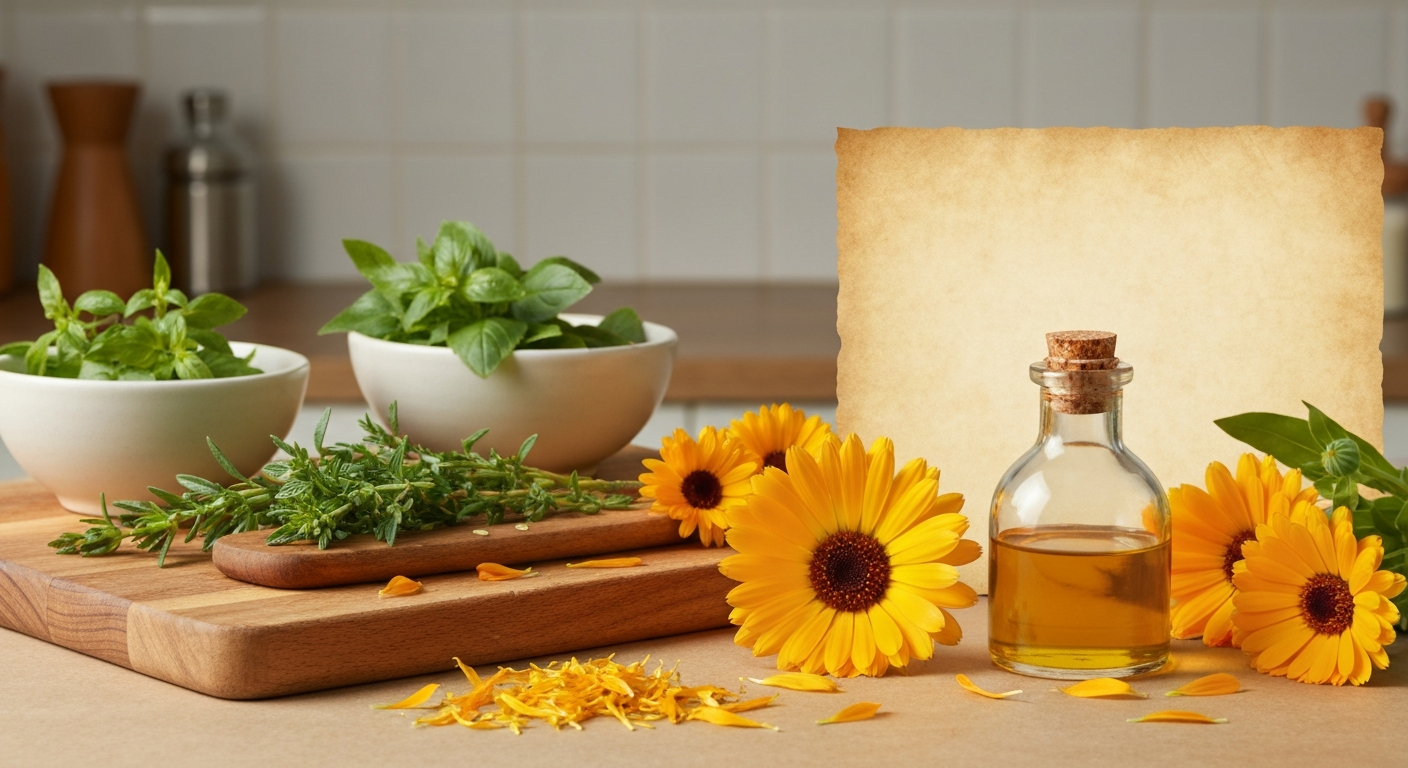
Calendula Oil Muscle Rub Recipe for Post-Workout Soreness
Calendula oil is a fine base for a post-workout rub, but be clear about which part is doing the work. The evidence points to the rubbing, not the calendula. We found no human trial of topical calendula for muscle soreness, and the best evidence on soreness favors massage itself. So this is a recipe for a good massage oil, with an honest account of what it will and will not do.

Calendula Oil
Our own small-batch calendula oil, in sizes from 0.5 oz to bulk.
From $13.99
Shop Calendula Oil →What the evidence supports, and what it does not
A 2018 systematic review and meta-analysis of 99 studies on recovery methods found that massage was associated with a decrease in delayed onset muscle soreness and was the most effective of the techniques compared for soreness and perceived fatigue (Dupuy et al., Front Physiol, 2018). Across the techniques that worked, effect sizes ranged from small to large (Hedges g between -0.40 and -2.26), and that range covers active recovery, compression, cold water and others, so it is a ceiling for the field and not a number for massage alone. The review compared techniques, not oils. Reasoning from that, the useful thing an oil does in a rub is let you apply pressure without dragging on skin. Calendula is one choice of oil.
What about calendula's own anti-inflammatory reputation? The laboratory work is real but it is not about this use. Mouse-ear swelling studies identified faradiol esters from the flower heads as the active fraction, using isolated compounds and extracts (Zitterl-Eglseer et al., J Ethnopharmacol, 1997), and a 2025 plant study found these esters in the petals at roughly 12-13 mg per gram of dried ray flower (Golubova et al., Nat Commun, 2025). That paper does not show how much of them ends up in an infused oil. So we cannot tell you what is in our oil in that respect, and no one can tell you that an infused oil reduces muscle soreness. The regulator's own position is that calendula's evidence is traditional use for minor skin inflammation and minor wounds, not muscle (EMA/HMPC, 2018).
There is a legal edge to this too. FDA's aromatherapy page lists claims about easing pain or relaxing muscles as drug claims, and says a plant origin does not exempt a product (FDA, Aromatherapy). If you sell or gift rubs, describe them as massage oil and leave out relief claims.
Option 1: the oil, straight
The simplest rub is the infused oil on its own, applied with slow strokes after you have cooled down and showered. Nothing to melt, nothing to spoil, and one ingredient to patch test. For large muscle groups, oil gives more glide than a salve and more working time than a cream.
Option 2: a firmer rub for a gym bag
If you want something that does not leak, make a balm. A common starting point is about 1 part beeswax to 4 parts infused oil, softer with less wax and firmer with more (Mountain Rose Herbs, How to Make Herbal Salves). Melt both on low heat in a double boiler, check firmness on a cold saucer, pour into a tin and let it set. Our salve article covers why it must stay free of water, and why to use a dry, not fresh, herb if you add any. Keep oil and wax free of added water or gel, because water-containing products need preservatives and oil-and-wax products do not (Brannan, J Soc Cosmet Chem, 1995). Wipe the tin with clean hands, not wet ones.
What about warming or cooling essential oils?
Most "muscle rub" recipes add essential oils such as peppermint or eucalyptus. Our position is to leave them out of a first batch. They add a second thing that can irritate, on skin that is already working hard, and you will not be able to tell which ingredient caused a reaction. The Tisserand Institute says allergic reactions are the most common reaction to essential oils and can last for days or weeks (Tisserand Institute). It lists 3-10% for pain-type rollerballs and 1-3% for body oils (Tisserand Institute, Dilution), and says to start low. If you do add one, work from the lower end and do the arithmetic: 1% of a 30 mL bottle is 0.3 mL. If you already use a commercial menthol or salicylate rub, ask a pharmacist before layering anything over it. Keep essential-oil blends away from children, pets and anyone pregnant unless a clinician or veterinarian has said otherwise; cats in particular can swallow what they groom off (Pet Poison Helpline).
Who should not use this
- Anyone allergic to ragweed, daisies, chrysanthemums or marigolds. Calendula is in the Asteraceae family, and the EU monograph lists hypersensitivity to that family as a contraindication. Patch test first and stop if you react, which is our own guidance too; see the patch test article.
- Children under 6, and pregnancy or breastfeeding. The monograph does not recommend skin use under 6 and says safety in pregnancy and lactation has not been established. Ask a pediatrician or OB/GYN or midwife.
- Skin that is broken, burned, or hot and swollen. Oil on top of a wound or a sprain's swelling is not the tool; see a clinician.
When soreness is not just soreness
No rub, calendula or otherwise, is the answer to the following. MedlinePlus describes rhabdomyolysis as muscle breakdown that releases muscle contents into the blood and can damage the kidneys. Its listed symptoms include dark, red or cola-colored urine, decreased urine output, weakness and muscle pain, and it names severe exertion as a cause (MedlinePlus, Rhabdomyolysis). Contact a clinician if you have those symptoms after hard exercise. Sharp pain, a pop, a joint that will not bear weight, or soreness that is lopsided or getting worse after several days are also questions for a physician or physical therapist, not for an oil.
Where our oil fits
We make one product: an infused calendula oil, made from dried organically grown flowers, extracted in two stages and brought into a carrier oil, with nothing added. That last point means no stabilizer, so keep the bottle closed and away from gym-bag heat and sun; light, heat and oxygen speed oxidation (Gharby et al., Food Chem X, 2025). The carrier is on the batch paperwork on request; email the lot number to [email protected]. If you want an arnica comparison, see calendula oil vs arnica oil, and for massage-specific points, calendula oil in massage. Our storage article has the handling details.
So make the rub because you like the feel of a plain, single-ingredient oil, and keep expectations where the evidence is: the benefit you can count on is the massage.
Calendula Oil
Nature's Golden Botanical, bottled: small-batch calendula oil in sizes from 0.5 oz to bulk.
From $13.99
Shop Calendula Oil →Sources & Further Reading
- Dupuy O et al., 2018. An evidence-based approach for choosing post-exercise recovery techniques. pubmed.ncbi.nlm.nih.gov/29755363
- Zitterl-Eglseer K et al., 1997. Anti-oedematous activities of the main triterpendiol esters of marigold. pubmed.ncbi.nlm.nih.gov/9254116
- Golubova D et al., 2025. Biosynthesis and bioactivity of anti-inflammatory triterpenoids in Calendula officinalis. PMC12304140
- EMA/HMPC, 2018. European Union herbal monograph on Calendula officinalis L., flos. ema.europa.eu
- FDA. Aromatherapy. fda.gov
- Mountain Rose Herbs. How to Make Herbal Salves. blog.mountainroseherbs.com
- Brannan DK, 1995. Cosmetic preservation. library.scconline.org
- Tisserand Institute. Irritation and allergic reactions. tisserandinstitute.org
- Tisserand Institute. Dilution for essential oils. tisserandinstitute.org
- Pet Poison Helpline. Essential oils and cats. petpoisonhelpline.com
- MedlinePlus. Rhabdomyolysis. medlineplus.gov
- Gharby S et al., 2025. Vegetable oil oxidation. PMC12146556