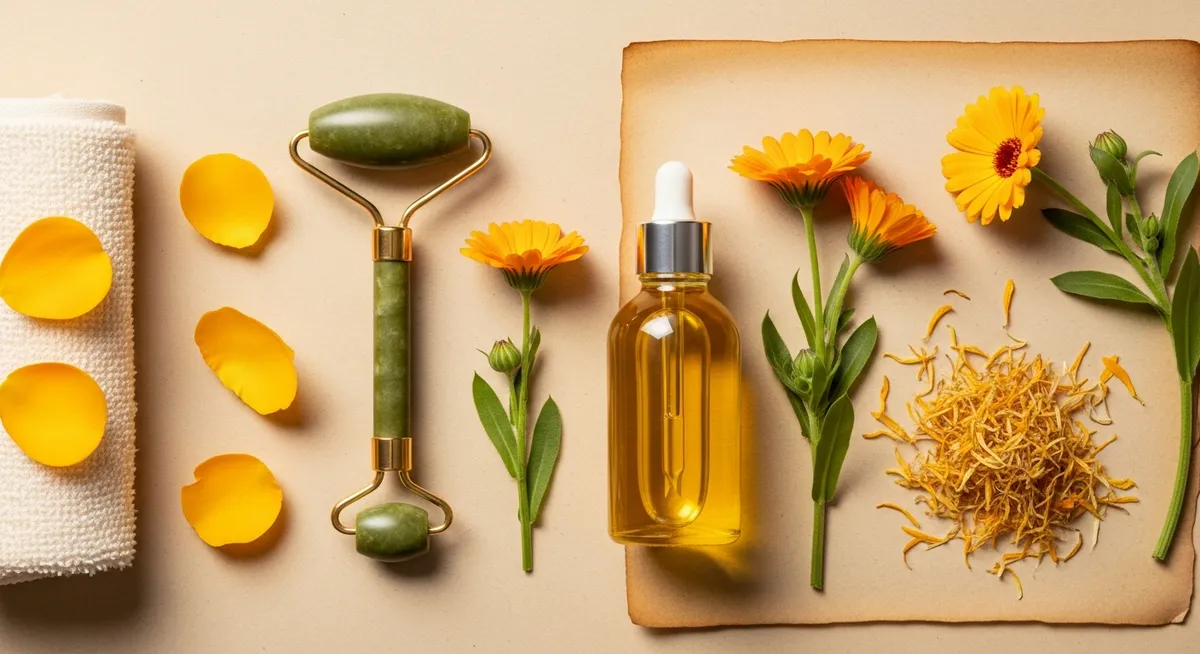
Wedding Season: Calendula Oil for Bridal Skincare Prep
The most useful thing to know about calendula oil before a wedding is when to stop trying new things. A product that is new in the last two weeks is a risk to your skin and to your photos, and calendula, as a daisy-family plant, is one of the products that needs a test period first. This page is a countdown, ordered the way we would walk a bride or groom through the decision: whether to use it at all, when to test, what to expect, and what to leave to a professional.

Calendula Oil
Our own small-batch calendula oil, in sizes from 0.5 oz to bulk.
From $13.99
Shop Calendula Oil →Twelve weeks out: decide whether it belongs in your routine
Start with the honest limit of the evidence. Almost all human studies of calendula tested extracts, ointments or creams, not infused oils, and the few cosmetic-type studies are small. In one 2025 double-blind study of 20 healthy volunteers with chemically induced irritation, forearm sites treated with a cream containing 1% calendula CO2 extract had higher skin hydration on day 4 than placebo-cream or untreated sites (Crnčević et al., Acta Pharm, 2025). In an 8-week study of 21 volunteers, two of seven skin-mechanics measurements differed between a calendula-extract cream and a base cream, and the study did not assess wrinkles (Akhtar et al., Acta Pol Pharm, 2011). Those are interesting, and they are not evidence that an oil makes skin look better on a given day. We do not claim a glow, and we would be skeptical of anyone who does.
If you have acne, eczema, rosacea or any skin condition you want in shape by the wedding, a dermatologist is the person with a timeline for it, and several months is not too early to book. Calendula oil is not a substitute for that appointment. The one trial in the evidence on acne-type lesions tested a three-ingredient serum on mask-related acne, so it says nothing about calendula alone (Puaratanaarunkon et al., J Cosmet Dermatol, 2022).
Skip calendula oil entirely if you have reacted to chamomile, arnica, chrysanthemum, daisy or ragweed products. The EU herbal monograph lists hypersensitivity to Asteraceae plants as a contraindication, and skin sensitization has been reported, frequency unknown (EMA/HMPC, 2018). More on that in reactions and what to do.
Ten weeks out: patch test, and do not skip it
Dermatologists test leave-on products with the repeated open application test, twice daily on the inner forearm. The 1986 protocol ran 7 days unless a rash appeared sooner (Hannuksela and Salo, Contact Dermatitis, 1986), and a survey found most dermatologists continue it for one or two weeks, with no standardized method (Brown et al., Dermatitis, 2015). The American Academy of Dermatology notes allergic rashes tend to show up hours or days after contact (AAD). Reasoning from those, a two-week test with a pause and a look afterward is a sensible minimum, and ten weeks out leaves room for a second product test if you want to try one. Our walkthrough is in the patch test guide. Order early: we ship within 1-2 business days, so the test can start the same week.
Six weeks out: freeze the routine
By this point, whatever is working stays, and nothing new is added. A short routine is easier to troubleshoot than a long one, because when a breakout or rash appears, you can name the cause. If you want an oil step, keep it to the evening, after cleansing, and use sunscreen as the morning product that does the real work: the American Academy of Dermatology advises SPF 30 or higher, water resistant and broad-spectrum, applied about a teaspoon for the face and reapplied every two hours outdoors (AAD). Calendula oil is not sun protection, and we do not know our oil's SPF; the published SPF figures we found are in vitro estimates for distilled essential oil, for example 8.36 in a 2019 laboratory study, not human tests of an infused oil.
If you are worried about breakouts from an oil, the comedogenic scales are less reliable than they look. They trace largely to rabbit-ear assays whose authors called the model "not ideal" (Fulton et al., J Am Acad Dermatol, 1984), and a small human study found finished products containing ingredients rated comedogenic in animals were not necessarily comedogenic (Draelos and DiNardo, J Am Acad Dermatol, 2006). We found no human acne trial of calendula oil. The test on your own skin is the better guide; see comedogenicity.
Two weeks out: rehearse, then stop changing things
Do the hair and makeup trial wearing exactly what you will wear on the day, including your evening oil step the night before. That is the only way to learn whether oil in the routine plays well with your makeup, and we cannot predict it: we have no source on calendula oil under makeup, and the carrier sets the feel, which is not named on the shop page but is on the batch paperwork (email the lot number to [email protected]). If a rash appears, the FDA advises stopping the product, contacting a healthcare provider and reporting the reaction (FDA). It also does not define "hypoallergenic," so we do not use that word either.
The week of the wedding, leave the routine alone. Our reasoning: a routine unchanged for the last several weeks leaves nothing new to blame if something flares. Do not introduce a new oil, a new mask or a new exfoliant. For anything more active, such as peels or prescription treatments, the timing is a dermatologist's judgment, and you should ask that person for the date to stop.
Who this is not for
If you are pregnant or breastfeeding, the EU monograph says safety has not been established and recommends against use for lack of data; ask an OB/GYN or midwife before adding it. Children in the wedding party under 6 fall under the same monograph's "not recommended for skin use due to lack of adequate data," so ask a pediatrician. We would rather you use nothing new than be the test case.
What we can say about our oil
We make one product: an infused calendula oil, extracted from dried, organically grown flowers on family farms in Egypt, Hungary, the Balkans and Turkey, with petals separated by hand from sound whole-dried heads. Calendula alone is extracted first and brought into a carrier oil. No preservatives, tocopherol or stabilizers are added, and every bottle is dated and lot-numbered; batches are tested by independent third-party labs, with documentation on request. We cannot tell you how it will look in photos or on your skin. If you would like the small, low-commitment option for a test, the half-ounce and one-ounce bottles are on the shop page. For wedding gifts or favors, see the gift set article, and for daily routines in general, the daily routine guide.
Plan the test first and the rest follows: the sooner the two weeks start, the less the date on the calendar can push you into shortcuts.
Calendula Oil
Nature's Golden Botanical, bottled: small-batch calendula oil in sizes from 0.5 oz to bulk.
From $13.99
Shop Calendula Oil →Sources & Further Reading
- Crnčević MŠ et al., 2025. Emollient cream with and without 1% supercritical CO2 extract of Calendula officinalis in contact dermatitis. PMID 41527980
- Akhtar N et al., 2011. Calendula extract: effects on mechanical parameters of human skin. PMID 21928714
- Puaratanaarunkon T et al., 2022. Facial serum with snail secretion filtrate, Calendula officinalis and Glycyrrhiza glabra in maskne. PMID 35763437
- EMA/HMPC, 2018. EU herbal monograph on Calendula officinalis L., flos. ema.europa.eu/EMA/HMPC/437450/2017
- Hannuksela M, Salo H, 1986. The repeated open application test. PMID 2941220
- Brown GE et al., 2015. Clinical utilization of repeated open application test. PMID 26367205
- Lohani A et al., 2019. Cosmeceutical potential of geranium and calendula essential oil. PMID 30251317
- American Academy of Dermatology. Contact dermatitis. aad.org/contact-dermatitis
- American Academy of Dermatology. How to apply sunscreen. aad.org/how-to-apply-sunscreen
- Fulton JE et al., 1984. Comedogenicity of current therapeutic products, cosmetics, and ingredients in the rabbit ear. PMID 6229554
- Draelos ZD, DiNardo JC, 2006. A re-evaluation of the comedogenicity concept. PMID 16488305
- FDA. Using Cosmetics Safely. fda.gov/using-cosmetics-safely