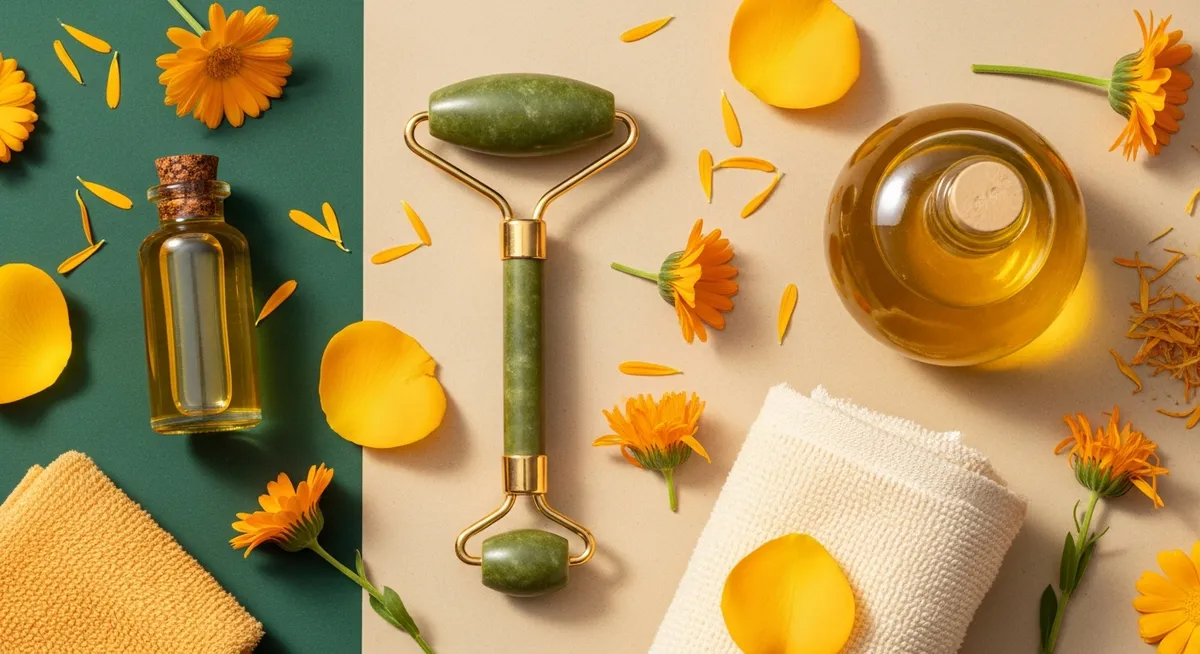
Calendula Oil in Summer: Heat, Storage and Sun Safety
Calendula oil is not summer protection, and it is not a repair step for sun damage. Sunscreen does the protecting, a clinician handles a bad burn, and what summer changes for someone using an infused oil is mostly practical: heat is hard on the bottle, and a new layer on your skin sits next to products whose labels were tested without it. This page sets out what the sources say, and where we have nothing to offer.

Calendula Oil
Our own small-batch calendula oil, in sizes from 0.5 oz to bulk.
From $13.99
Shop Calendula Oil →Protection: sunscreen, not oil
The American Academy of Dermatology recommends broad-spectrum, water-resistant sunscreen with SPF 30 or higher, at least 1 ounce for the body and at least 1 teaspoon for the face, applied about 15 minutes before going outside and reapplied every two hours and after swimming or sweating (AAD, how to apply sunscreen). FDA says SPF values come from a standardized test against sunburn, and regulates sunscreens as nonprescription drugs (FDA, sunscreen).
Calendula has no human SPF test that we could find. Memorial Sloan Kettering describes its sun-protective effects as coming from preclinical work (MSK, 2023). The numbers you may see online, an in vitro SPF of 8.36 for calendula essential oil (Lohani et al., J Cosmet Dermatol, 2019) and about 14.8 for a cream containing it (Mishra et al., J Young Pharm, 2012), are spectrophotometer estimates for steam-distilled essential oil. That is a different product from an infused oil, and nobody tested it on skin. In a mouse study, calendula extract given orally kept skin glutathione near normal after UVB exposure, which tells you nothing about applying oil to human skin (Fonseca et al., J Ethnopharmacol, 2010). Home recipes are not a workaround: a 2019 study of popular Pinterest homemade sunscreen recipes found 68% would give insufficient UV protection (Merten et al., Health Communication, 2019). Our SPF article goes into more detail.
One practical corollary: we would not stir oil into a sunscreen. The label's SPF belongs to the finished product as tested, so a diluted jar no longer matches it. That is reasoning from FDA's description of how SPF is determined, not a measurement.
Repair: what to do after a burn
We have no evidence that calendula oil, ours or anyone's, helps sun-damaged skin. Our literature search found no human sunburn trial of topical calendula. The EU herbal monograph names sunburn as an example of a minor skin inflammation for a traditional herbal medicine, based on long-standing use rather than trials, and those are licensed medicinal preparations, not cosmetic oils (EMA/HMPC, 2018). The same monograph says to consult a doctor if symptoms last longer than one week.
The AAD's sunburn advice names no plant oils: get out of the sun, take cool baths or showers, moisturize with a product containing aloe vera or soy while skin is still damp, leave blisters intact and keep them clean with petroleum jelly, drink extra water. It lists high fever, chills, nausea, pus or swelling as reasons to seek medical attention (AAD, how to treat a sunburn). Blisters across a large area, or chills, headache or fever, call for immediate care (AAD, sunscreen FAQs). Our sunburn article and aloe comparison go through what is and is not known. For a burn with blisters, a clinician is the right person, not a bottle of oil.
Heat is the real summer problem for the oil
Light, heat, oxygen and trace metals all speed oil oxidation, and the rate rises steeply with temperature (Gharby et al., Food Chem X, 2025). That review concerns edible oils, and it is the best published guide we have on mechanism. One commercial calendula macerate's data sheet gives storage at 15-25 C, protected from air and light, in the original closed container, with a 36-month shelf life (Golgemma/Biolandes, FB026, 2025). That sheet describes a different product with a sunflower carrier and added tocopherol. Our oil has nothing added, and we do not publish shelf-life test data, so we cannot give you a number for ours.
Reasoning from the mechanism, the practical summer rules are the obvious ones, which is why they are worth stating:
- Do not leave the bottle in a parked car, a beach bag in the sun, or a sunny window.
- Keep it closed between uses, since oxygen is part of the process.
- Consider a smaller bottle you finish sooner. Our sizes start at 0.5 oz and 1 oz.
- Smell it. Rancidity has a characteristic odour from aldehydes formed in later oxidation (Cawood Scientific, 2020). If it smells off, do not use it.
Bottles are dated and lot-numbered, so you can tell how old yours is, and the batch documentation is available by emailing the lot number to [email protected]. Our storage article has more.
"Lightweight" depends on the carrier, and so does the rest of the feel
Calling calendula oil lightweight is a claim about feel, and we cannot make it. Reasoning from how an infused oil is made, flowers soaked in a carrier, its make-up is mainly that of the carrier, so the feel should largely follow it. Carrier oils differ widely: sunflower oil comes in high-linoleic (about 65% linoleic) and high-oleic (about 83% oleic) types that behave differently in stability and feel (USDA FoodData Central, SR Legacy), and jojoba is a liquid wax of wax esters, not a triglyceride oil (Abdalla et al., ACS Omega, 2024). The carrier of our oil is named on the batch paperwork; we are not stating it here and will not describe the feel on your skin in heat and humidity without it. If you want a firm answer on weight, ask for the carrier and compare.
Photosensitivity and what you add to the bottle
The EU assessment report found "no evidence for phototoxic activity" for calendula flower preparations (EMA/HMPC assessment report, 2018), and the Cosmetic Ingredient Review panel found calendula-derived ingredients not photosensitizing in animal or clinical tests (Andersen et al., Int J Toxicol, 2010). The caution is about what you blend in. The Tisserand Institute says expressed (cold-pressed) citrus rind oils can be phototoxic because of furanocoumarins, while distilled citrus oils are not; expressed grapefruit is slightly phototoxic, and sweet orange is generally thought not to be even when expressed (Tisserand Institute). If a blend includes a citrus oil, find out whether it is expressed or distilled before it goes on skin that will be in the sun.
Who should skip it
People with an Asteraceae (daisy, ragweed, chamomile) allergy should not use it; the monograph lists it as a contraindication and notes skin sensitization has been reported with unknown frequency. The monograph also does not recommend use in pregnancy and lactation or on skin under age 6 for lack of data. Patch test first (our walkthrough), because allergic rashes can appear hours or days after contact. Anyone with a skin condition or a serious burn should see a dermatologist.
If you want an everyday summer routine that uses the oil, our summer routine article covers the layering. For what we can add, it is the batch paperwork and a closed, dated glass bottle; the sun protection part is sunscreen.
Calendula Oil
Nature's Golden Botanical, bottled: small-batch calendula oil in sizes from 0.5 oz to bulk.
From $13.99
Shop Calendula Oil →Sources & Further Reading
- American Academy of Dermatology. How to apply sunscreen. aad.org
- American Academy of Dermatology. How to treat a sunburn. aad.org
- American Academy of Dermatology. Sunscreen FAQs. aad.org
- FDA. Sunscreen: how to help protect your skin from the sun. fda.gov
- Memorial Sloan Kettering Cancer Center, 2023. About Herbs: Calendula. mskcc.org
- Lohani A et al., 2019. Cosmeceutical potential of geranium and calendula essential oil. J Cosmet Dermatol 18(2):550-557. PMID 30251317
- Mishra A et al., 2012. Assessment of in vitro sun protection factor of Calendula officinalis L. essential oil formulation. J Young Pharm 4(1):17-21. PMID 22523455
- Fonseca YM et al., 2010. Protective effect of Calendula officinalis extract against UVB-induced oxidative stress in skin. J Ethnopharmacol 127(3):596-601. PMID 20026397
- Merten JW et al., 2019. Homemade sunscreen on Pinterest (Health Communication); Nationwide Children's Hospital release. nationwidechildrens.org
- EMA/HMPC, 2018. European Union herbal monograph on Calendula officinalis L., flos (Revision 1). ema.europa.eu
- EMA/HMPC, 2018. Assessment report on Calendula officinalis L., flos (EMA/HMPC/603409/2017). ema.europa.eu
- Gharby S et al., 2025. Vegetable oil oxidation: mechanisms, impacts on quality, and approaches to enhance shelf life. Food Chem X 28:102541. PMC12146556
- Golgemma/Biolandes, 2025. Technical data sheet, Calendula Org Macerate/Oil, FB026. biolandes.com
- Cawood Scientific, 2020. Peroxide value, anisidine value and total oxidation value. cawood.co.uk
- Abdalla S et al., 2024. A comprehensive review of plant-based cosmetic oils. ACS Omega 9:44019-44032. PMC11541506
- USDA Agricultural Research Service. FoodData Central, SR Legacy (sunflower oil entries). fdc.nal.usda.gov
- Andersen FA et al., 2010. Amended safety assessment of Calendula officinalis-derived cosmetic ingredients. Int J Toxicol 29(6 Suppl):221S-243S. PMID 21164072
- Tisserand Institute. Citruses: a comparison of different oils. tisserandinstitute.org