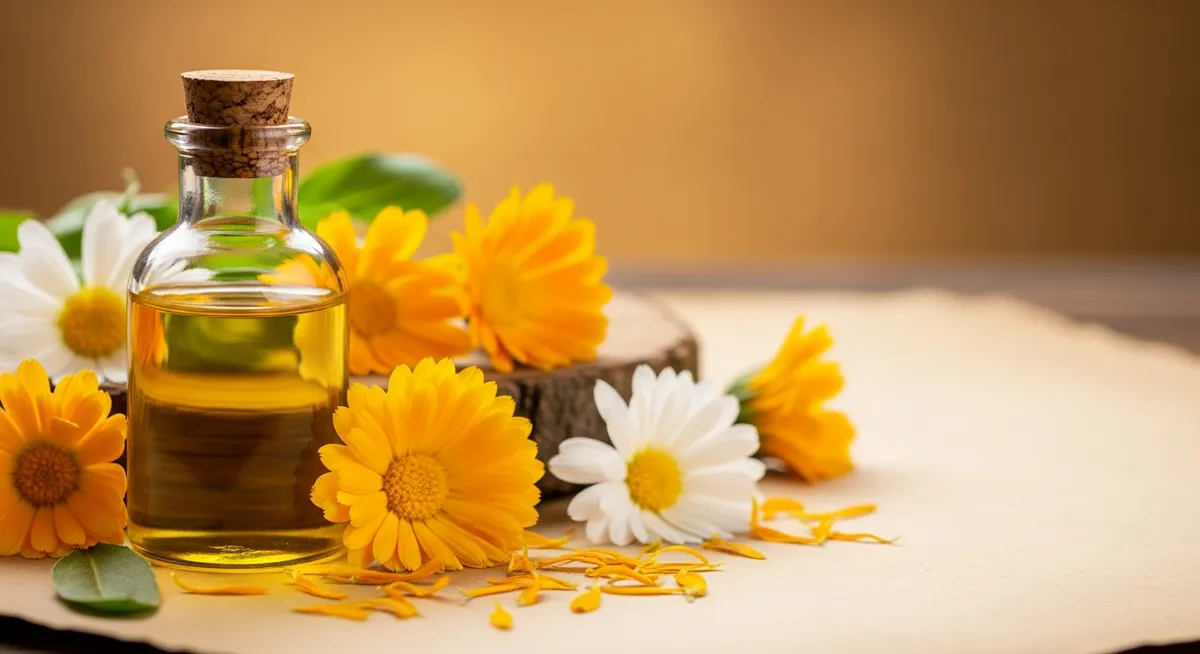
Calendula Oil After Sun: What Is Known and What to Use First
For a fresh sunburn, calendula oil is not what dermatology advice reaches for first, and it has never been tested on sunburn in people. If you are burned right now, start with the steps in the next section and read the oil part later. If your skin is past the worst and simply dry or peeling, an infused oil is a reasonable thing to consider, and the rest of this page is about when, and about what an oil cannot do.

Calendula Oil
Our own small-batch calendula oil, in sizes from 0.5 oz to bulk.
From $13.99
Shop Calendula Oil →Sort the burn before you reach for any product
The American Academy of Dermatology (AAD) gives a short list for sunburn in its sunburn advice and its sunburn care page:
- Take cool baths or showers to ease pain, then gently pat the skin dry.
- Apply a moisturizer with "aloe vera or soy" while the skin is still damp.
- "Drink extra water," because a sunburn pulls fluid toward the skin's surface.
- Do not pop blisters. Blisters mean a second-degree sunburn; keep them clean and, per the AAD, protect them with petroleum jelly until they resolve.
- Warning signs that need medical attention: "high fever, chills, or nausea, or pus or swelling of the skin."
Notice what the AAD names for moisturizing: aloe and soy products, and petroleum jelly for blisters. It does not name an infused oil, and we have found no dermatology source that recommends one in the first hours. Reasoning from that, an oil is not part of the first-aid step. That is our position even though we sell one. A blistered, very painful, or large-area burn, or any burn with fever or chills, belongs with a doctor or a dermatologist, not a bottle.
What exists for calendula and sunburn, which is not much
The EU herbal committee's 2018 monograph accepts calendula flower for "minor inflammations of the skin (such as sunburn)" and minor wounds, and it says plainly that this is "exclusively based upon long-standing use." In its assessment report the committee judged most calendula skin studies small and methodologically weak, and added that it found no evidence of phototoxic activity. The oil in that regulatory text is a 1:10 extract in a fatty oil such as olive oil, used in semi-solid products, which is the nearest regulatory relative of an infused oil but not the same as a bottle of pure oil.
In a PubMed search run on 14 October 2026, no human trial of calendula on sunburn turned up. What exists is indirect:
- A 2010 mouse study (Fonseca et al., J Ethnopharmacol) gave a calendula extract by mouth to hairless mice and found it kept skin glutathione levels near normal after UVB exposure. It was oral, in mice, and tested neither topical use nor sunburn.
- Laboratory estimates of sun protection exist for calendula essential oil, which is steam-distilled and chemically different from an infused oil. One 2019 study (Lohani et al.) reported an in vitro SPF of 8.36 from a spectrophotometer. That is not a test on skin.
By contrast, the "UV erythema test", in which volunteers are exposed to measured UVB and then treated, has been run for other plants. A 2008 trial in 40 volunteers (Reuter et al.) found 97.5% aloe vera gel reduced UV-induced redness at 48 hours, better than 1% hydrocortisone in a placebo gel but less than 1% hydrocortisone cream. A 2013 German study of seven plant extracts (Beikert et al.), which did not include calendula, found effects for several but only statistically significant for aloe. Calendula has not been run through that test in anything we located. For a direct comparison, see our calendula-versus-aloe article.
Where an infused oil can reasonably fit
Days after the burn, once the heat and tenderness have eased and the skin is tight, dry or peeling, you are in ordinary dry-skin territory, and any plain emollient is a sensible choice. This is reasoning, not a calendula finding: an oil on intact skin slows water loss, and the AAD's moisturizer advice is the same logic. If you choose ours, the points that matter are these.
- It is not sunscreen. The FDA says sunscreens are regulated as nonprescription drugs and that SPF values come from a test that measures protection against sunburn. We make no SPF claim and state no SPF for our oil. The AAD recommends broad-spectrum, water-resistant sunscreen of SPF 30 or higher, reapplied about every two hours. A 2019 study of popular online homemade-sunscreen recipes (Merten et al., summarised by Nationwide Children's Hospital) found that 68% recommended recipes with insufficient UV protection. Our SPF article covers the in vitro numbers.
- Do not add citrus essential oils casually. After-sun spray recipes often include them. The Tisserand Institute says expressed citrus rind oils can be phototoxic because of furanocoumarins, while distilled citrus oils are not. Calendula itself is a different matter: the Cosmetic Ingredient Review panel's 2010 assessment (Andersen et al., Int J Toxicol) found calendula-derived ingredients not photosensitizing in animal or clinical tests, though it noted they may be mild eye irritants, so keep it off eyelids.
- Know the carrier. Our oil is calendula extract brought into a carrier oil, and the carrier is on the batch paperwork: email the lot number to [email protected].
- Freshness. Bottles are dated and lot-numbered, and nothing is added to the oil. If it smells rancid, replace it.
Reaction risk is real on already-irritated skin
Calendula belongs to the Asteraceae (Compositae) family, and the EMA monograph lists hypersensitivity to Asteraceae plants as a contraindication and notes that skin sensitization has been reported, frequency unknown. In one Austrian patch-test series of 443 dermatitis patients (Reider et al., 2001), 9 (about 2%) reacted to marigold; those were clinic patients, so it is not a population rate. The practical problem is that a sunburn is already red, hot and itchy, so a reaction to an added product is hard to tell apart from the burn. That is a reason to patch test on unburned skin first (our patch test article) and to skip it on skin that is raw or blistering.
Skip calendula if you have a daisy-family allergy. The EMA monograph does not recommend use during pregnancy or breastfeeding, or skin use under age 6, because safety data are lacking, so ask an OB/GYN, midwife or pediatrician first.
What actually prevents the next burn
Shade, clothing and an SPF 30 or higher broad-spectrum sunscreen do. If a bottle of calendula oil makes you feel prepared for the sun, it is not protecting you. For sun-season routines that include oil in the right place, see our summer routine article.
In short: use the AAD steps for the burn, see a clinician for blisters or fever, and consider a calendula oil only afterward, on intact skin, for dryness. It is a moisturizer with a long tradition, not sun protection and not a burn care product.
Calendula Oil
Nature's Golden Botanical, bottled: small-batch calendula oil in sizes from 0.5 oz to bulk.
From $13.99
Shop Calendula Oil →Sources & Further Reading
- American Academy of Dermatology. How to treat a sunburn. aad.org/news
- American Academy of Dermatology. How to treat sunburn. aad.org, burns section
- EMA/HMPC, 2018. European Union herbal monograph on Calendula officinalis L., flos. ema.europa.eu
- EMA/HMPC, 2018. Assessment report on Calendula officinalis L., flos (EMA/HMPC/603409/2017). ema.europa.eu
- Fonseca et al., 2010. Protective effect of Calendula officinalis extract against UVB-induced oxidative stress in skin. J Ethnopharmacol. PMID 20026397
- Lohani et al., 2019. Cosmeceutical potential of geranium and calendula essential oil. J Cosmet Dermatol. PMID 30251317
- Reuter et al., 2008. Investigation of the anti-inflammatory potential of Aloe vera gel (97.5%) in the ultraviolet erythema test. Skin Pharmacol Physiol. PMID 18253066
- Beikert et al., 2013. Antiinflammatory potential of seven plant extracts in the ultraviolet erythema test. Hautarzt. PMID 23337964
- American Academy of Dermatology. Sunscreen FAQs. aad.org, sunscreen FAQs
- FDA. Sunscreen: How to Help Protect Your Skin from the Sun. fda.gov
- Nationwide Children's Hospital, 2019. Study on homemade sunscreen recipes (Merten et al., Health Communication). nationwidechildrens.org
- Tisserand Institute. Citruses: a comparison of different oils. tisserandinstitute.org
- Andersen et al., 2010. Final report of the Cosmetic Ingredient Review Expert Panel amended safety assessment of Calendula officinalis-derived cosmetic ingredients. Int J Toxicol. PMID 21164072
- Reider et al., 2001. The seamy side of natural medicines. Contact Dermatitis. PMID 11722485