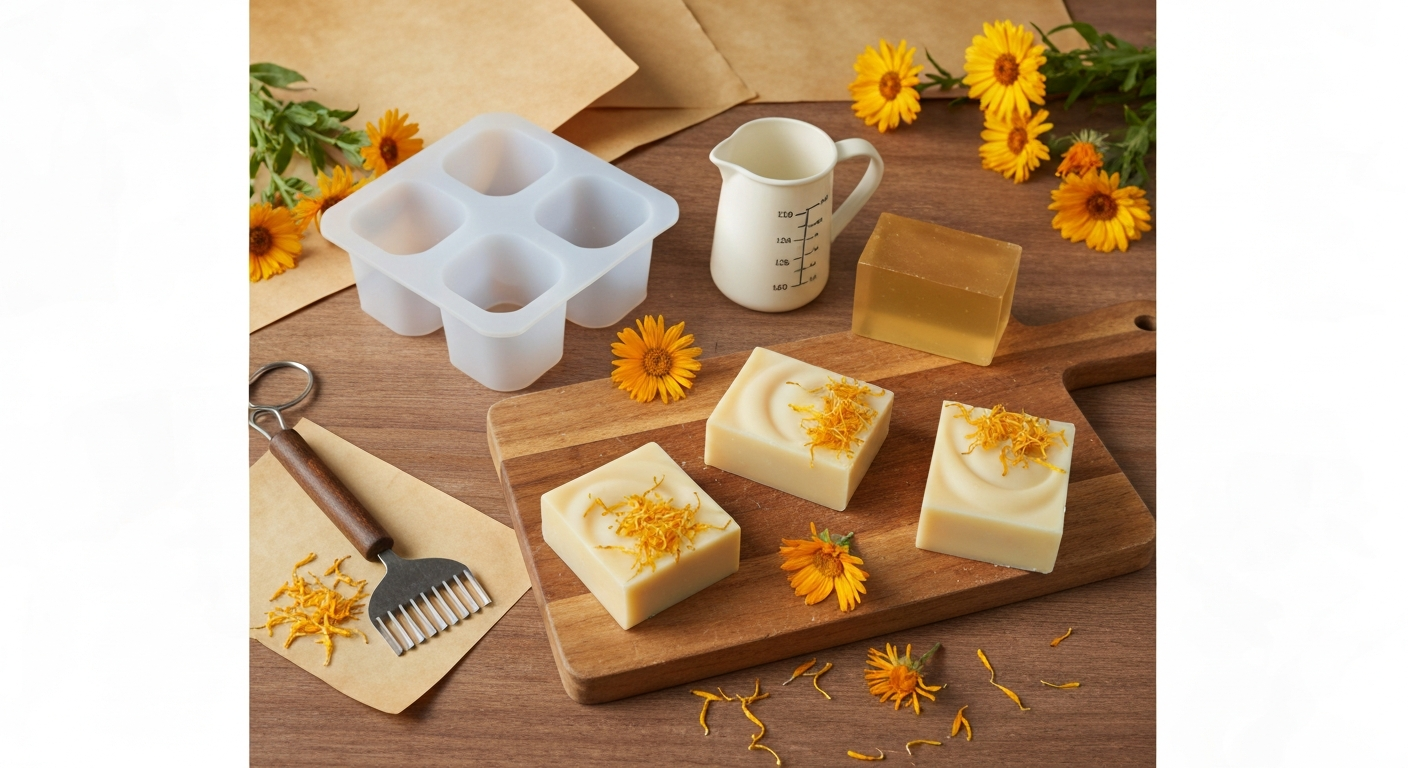
How to Make Calendula Oil Soap: Process, Safety and Limits
Do not copy a calendula soap recipe with oil weights from a blog, including ours, because a cold-process recipe is only correct if it was calculated for the exact oils in your pot. Our calendula oil is an infused oil, which means most of what saponifies is its carrier, and a lye calculator needs to know which carrier that is. The method below is the order of work, with the numbers you must calculate yourself marked as such.

Calendula Oil
Our own small-batch calendula oil, in sizes from 0.5 oz to bulk.
From $13.99
Shop Calendula Oil →The problem with a recipe card: lye math is per oil
Cold-process soap is made by reacting oils with lye (sodium hydroxide). The amount of lye depends on the oils used, so the same weight of two different oils needs two different lye amounts. Soap Queen (Bramble Berry) says its soap recipes are measured by weight, not volume, and points makers to a lye calculator that also works out the superfat level (Soap Queen, Beginner's Guide to Cold Process). That page does not give a lye ratio for infused oils, and we could not verify a source that does.
So here is how I would handle our oil in a calculator. We make one product: calendula flowers extracted first, then that extract brought into a carrier oil. The carrier is not named on our site, but the batch paperwork lists it: email the lot number to [email protected]. Reasoning from how the calculation works, you enter the carrier as the oil, at the weight of calendula oil you use, because the carrier is what the lye reacts with. If you cannot find out the carrier, the safe choice is to not use a guess in a lye calculation; use melt-and-pour instead.
We have no tested soap recipe, and we have no lab data on how much of the flower's color or constituents survives saponification. We found no source that measures it either. So the honest description of calendula in a cold-process bar is: a named ingredient, an oil in the recipe, and possibly some color. Do not promise more.
Cold process, in the order you do it
- Gear and rules first. The National Capital Poison Center says to wear a mask, goggles and gloves when handling lye, which "will burn any tissue it touches" (National Capital Poison Center). Soap Queen adds long sleeves, goggles that protect from all sides, no aluminum containers, and kids and pets out of the room. If lye touches skin or eyes, flush with plenty of water for at least 15 minutes (MedlinePlus, Sodium hydroxide poisoning); the poison center says to go to urgent care or an emergency room if burning or redness remains. Read a full lye safety guide before you open the container.
- Calculate. Enter every oil and the carrier of your calendula oil into a lye calculator and choose your superfat. The superfat figure is your decision; the sources we found do not recommend one.
- Weigh everything. Oils, lye and water by weight on a scale, not by measuring cup.
- Combine to trace. Trace is the point when the oils and lye water have emulsified. Pour into the mold.
- Expect heat. In the gel phase the soap can get as hot as 180 F (Soap Queen), so do not handle it bare.
- Cure. Soap Queen recommends 4-6 weeks in a cool, dry place with good airflow. It says cold-process soap is technically safe to use after a few days, but I would follow the 4-6 week figure and leave the first bar unused for that time.
Melt-and-pour: simpler, but the quantity is the base maker's call
Melt-and-pour starts with a premade soap base, so you do not handle lye, which is the whole appeal. I could not verify a published, manufacturer-stated amount of infused oil that a melt-and-pour base will take. Forum threads give small numbers (a teaspoon per pound is the figure that gets repeated), but that is anecdote and we do not cite it. What you can do is read the base's own instruction sheet and ask the manufacturer.
The reasoning behind that caution is simple: a premade base has already been formulated to be a certain hardness, and more liquid oil makes the bar softer. Add oil in small increments, test one small bar, and see whether it unmolds clean and holds its shape for a week. If you want color from the flower, say so on the label as an ingredient, not as a claim.
- Cut and melt the base following the maker's directions. We will not invent a temperature.
- Stir in the calendula oil, starting at a very small amount and changing only one variable per test.
- Pour into a clean, dry mold and let it set fully.
- Wrap the finished bars and keep them dry. We have no source for how long a calendula melt-and-pour bar keeps, so date it and judge it by sight and smell.
What soap does to skin, and why a calendula oil bar is not a skin-care step
A review of vulvar hygiene gives conventional soap a pH of about 8.5-11 and syndet cleansers 5.5-7, against skin at about 4-6, and notes that repeated washing with conventional soap alters stratum corneum proteins and lipids and increases water loss (Bohbot et al., Healthcare, 2025). That review is about the vulva, not the face or hands, but the pH figures apply to soap generally. Reasoning from that, an oil in the recipe does not change what the bar is: an alkaline cleanser that is rinsed off. If your reason for the bar is a calendula skin-care step, a leave-on oil is the better vehicle, and our pH post explains why an oil has no pH. For readers who want to buy bars instead, the soap bar roundup covers that.
Labeling and claims
FDA regulates a product as soap only if its nonvolatile matter is mostly an alkali salt of fatty acids and it is labeled, sold and represented solely as soap; a bar sold with drug-type claims is regulated as a drug (FDA, Is It a Cosmetic, a Drug, or Both? (Or Is It Soap?)). So for gifts and sales, "made with calendula oil" is a description, and anything about irritation, skin conditions or antibacterial effects is a claim you cannot support from this recipe.
Who should skip it
Calendula is in the daisy family (Asteraceae). The EU monograph lists hypersensitivity to Asteraceae plants as a contraindication and notes that skin sensitization has been reported, with unknown frequency (EMA/HMPC, 2018). Reasoning from the fact that soap is rinsed off, exposure is shorter than with a leave-on product, but we have no data that this lowers the chance of a reaction. If you are making soap to give away, say on the label that it contains calendula. If someone reacts to a bar, they should stop and see a dermatologist. Lye is the larger hazard in the room for anyone who has never made soap; if you are not ready for it, start with melt-and-pour or the other formats on this site, such as a lotion bar.
The crafter's buying guide says what to ask any oil supplier for. Ours is on the shop page; a 4 oz or 8 oz bottle is enough for a test batch.
Calendula Oil
Nature's Golden Botanical, bottled: small-batch calendula oil in sizes from 0.5 oz to bulk.
From $13.99
Shop Calendula Oil →Sources & Further Reading
- Soap Queen (Bramble Berry). Free Beginner's Guide to Soapmaking: Cold Process. soapqueen.com/cold-process-beginners-guide
- National Capital Poison Center. Is it safe to make soap at home? poison.org/is-it-safe-to-make-soap
- MedlinePlus, 2025. Sodium hydroxide poisoning. medlineplus.gov/ency/002487
- Bohbot JM, Rebelo C, Nappi RE, 2025. Vulvar care: reviewing concepts in daily hygiene. Healthcare 13(13):1523. pmc.ncbi.nlm.nih.gov/PMC12248671
- U.S. FDA. Is It a Cosmetic, a Drug, or Both? (Or Is It Soap?). fda.gov/it-cosmetic-drug-or-both-or-it-soap
- EMA/HMPC, 2018. European Union herbal monograph on Calendula officinalis L., flos (Revision 1), EMA/HMPC/437450/2017. ema.europa.eu/EMA/HMPC/437450/2017