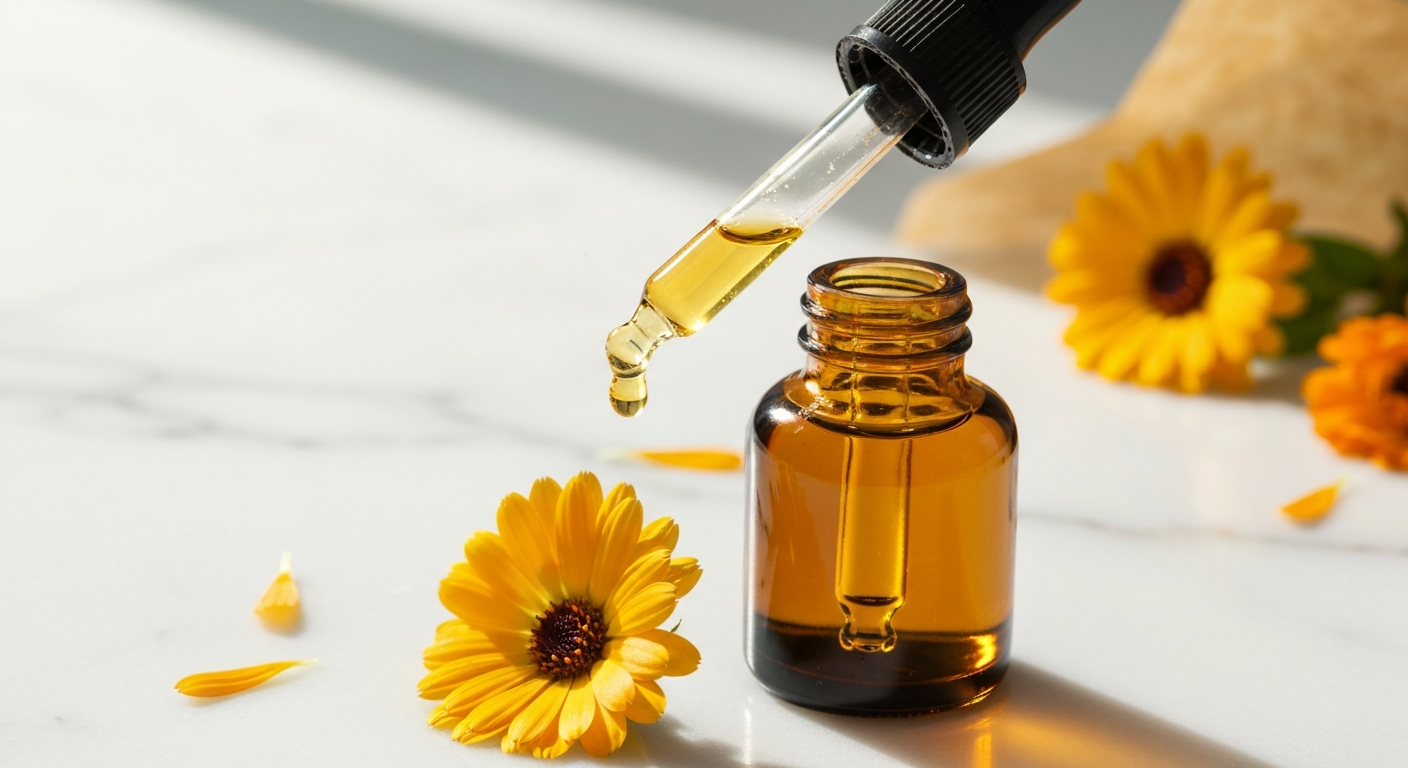
How to Create a Calendula Oil Serum for Glowing Skin
A calendula oil "serum" is a blend of oils, and the calendula part of it is already finished: the oil we make is a whole-flower infusion in a carrier, so it can be used on its own, and everything you add to it changes texture and storage life more than it changes anything else. We cannot promise a glow, and neither can the literature. What we can give you is a method for blending that is honest about trade-offs, with the quantities that have a source and a plain statement of the ones that do not.

Calendula Oil
Our own small-batch calendula oil, in sizes from 0.5 oz to bulk.
From $13.99
Shop Calendula Oil →What you are actually making
An oil serum has no water in it, and that is the property that makes homemade versions workable. A 1995 cosmetic-science review states that "the cosmetics that most need preservatives are those that contain water," and that products with low water activity need far less protection, because "the only limit to microbial life is the availability of liquid water" (Brannan, J Soc Cosmet Chem, 1995). The FDA likewise lists contaminated raw materials, water and ineffective preservation as sources of harmful contamination (FDA, Microbiological Safety and Cosmetics). So the first rule is a rule of exclusion: no water, no hydrosol, no aloe gel, no "splash of tea" in this bottle. Oils only. Once you add water you are making an emulsion or a water-based product, and that needs a real preservation system, which is a different project from this one.
Decide what you want, then choose the blend
People say "glowing" to mean at least three different things. The table sorts them, with what each costs you.
| You want | Blend approach | What it costs |
|---|---|---|
| Simplest possible, lowest risk | Our calendula oil alone, a few drops, after a patch test | Fewest variables if you do react; texture is whatever the carrier gives |
| A longer shelf life in a blend | Keep additions to oils that resist oxidation, such as jojoba | Jojoba is a liquid wax (over 98% wax esters in one 2024 review), so the feel differs from a triglyceride oil |
| A richer feel | Add a small share of rosehip seed oil | Rosehip had the shortest oxidation induction time of four oils in a 2026 test, so buy small and use it up |
The jojoba and rosehip rows rest on two sources. A 2024 review describes jojoba as a "liquid wax" because it is over 98% wax esters and related compounds (Abdalla et al., ACS Omega, 2024), and an accelerated oxidation test of rosehip, sunflower, olive and jojoba oils found jojoba the most stable and rosehip the least, tracking polyunsaturated fatty acid content (Fagoaga et al., Antioxidants, 2026). That test ran at 100 C, so read it as a ranking, not as months on your shelf. For a deeper comparison see calendula oil vs jojoba oil and vs rosehip oil.
The method, step by step
- Patch test first. Calendula is in the daisy family, and the EU herbal monograph lists Asteraceae allergy as a contraindication (EMA/HMPC, 2018). Test the finished blend, not only the calendula oil; our patch-test method uses a week of twice-daily forearm applications.
- Start with a small batch. We do not have a sourced ratio for calendula oil to jojoba or rosehip, and it would be invented to give you one. Make a 1 oz (30 mL) bottle, so that if the blend is wrong for your skin or goes stale, you have lost a little. Our 0.5 oz, 1 oz and 2 oz bottles exist for exactly this kind of trial, and the bulk guide suggests a 4 oz or 8 oz bottle for formulation stability checks.
- Measure by volume with a clean pipette or syringe. Write the proportions on the label with the date. A blend you cannot reproduce is a blend you cannot troubleshoot.
- If you add essential oil, use the published dilution, not a recipe's drop count. The Tisserand Institute lists 0.5-1.2% for facial cosmetics and 0.2-1% for sensitive or impaired skin, and says to start low (Tisserand Institute, Dilution for essential oils). In a 30 mL bottle, 0.5% is 0.15 mL and 1.2% is 0.36 mL. Drop sizes vary between bottles, so measure the volume. Expressed (cold-pressed) citrus rind oils can be phototoxic, while distilled citrus oils are not (Tisserand Institute, Citruses), so check which kind you are buying. Essential oils are also the likeliest source of a reaction you will blame on the calendula, so for a first blend we would leave them out.
- Bottle in dark glass with a dropper or pump. That keeps light out, which is a recognized driver of oil oxidation (Gharby et al., Food Chemistry X, 2025), and it spares you dipping fingers into the container, which the FDA advises against without clean hands. Keep it cool, and date it. Our shelf-life page explains why we give no single number.
What "glow" can honestly mean
We know of no human trial of an infused calendula oil on skin radiance. What exists is on extract creams. In an 8-week study of 21 healthy volunteers, two of seven skin-mechanics parameters differed significantly between a calendula-extract cream and a base cream; the study did not assess wrinkles (Akhtar et al., Acta Pol Pharm, 2011). In a 2025 double-blind trial of 20 healthy volunteers, forearm sites with a 1% supercritical CO2 calendula extract cream had higher hydration than placebo-cream or untreated sites on day 4 (Crnčević et al., Acta Pharm, 2025). Both are small, both are extracts in creams, and extrapolating to an oil is an inference. If your skin looks better using a good oil, the most defensible explanation on this evidence is that oil on skin reduces dryness, which is not specific to calendula.
Acne-prone readers often ask whether the blend will clog pores. The numeric "comedogenic" scales trace largely to a rabbit-ear assay whose own authors called the model "not ideal" (Fulton et al., J Am Acad Dermatol, 1984), and a small human study concluded that "finished products using comedogenic ingredients are not necessarily comedogenic" (Draelos and DiNardo, 2006). So no rating can tell you; a patch test on the area you care about, run for the same week, is the practical answer. See our comedogenicity page.
Limits, and if you plan to sell it
Keep the blend away from the eyes: the Cosmetic Ingredient Review panel noted calendula-derived ingredients "may be mild ocular irritants" (Andersen et al., Int J Toxicol, 2010). Do not use it on broken skin. And if you intend to sell a serum rather than use it yourself, the FDA decides whether a product is a cosmetic or a drug by its intended use, which claims can establish (FDA, Is it a cosmetic, a drug, or both?); "improves the look of skin" and "addresses acne" fall on opposite sides of that line.
If after this you decide the simplest version suits you, our oil in a 1 oz bottle is the whole recipe. Everything else here is for readers who want to build on it and now know which choices are sourced and which are theirs to make.
Calendula Oil
Nature's Golden Botanical, bottled: small-batch calendula oil in sizes from 0.5 oz to bulk.
From $13.99
Shop Calendula Oil →Sources & Further Reading
- Brannan DK, 1995. Cosmetic preservation. J Soc Cosmet Chem 46:199-220. library.scconline.org
- U.S. FDA. Microbiological safety and cosmetics. fda.gov
- U.S. FDA. Is it a cosmetic, a drug, or both? fda.gov
- Abdalla et al., 2024. ACS Omega (jojoba as liquid wax). PMC11541506
- Fagoaga C et al., 2026. Oxidative stability of rosehip, sunflower, olive and jojoba oils. Antioxidants 15(5):646. doi.org/10.3390/antiox15050646
- Gharby S et al., 2025. Vegetable oil oxidation. Food Chemistry X 28:102541. PMC12146556
- EMA/HMPC, 2018. EU herbal monograph on Calendula officinalis L., flos. ema.europa.eu
- Tisserand Institute. Dilution for essential oils. tisserandinstitute.org
- Tisserand Institute. Citruses: a comparison of different oils. tisserandinstitute.org
- Akhtar N et al., 2011. Calendula extract: effects on mechanical parameters of human skin. PubMed 21928714
- Crnčević MŠ et al., 2025. Emollient cream with and without 1% supercritical CO2 calendula extract in contact dermatitis. PubMed 41527980
- Fulton JE Jr et al., 1984. Comedogenicity of current therapeutic products, cosmetics, and ingredients in the rabbit ear. PubMed 6229554
- Draelos ZD, DiNardo JC, 2006. A re-evaluation of the comedogenicity concept. PubMed 16488305
- Andersen FA et al., 2010. CIR amended safety assessment of Calendula officinalis-derived cosmetic ingredients. PubMed 21164072