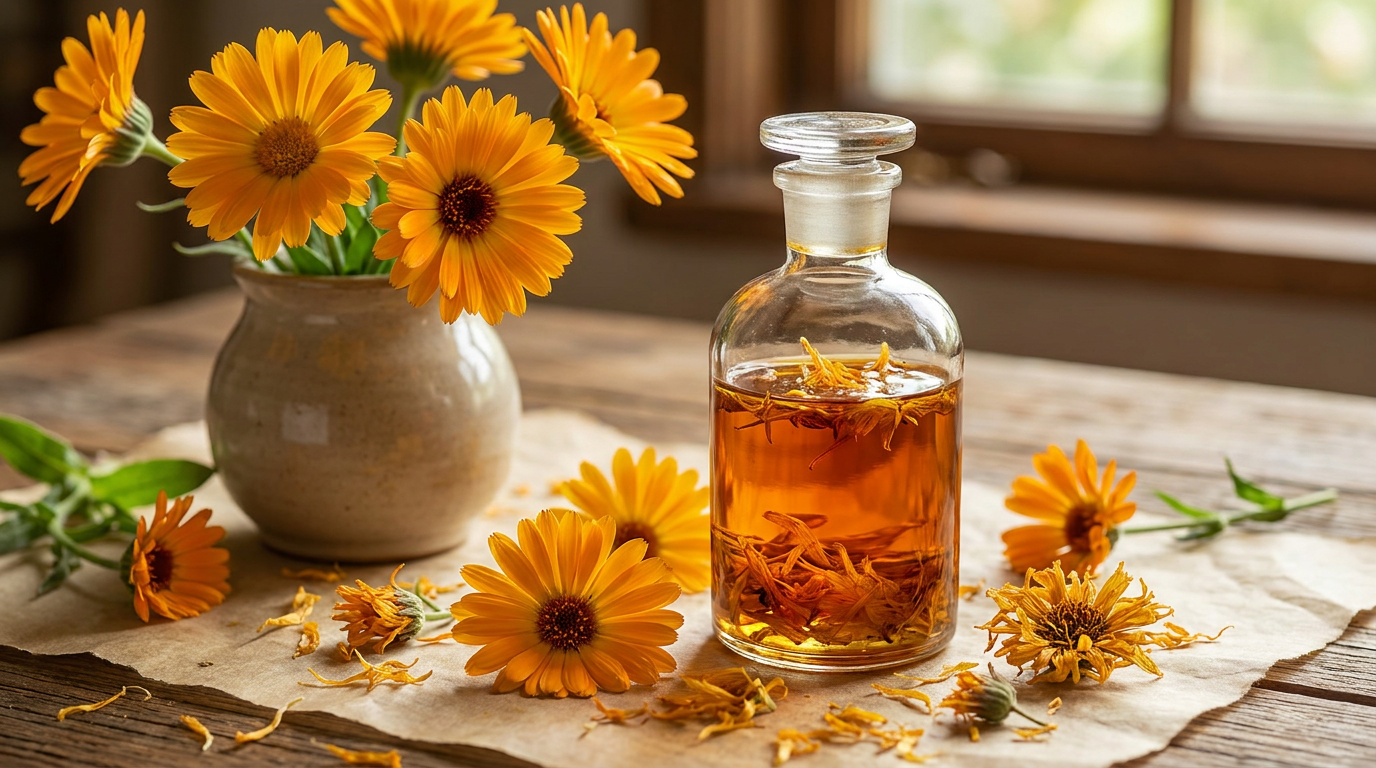
Calendula Infused Coconut Oil: How to Make and Use It
Calendula infused coconut oil is easy to make and easy to make badly, and the difference is almost entirely water and storage. Coconut oil also behaves differently from the olive or sunflower oil most recipes assume, because it is solid below room temperature. We make a calendula infused oil, not a coconut one, so what follows is what the published guidance supports for a home batch, with our process knowledge of the flower where it applies.
Calendula Oil
Our own small-batch calendula oil, in sizes from 0.5 oz to bulk.
From $13.99
Shop Calendula Oil →Decide first whether to make it
A home infusion gives you control of the oil and the flowers and a low-stakes experiment. It gives you no batch testing. Nothing in a kitchen jar tells you the peroxide value, the microbial count or whether the oil has started to oxidize. A commercial macerate's data sheet shows what a producer checks: physical constants, a peroxide-value limit and microbial limits of 1,000 CFU/g (Golgemma FB026, 2025). If you want the flower in your recipe without the guesswork, our oil is made in-house from dried flower to sealed bottle and each batch is tested by independent third-party labs, with documentation on request by lot number. If you want to make your own, read on.
Start with dried flowers, not fresh
This is where we disagree with a common recipe step. One widely read herb-supplier recipe says that if you use fresh calendula, you should wilt it for 12 hours to remove most of the moisture (Mountain Rose Herbs). Wilting does not dry a flower. The University of Maine Extension bulletin on homemade infused oils says that using dried herbs is the safest way to make infused oils because fresh material most likely carries C. botulinum spores (Bulletin 4385, written for food oils, so applying it to cosmetics is an inference). The CDC's advice on homemade oils made with garlic or herbs is blunter: refrigerate them and throw them away after 4 days, because you cannot see, smell or taste the toxin. Reasoning from those two, a fresh-flower oil in a warm jar is the setup to avoid.
Dry your own flowers properly or buy them dry. Utah State Extension says to pick the complete flower at full bloom and dry it in a ventilated place out of sunlight, which takes 1 to 5 days (Braithwaite and Drost, 2020). Oregon State's herb guidance, written for culinary leaf herbs, uses a dehydrator at 95-115 F and calls herbs dry when they crumble easily between your fingers; thick flower heads take longer, so test the center. When we buy flowers they are dried naturally by traditional methods, with no industrial heat or forced air, and we infuse petals separated by hand from sound whole-dried flower heads, not broken florets.
Pick a method that suits coconut oil
Most published methods were written for liquid oils. The solar method fills a jar two-thirds with dried flowers, covers them with oil by at least an inch, and leaves it on a sunny sill for 4 to 6 weeks, shaking daily. The warm method uses a double boiler on low to medium heat for at least 4 hours and up to 2 days, turned off whenever unattended (Soap Queen/Bramble Berry). Coconut oil is mostly saturated fat, about 82.5 g per 100 g in USDA reference data, with lauric acid at roughly 40-48%, and it is solid below room temperature (Abdalla et al., ACS Omega, 2024). Reasoning from that, on a cool windowsill the jar would be a block with petals sitting in it and little contact, so the gentle warm method suits coconut better. Keep the heat low. A kinetic study showed carotenoids in oil degrade faster as temperature rises, but its range was 120-180 C, far above an infusion, so no verified figure exists for a safe infusion temperature (Achir et al., 2010). We will not invent one; the Soap Queen method gives none either.
Ratios, and what they imply
The EU monograph lists a calendula oil extract at 1:10, flower to oil, with olive oil as the example (EMA/HMPC, 2018). A 2005 laboratory comparison found the highest carotene content, 57.5 mg/kg as beta-carotene, in an olive oil extract macerated for 72 hours at room temperature at 1:5 by weight (Novkovic et al., Hemijska industrija, 2005, abstract only). So 1:5 to 1:10 by weight is the range the literature supports, and a stronger color means more carotenoid pigment, not necessarily more of anything else. Weigh the flowers and the oil if you want to compare batches.
- Weigh dried petals or whole heads into a clean, dry jar.
- Melt the coconut oil gently and pour it over the flowers so they are fully covered; by our reasoning from the moisture guidance above, any petal left above the oil is a mold risk.
- Infuse by your chosen method, stirring or shaking; stop when the oil is deeply colored.
- Strain through cheesecloth or a coffee filter while the oil is still liquid, and press the flowers.
- Bottle in a clean, dry glass jar, label it with the date, and store it in a cool, dark place.
How long it keeps
The published shelf-life guidance disagrees because it covers different materials. The University of Maine says not to store infused homemade oils more than three months (food oils, dried herbs). Soap Queen says use within 6 months to a year depending on the carrier. Mountain Rose says 1 to 3 years for salves made with dried herbs. Do not collapse those into one number. Coconut helps here because more saturated oils resist oxidation better than linoleic-rich oils (Gharby et al., 2025), but it carries far less natural vitamin E than sunflower oil, 0.11 mg per 100 g against 41.1 in USDA data. Reasoning from both, a conservative home rule is to make small batches, refrigerate if you are unsure, and discard anything that smells sharp or off, or that shows any water droplets or mold. Our own oil carries no added tocopherol or preservatives, and we do not publish a shelf-life figure for it, so we will not claim one here.
Using it, and the comedogenic question
Used as an oil, it needs no dilution, since there is no essential oil in it. As a balm, a common starting point is about 1 part beeswax to 4 parts infused oil (Mountain Rose Herbs), but that ratio was written for liquid oils. Coconut is already solid, so by our reasoning start with less wax and test a small tin. For a full recipe see our salve article.
Coconut oil is often labeled comedogenic. Narrative reviews say so, but these ratings rest mainly on rabbit-ear tests, which their own authors called "not an ideal animal model" (Fulton et al., 1984), and a small human study found that finished products with so-called comedogenic ingredients were not necessarily comedogenic (Draelos and DiNardo, 2006). Our position is that neither "safe" nor "clogging" has been shown for your face. If you are prone to breakouts, try it on the body first and see our carrier oils article for alternatives.
Who should not use it
Calendula is in the daisy family. The EU monograph lists hypersensitivity to Asteraceae plants as a contraindication, notes skin sensitization has been reported, and does not recommend skin use under 6 years or during pregnancy and breastfeeding, because data are lacking (EMA/HMPC, 2018). Patch test first, skip it if you react, and ask a pediatrician or midwife before using it on a baby or while pregnant. If you want to avoid coconut or any specific carrier in our oil, the carrier is on the batch paperwork rather than the website: email the lot number to [email protected].
A jar of calendula in coconut oil is a fair kitchen project if the flowers are dry, the jar is clean, the batch is small and the label carries a date. For flower, drying and infusion questions we can answer firsthand, see where our oil comes from.
Calendula Oil
Nature's Golden Botanical, bottled: small-batch calendula oil in sizes from 0.5 oz to bulk.
From $13.99
Shop Calendula Oil →Sources & Further Reading
- Golgemma/Biolandes, 2025. Technical data sheet FB026, Calendula organic macerate. biolandes.com/FB026
- Mountain Rose Herbs. Calendula uses and infused olive oil recipe. blog.mountainroseherbs.com/healing-calendula
- Mountain Rose Herbs. How to make herbal salves. blog.mountainroseherbs.com/diy-herbal-salves
- University of Maine Cooperative Extension. Safe homemade flavored and infused oils (Bulletin 4385). extension.umaine.edu/4385e
- CDC. Botulism: prevention. cdc.gov/botulism/prevention
- Braithwaite L, Drost D, 2020. How to grow calendula in your garden. Utah State University Extension. extension.usu.edu/calendula-in-the-garden
- Oregon State University Extension. Drying herbs. extension.oregonstate.edu/drying-herbs
- Soap Queen (Bramble Berry). Infusing oil. soapqueen.com/?p=3674
- USDA FoodData Central, SR Legacy coconut and sunflower oil entries. fdc.nal.usda.gov
- Abdalla S, Aroua MK, Gew LT, 2024. A comprehensive review of plant-based cosmetic oils. ACS Omega 9:44019-44032. pmc/PMC11541506
- Achir N et al., 2010. Kinetic study of beta-carotene and lutein degradation in oils during heat treatment. Eur J Lipid Sci Technol 112:349-361. doi/10.1002/ejlt.200900165
- EMA/HMPC, 2018. EU herbal monograph on Calendula officinalis L., flos. ema.europa.eu/monograph
- Novkovic et al., 2005. Determination of total lipids and characterization of marigold flower extracts. Hem Ind. doi/10.2298/HEMIND0510254N
- Gharby S et al., 2025. Vegetable oil oxidation. Food Chem X 28:102541. pmc/PMC12146556
- Fulton JE Jr et al., 1984. Comedogenicity of current therapeutic products, cosmetics, and ingredients in the rabbit ear. J Am Acad Dermatol 10(1). pubmed/6229554
- Draelos ZD, DiNardo JC, 2006. A re-evaluation of the comedogenicity concept. J Am Acad Dermatol 54(3). pubmed/16488305