How to Dry Calendula Flowers for Oil, Step by Step
A fresh calendula head is bright, soft and full of water, and a good calendula oil starts with none of that water at all. Drying is the quiet step between the garden and the bottle, and it decides how clean the finished oil is. Here is how we think about it, and how to do it well in your own kitchen.

Calendula Oil
Our own small-batch calendula oil, in sizes from 0.5 oz to bulk.
From $13.99
Shop Calendula Oil →Why do dry flowers make better calendula oil?
Water and oil do not mix, and that is the whole story. Fresh petals carry moisture into an infusion, and moisture is what microbes need. The University of Maine Cooperative Extension, writing about flavored oils for the kitchen, calls dried herbs the safest way to infuse oil because dried material lacks the moisture bacteria need to grow (Bulletin #4385). That bulletin is written for food, so applying it to a skin oil is our own reasoning, but it is the cautious way to read it, and it is why we only work from dried flowers.
For our own oil, we buy flowers that were already dried naturally by traditional methods, with no industrial heat or forced air. Then we separate the petals by hand from sound, whole-dried flower heads rather than broken florets. Much of the care happens before the flower ever reaches us, and we love that the petals arrive whole, golden and intact.
Harvesting Calendula officinalis heads at full bloom
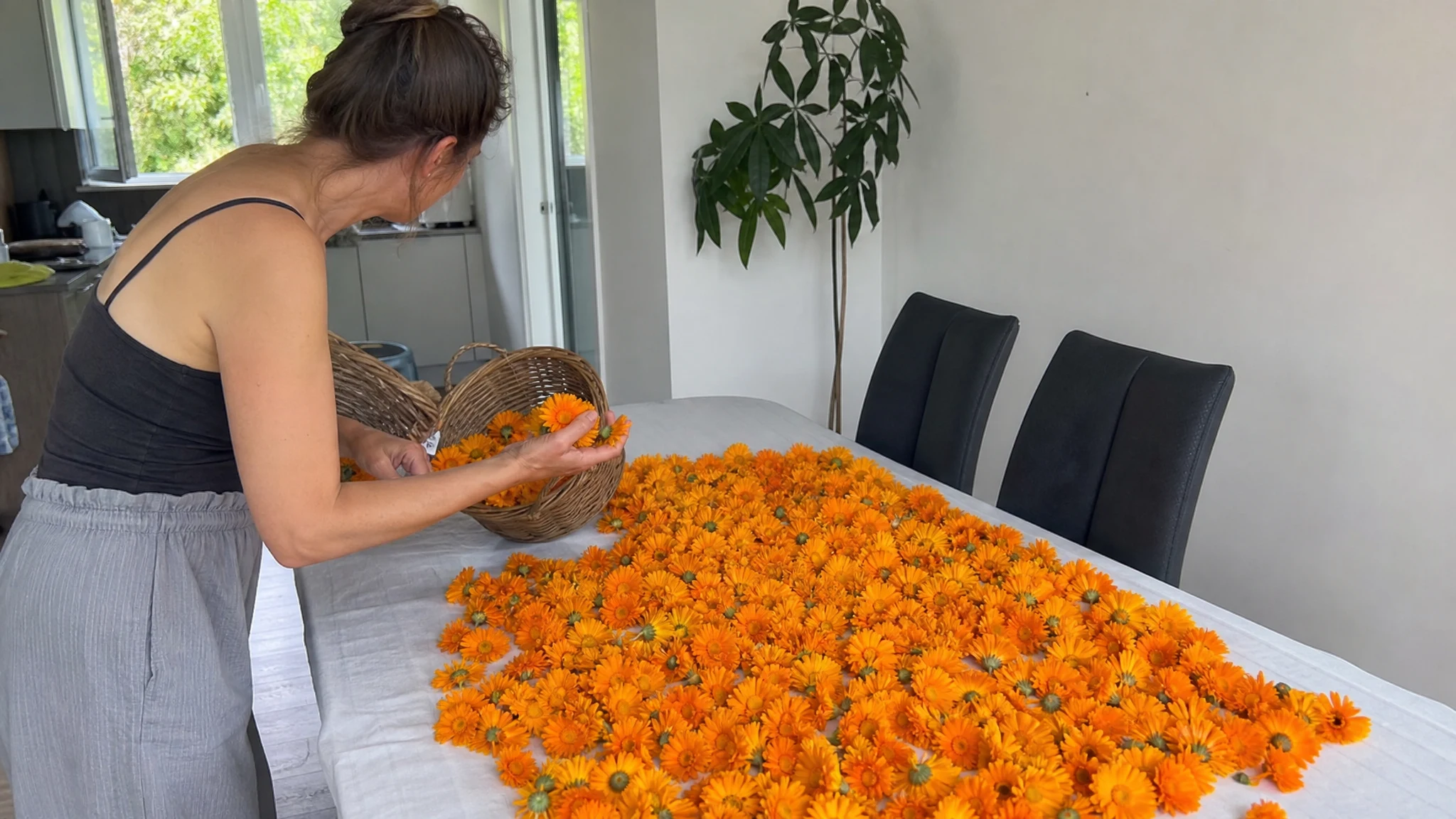
Utah State University Extension says to pick the complete flower at full bloom, and that calendula can be harvested many times in a season, with the plant re-blooming in about two weeks (How to Grow Calendula in Your Garden). That is good news for a home gardener: a few plants keep you supplied all summer. Our growing and harvesting guide covers the garden side.
Oregon State University Extension adds a tip for herbs in general: gather in the early morning after the dew has evaporated, and do not leave cut plants lying in the sun (Drying herbs). That page is about leafy culinary herbs, not calendula, but the logic carries over: a dry flower on the way in is less water to remove later.
Two drying methods for flower heads
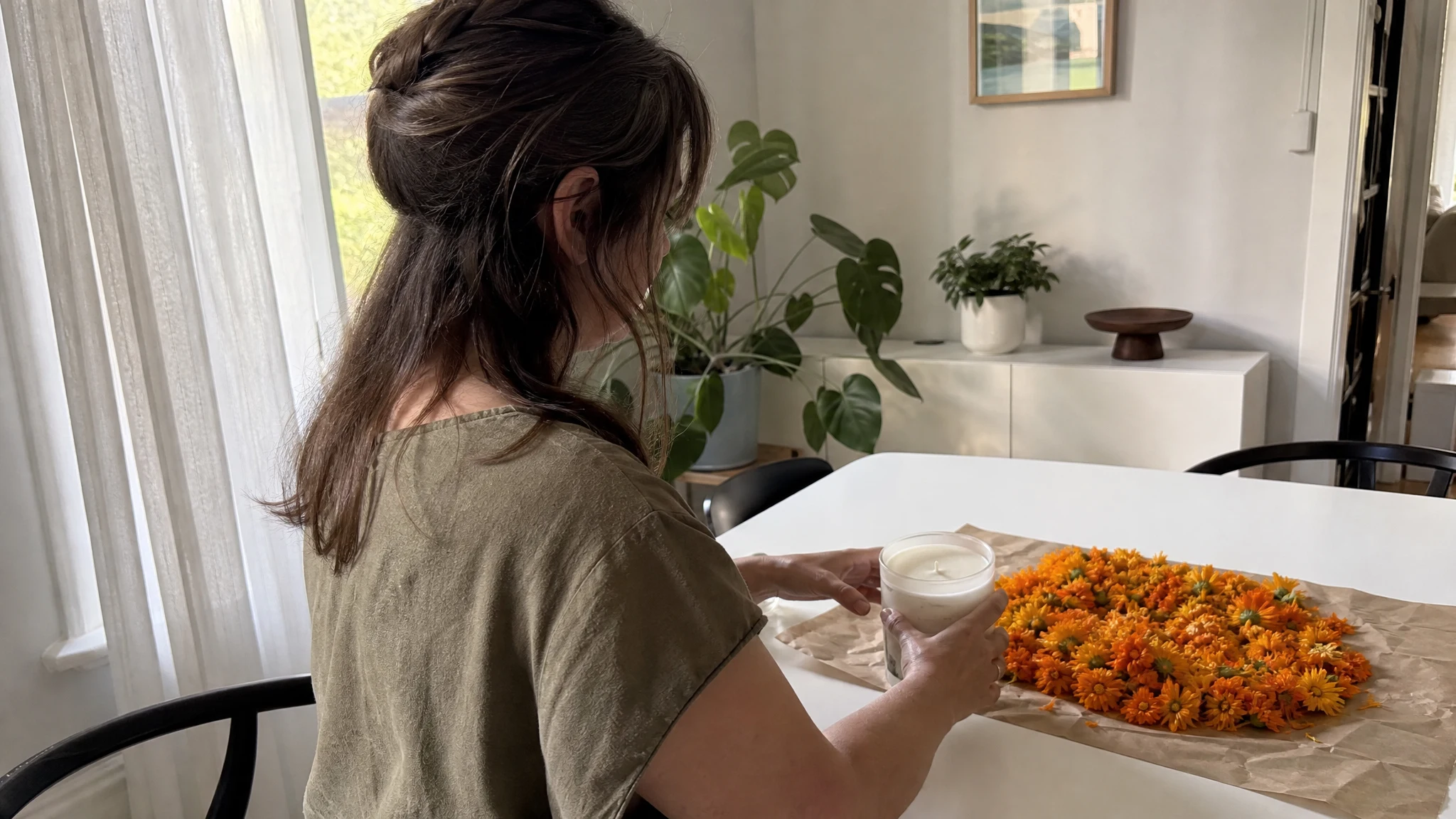
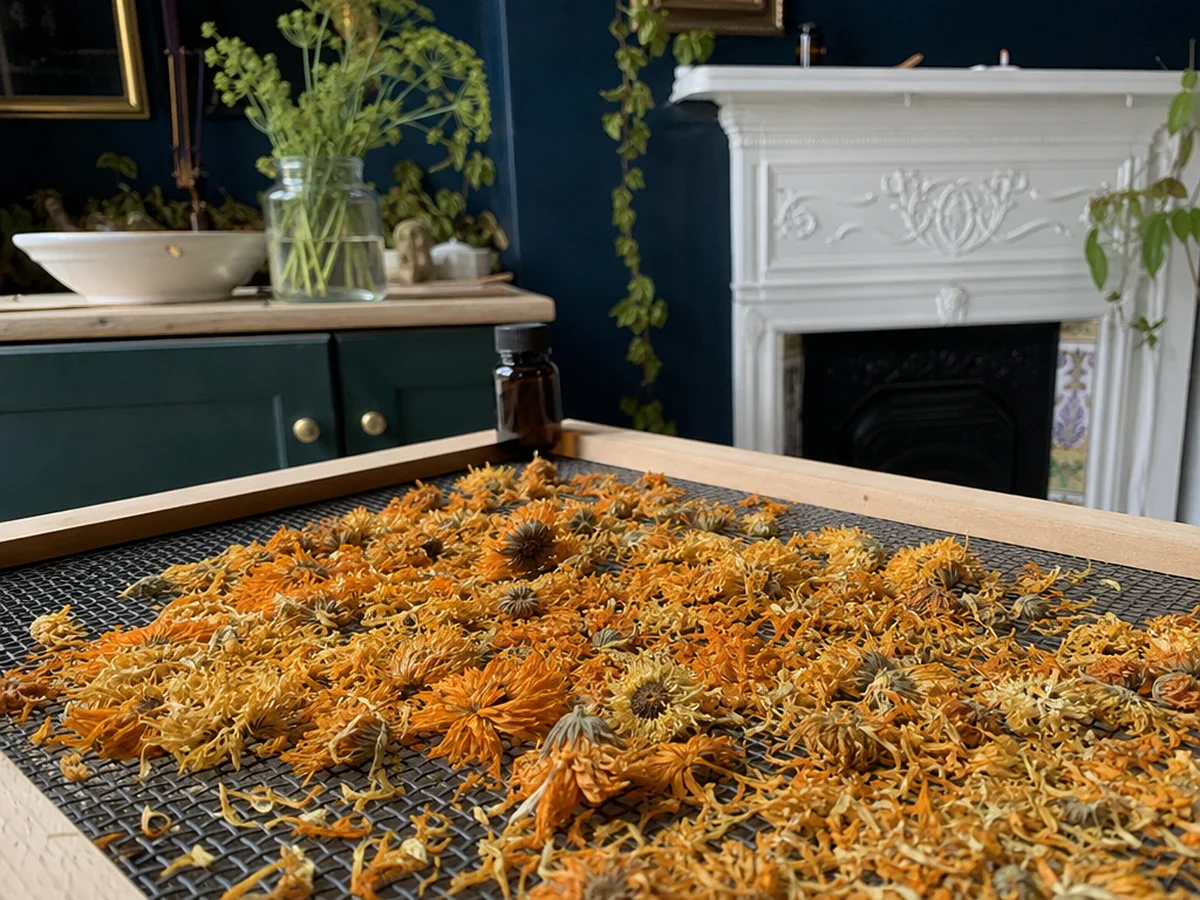
Air drying is the gentle way, and it is the one that suits calendula's thick heads. Utah State says to dry blooms in a well-ventilated place away from sunlight, and to expect 1 to 5 days. Spread the heads in a single layer on a screen or a paper-lined tray so air reaches both sides, and turn them now and then. Keeping them out of direct sun matters for a flower whose golden color is the point of the exercise.
A dehydrator is faster. Utah State notes a food dryer can work well, and Oregon State's herb guidance is to keep the temperature low, preheating to 95 to 115 F (up to 125 F in humid areas). Those numbers are for leaves, which dry in 1 to 4 hours. A calendula head is far thicker, so expect it to take longer and check it rather than trust a timer. We do not dry with machine heat ourselves, and a low setting is the closest home equivalent to that approach.
Setting up a shady, airy drying spot
You do not need special equipment. A window screen, a baking rack lined with paper, or a shallow cardboard box with a sheet of paper in the bottom will do. Choose a spot that is shady, airy and out of the kitchen steam, such as a spare room with the window cracked open. Write the date on a scrap of paper and tuck it beside the tray, so you remember when you started.
Give the heads room. Flowers piled on top of each other trap moisture, and the ones in the middle are the last to dry. A single layer, with a little air between neighbors, is the easy fix.
What do well-dried petals look like?
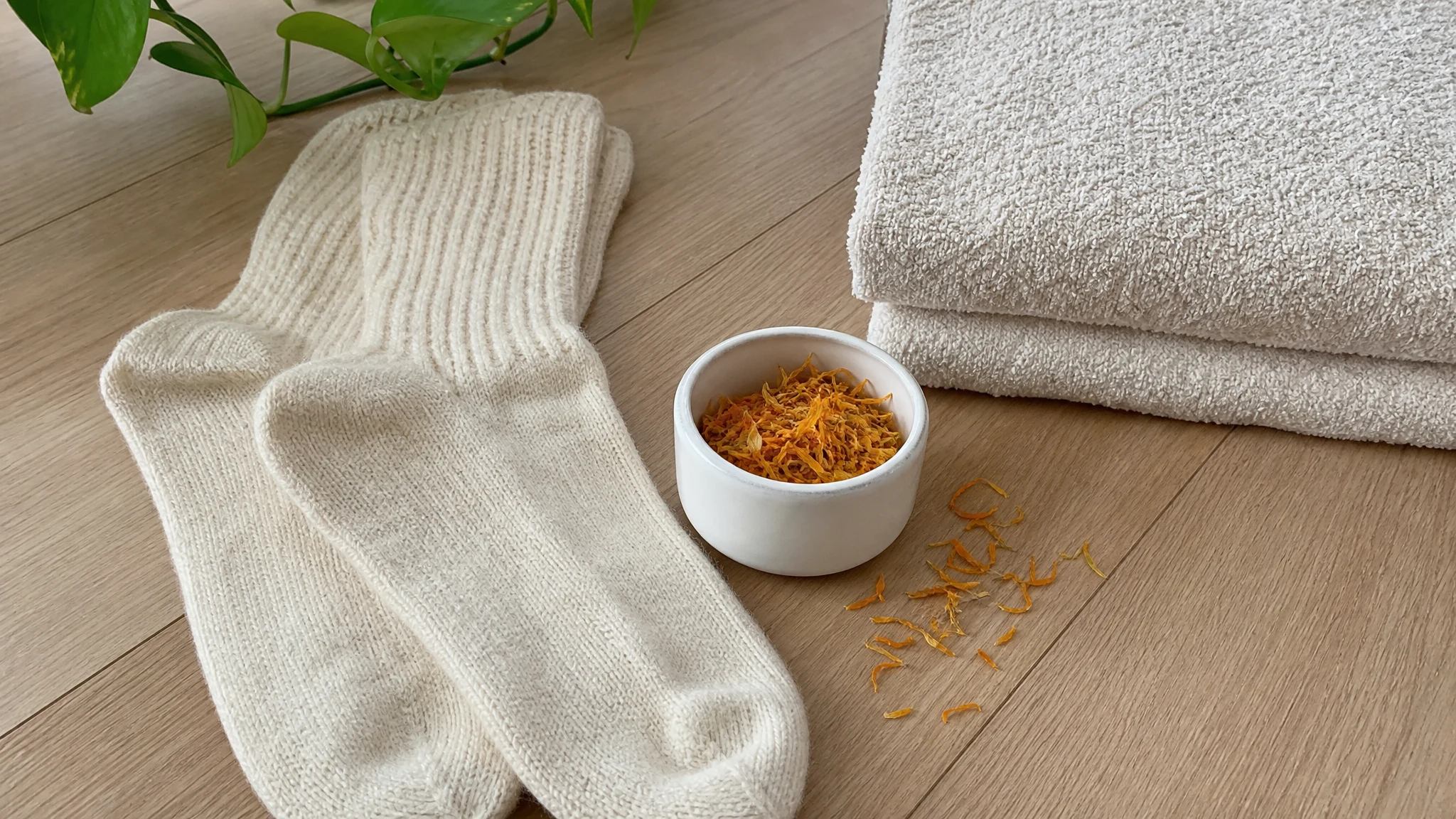
When the drying goes well, you will notice petals that are still a deep orange to gold, papery and light, with a clean, faintly herbal smell. Dull, brownish petals suggest the flowers sat too long in too much light. A musty smell is a sign they were damp for too long. Either way, trust your eyes and nose, and start a fresh tray rather than hoping.
How can you tell flower heads are fully dry?
Oregon State's test for herbs is simple and works just as well for flowers: they are dry when they crumble and stems snap when bent. For calendula, check the base of the head. The thick green cup under the petals dries last, so if it still feels cool or springy, give it another day. When in doubt, dry longer; a brittle flower costs you nothing, and a damp one can spoil a whole jar of oil.
Once dry, keep the flowers in a moisture-tight container in a cool, dark place, as Utah State advises. Oregon State says dried herbs keep well for up to a year stored that way. A quick check we suggest, as practical sense rather than a tested method: after a day in a closed jar, any fog on the glass means the flowers need more time.
Asteraceae allergy precautions when handling flowers
Calendula belongs to the daisy family. The European Union herbal monograph lists hypersensitivity to plants of the Asteraceae family as a contraindication (European Union herbal monograph on Calendula officinalis L., flos). If daisies or ragweed bother you, talk with an allergist before handling the flowers, and read our piece on calendula and ragweed allergy.
When your flowers are crisp and golden, the next step is the infusion itself, and our home infusion guide walks through it. Dry flowers, a clean jar and patience are most of what a good oil needs.
Calendula Oil
Nature's Golden Botanical, bottled: small-batch calendula oil in sizes from 0.5 oz to bulk.
From $13.99
Shop Calendula Oil →Sources & Further Reading
- University of Maine Cooperative Extension. Bulletin #4385, Safe Homemade Flavored and Infused Oils. extension.umaine.edu
- Utah State University Extension. How to Grow Calendula in Your Garden. extension.usu.edu
- Oregon State University Extension. Drying herbs. extension.oregonstate.edu
- European Medicines Agency, HMPC. European Union herbal monograph on Calendula officinalis L., flos. ema.europa.eu