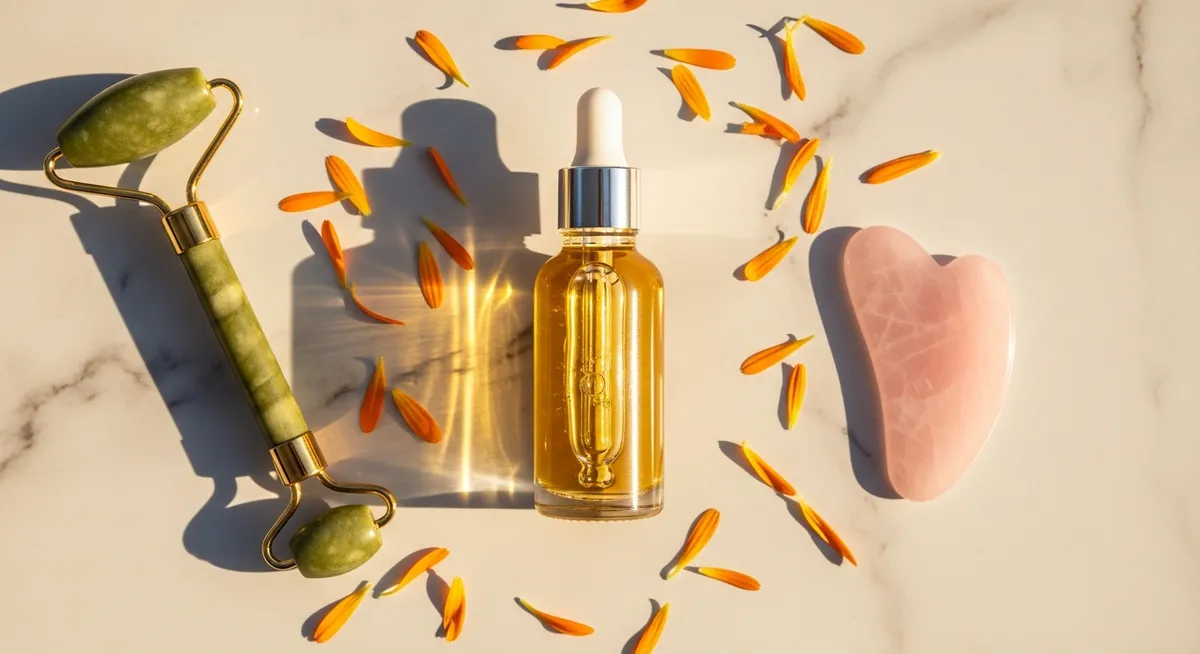
DIY Calendula Oil Face Serum for Anti-Aging
A home-made calendula oil serum is a moisturiser, and it is worth being clear about that before you spend an afternoon on it. The skin-aging evidence ranks a few things well above anything in an oil blend, and calendula's own data on aging skin is thin. If you still want to make one, because you like oils on your face, the later sections cover how to do it with fewer ways to go wrong.

Calendula Oil
Our own small-batch calendula oil, in sizes from 0.5 oz to bulk.
From $13.99
Shop Calendula Oil →What the aging-skin evidence puts first
Two products sit well ahead of any botanical. The American Academy of Dermatology recommends sunscreen that is broad-spectrum, SPF 30 or higher and water resistant, reapplied about every two hours or after swimming or sweating. And a 2024 systematic review of 25 studies called topical tretinoin the gold standard therapy for photoaging while noting its poor tolerability often limits its use (Siddiqui et al., 2024). The same review found that most studies comparing other topicals with tretinoin were of poor quality or biased, so there is no substantial evidence for an alternative first-line option. Tretinoin is a prescription drug, so that is a conversation with a dermatologist or other prescriber.
None of this makes oils useless. It means that a serum, whatever its ingredients, belongs after sun protection in the order of what matters, and that "anti-aging" on a bottle of oil is a marketing phrase, not a finding.
Where calendula sits
The human data are small. In an eight-week study of 21 healthy volunteers, a calendula extract cream was compared with a base cream on the cheeks; two of seven cutometer parameters differed significantly, and the authors described improved hydration and firmness, but the study did not assess wrinkles (Akhtar et al., 2011). A 2015 review of herbal anti-aging creams, calendula among about 27 botanicals, concluded that evidence-based studies of the anti-aging effects are still needed (Jadoon et al., 2015). Both concern extract creams, not an infused oil.
Laboratory papers are more enthusiastic and far less relevant. A 2021 study of creams containing encapsulated calendula essential oil reported an in vitro SPF of 18.54 and inhibition of collagen- and elastin-degrading enzymes in test tubes, with no human outcome measured (Lohani et al., 2021). Essential oil is a steam-distilled material, a different thing from the orange infused oil we make, and a spectrophotometer reading is not a sun-protection test on skin. We do not know the SPF of our oil and do not claim one. Sunscreens are regulated as over-the-counter drugs with SPF determined by a standardized test (FDA). Read more in our SPF article.
What an oil serum honestly does
Reasoning from the above: an oil on the face is an emollient, a layer that slows water loss from the surface and changes how the skin feels. That is a real, modest benefit for dry skin and no evidence about wrinkles. Whether a particular oil clogs pores for a particular person is also unsettled. The rabbit-ear tests behind many comedogenic scales were described by their own authors as "not an ideal animal model" (Fulton et al., 1984), and a six-person human study found that finished products using comedogenic-rated ingredients are not necessarily comedogenic (Draelos and DiNardo, 2006). If you are acne-prone, treat a new face oil as a trial, one product at a time. Our comedogenicity article goes through this.
If you build one anyway
Choose the base blend for stability as much as for feel
Our oil already contains a carrier, and the batch paperwork lists which (email the lot number to [email protected]). Anything you add changes how quickly the blend goes off. A 2025 review reported relative oxidation rates for pure fatty acids of 1 for stearic, 10 for oleic, 100 for linoleic and 150 for linolenic acid, so oils richer in linoleic or linolenic acid oxidise much faster than oleic-rich or saturated oils, and light, heat, oxygen and metals speed the process (Gharby et al., 2025). Those numbers are for pure acids at high temperature, so they show direction, not shelf life. In a 2026 accelerated test, rosehip oil had the shortest oxidation induction time among rosehip, sunflower, olive and jojoba oils, correlating with polyunsaturated fat level (Fagoaga et al., 2026). Practical consequence, reasoning from those sources: a serum built largely from rosehip, hemp or grapeseed oil is the kind most likely to go rancid on your shelf, so make it small and date it.
We add no tocopherol or preservative to our oil, so we cannot lean on one to protect a blend. Suppliers add tocopherol to slow oxidation, which delays rancidity rather than preventing it. If a bottle smells sharp, paint-like or stale, retire it.
Keep water out of it
A serum made only from oils is an anhydrous product, which preservation reviews treat as the lower-risk category; once water, hydrosol or aloe goes in, you have an emulsion that needs a preservative and testing (Halla et al., 2018). Keep to oils, keep tools dry, and do not dip wet fingers into the jar.
Think twice about essential oils
Many "anti-aging serum" recipes add essential oils. The Tisserand Institute suggests 0.5-1.2% for facial cosmetics and 0.2-1% for sensitive or impaired skin and notes that allergic reactions are the most common reaction type. Each added ingredient is one more candidate if the skin reacts, and none of them has trial evidence for aging. Our view, as a reasoned precaution: leave them out of a first batch. If you want a scent, see the carrier oil article for base-oil choices instead.
Who should not use it
- Anyone allergic to daisy-family plants. The EU herbal monograph lists hypersensitivity to Asteraceae as a contraindication. In one Austrian patch-test series, about 2% of 443 dermatitis patients reacted to marigold (Reider et al., 2001); those were clinic patients, not the general population. Patch test first: our guide.
- Pregnant or breastfeeding readers. The EU committee says safety has not been established and use is not recommended without sufficient data (EMA/HMPC, 2018). That is a statement about missing data, not a finding of harm; ask an OB/GYN or midwife, and see the pregnancy guide.
- Anyone using prescription retinoids or other actives should ask their prescriber before adding oils; we have no interaction data to offer.
So make the serum if you enjoy it, patch test it, keep it small and plain, and put sunscreen first. If you want the wider routine picture, our routine article covers it. We make the oil; the claims that an oil reverses aging are not ours to make.
Calendula Oil
Nature's Golden Botanical, bottled: small-batch calendula oil in sizes from 0.5 oz to bulk.
From $13.99
Shop Calendula Oil →Sources & Further Reading
- American Academy of Dermatology. Sunscreen recommendations. aad.org
- Siddiqui Z et al., 2024. Comparing tretinoin to other topical therapies in the treatment of skin photoaging: a systematic review. Am J Clin Dermatol. PMID 39348007
- Akhtar N et al., 2011. Calendula extract: effects on mechanical parameters of human skin. Acta Pol Pharm. PMID 21928714
- Jadoon S et al., 2015. Anti-aging potential of phytoextract loaded-pharmaceutical creams for human skin cell longevity. Oxid Med Cell Longev. PMID 26448818
- Lohani A et al., 2021. Topical delivery of geranium/calendula essential oil-entrapped ethanolic lipid vesicular cream to combat skin aging. Biomed Res Int. PMID 34552986
- U.S. Food and Drug Administration. Sunscreen: how to help protect your skin from the sun. fda.gov
- Fulton JE Jr et al., 1984. Comedogenicity of current therapeutic products, cosmetics, and ingredients in the rabbit ear. J Am Acad Dermatol. PMID 6229554
- Draelos ZD, DiNardo JC, 2006. A re-evaluation of the comedogenicity concept. J Am Acad Dermatol. PMID 16488305
- Gharby S et al., 2025. Vegetable oil oxidation: mechanisms, impacts on quality, and approaches to enhance shelf life. Food Chem X. PMC12146556
- Fagoaga C et al., 2026. Oxidative stability and kinetics of oxidation of rosehip, sunflower, olive and jojoba oils. Antioxidants. PMC13203508
- Halla N et al., 2018. Cosmetics preservation: a review on present strategies. Molecules. PMID 29958439
- Tisserand Institute. Dilution for essential oils. tisserandinstitute.org
- Reider N et al., 2001. The seamy side of natural medicines: contact sensitization to arnica and marigold. Contact Dermatitis. PMID 11722485
- European Medicines Agency, HMPC, 2018. EU herbal monograph on Calendula officinalis L., flos (EMA/HMPC/437450/2017). ema.europa.eu