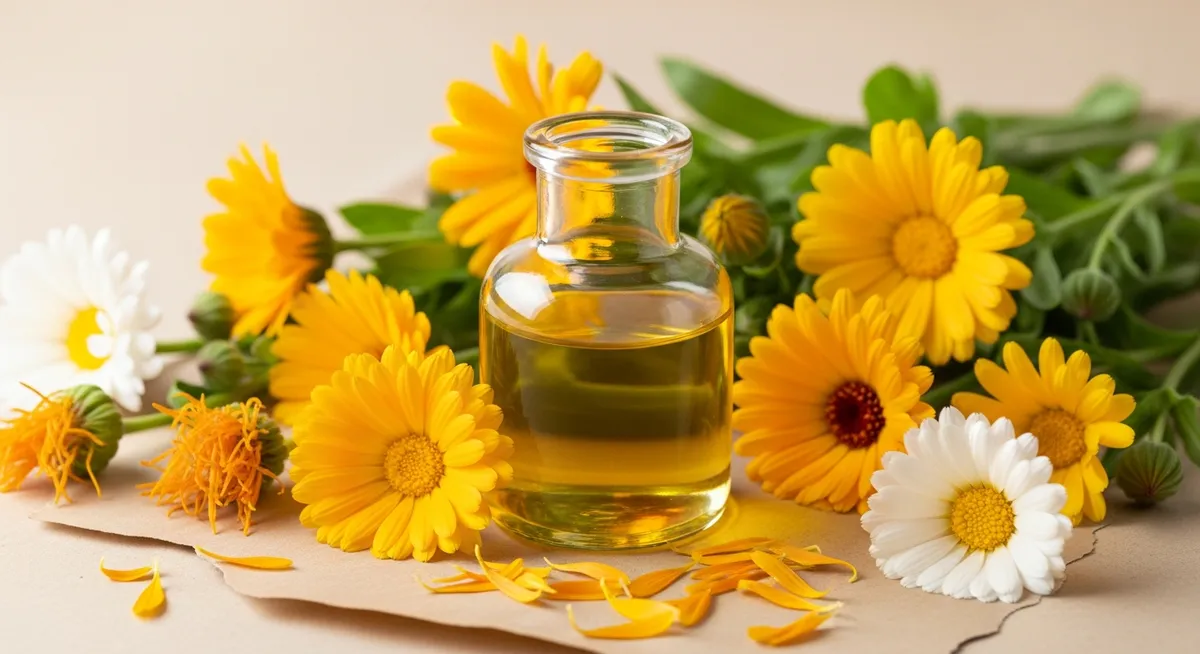
Calendula Oil in Pregnancy and Postpartum: What the Sources Say
The sources that give guidance on calendula in pregnancy and breastfeeding lean the same way: avoid it, because safety data are lacking. That is an absence-of-evidence position, not a documented harm, and one source cited in the EU's own assessment takes a milder view of external use. We make a calendula oil and we sit with the cautious sources: we do not recommend our oil during pregnancy or breastfeeding without your midwife's or OB/GYN's agreement. Below is how the evidence breaks down by stage, since the question differs for a pregnant belly, a fresh perineal or cesarean wound, and a nursing mother's nipples.

Calendula Oil
Our own small-batch calendula oil, in sizes from 0.5 oz to bulk.
From $13.99
Shop Calendula Oil →How strongly the sources say it
They agree that data are missing, and differ on how firmly to advise avoidance:
- The EU herbal committee's 2018 monograph says safety during pregnancy and lactation has not been established and, "in the absence of sufficient data," use is not recommended. No fertility data are available.
- Memorial Sloan Kettering tells patients not to take calendula if pregnant or breastfeeding, and tells clinicians to avoid it because safety data are lacking. Its advice is aimed at cancer patients and is written mostly about taking it by mouth.
- The EMA's assessment report cites a 2003 ESCOP monograph as having no objections to external use in pregnancy and lactation, while noting there are no data to confirm safety.
- NIH's LactMed says no information is available on oral calendula during breastfeeding and discusses topical use on nipples (below).
We would not average these into a verdict. They agree on what is unknown, and that is the point to take away.
During pregnancy: what has not been tested
The monograph's preclinical section says adequate tests on reproductive toxicity and carcinogenicity have not been performed. The Cosmetic Ingredient Review panel's 2010 assessment concluded calendula-derived cosmetic ingredients were safe as used, but it stated that the absence of reproductive and developmental toxicity was inferred from repeat-dose studies of coriander oil, which has a similar composition. That is an inference from a different plant, and it is not calendula data. We read those two statements together as the honest state of knowledge: no evidence of harm, and no direct evidence of safety.
We also looked for a trial of calendula for stretch marks, the reason many people ask. We found none, so we cannot cite any benefit there. If you are weighing it for pregnancy skin generally, a plain fragrance-free moisturizer your OB/GYN or midwife already approves has an easier case to make than a botanical with no pregnancy data.
After the birth: the trials were ointments in clinical settings
The postpartum studies are the strongest calendula material connected to this topic, and they are worth reading carefully. A 2022 Italian trial (De Angelis et al.) randomised 100 women after episiotomy to calendula ointment, applied 4 hours after the procedure and then every 8 hours for 10 days, or to standard care. The calendula group reported lower pain from day two onward, with less redness and swelling. A 2018 Iranian trial (Jahdi et al.) of 72 women compared calendula ointment with routine care after cesarean section, scoring wounds on days 3, 6 and 9; the abstract reports no scores. A 2013 trial of 111 women used a combined aloe vera and calendula ointment, so calendula's share cannot be separated.
Three things limit what this shows for a bottle of oil. Each used an ointment, not an infused oil, and the concentration is not stated in the abstracts we read. Each compared against routine care, not a placebo ointment. And each was run with clinical staff, on wounds that were being monitored. Reasoning from that, putting an oil that we do not describe as sterile on a fresh perineal tear or cesarean incision is not the situation those trials studied. Whoever delivered you can say whether anything goes on the wound at all, and which product.
Breastfeeding and nipple care
LactMed notes that topical calendula has been used for sore and cracked nipples, "although little high-quality evidence supports this use." The studies it describes involved calendula combined with other ingredients (one with Mimosa tenuiflora, one with Echinacea), which it says makes judging calendula alone impossible. A 2014 Cochrane review of interventions for painful nipples (Dennis et al.) pooled four good-quality trials with 656 women, testing glycerine pads, lanolin, expressed breast milk and an all-purpose nipple ointment. None of the interventions was calendula. So no calendula-only nipple trial turned up in what we reviewed.
The EMA monograph also says skin use in children under 6 has not been established for lack of data, and a nursing infant will take in whatever is on the nipple. Reasoning from those two facts, a lactation consultant, not a product page, should decide what goes on the breast before a feed.
What to bring to the appointment
A short list makes the conversation useful. Bring the bottle, so the clinician can see the lot number and the ingredient list. Say what you want the product for (dry skin, a healing incision, sore nipples), because the answer differs for each. Say whether you have reacted to ragweed, chamomile, arnica or chrysanthemum. And ask two direct questions: is there anything on this list that should not go on skin in my situation, and is there a product you would rather I used for this purpose? The second question matters because for most of these uses, such as a perineal wound or sore nipples, clinicians already have products they have reasons to prefer, and we would not want our oil to displace one of them.
If you decide to use it anyway
Some pregnant and nursing readers will weigh the same sources and decide differently, with their clinician's agreement. In that case:
- Pregnancy does not change allergy risk. Calendula is in the daisy family and the EMA lists Asteraceae hypersensitivity as a contraindication. Patch test first; our allergy FAQ covers how.
- Ask us for the carrier oil. Our oil is made from a calendula-only extract brought into a carrier oil, with no added preservatives, tocopherol or stabilizers. The carrier is on the batch paperwork: email the lot number from the bottle to [email protected] so your midwife can review both ingredients.
- Intact skin only. Not on open wounds, incisions or cracked nipples without clinician approval.
- Stop at any redness, itching or burning. The EMA's 2025 review of adverse-event reports lists exactly those, in 15 reports.
For the Q&A version of this topic, see the pregnancy FAQ, and for the wider safety table, dosage and side effects. If you want to know how our oil is made, here is where it comes from.
Calendula Oil
Nature's Golden Botanical, bottled: small-batch calendula oil in sizes from 0.5 oz to bulk.
From $13.99
Shop Calendula Oil →Sources & Further Reading
- EMA/HMPC, 2018. European Union herbal monograph on Calendula officinalis L., flos. ema.europa.eu/EMA/HMPC/437450/2017
- EMA/HMPC, 2018. Assessment report on Calendula officinalis L., flos. ema.europa.eu/EMA/HMPC/603409/2017
- Memorial Sloan Kettering Cancer Center, 2023. About Herbs: Calendula. mskcc.org/calendula
- NIH LactMed, 2021. Calendula. pubmed/30000917
- Andersen et al., 2010. CIR amended safety assessment of Calendula officinalis-derived cosmetic ingredients. Int J Toxicol. pubmed/21164072
- De Angelis et al., 2022. Use of calendula ointment after episiotomy: a randomized clinical trial. J Matern Fetal Neonatal Med. pubmed/32460565
- Jahdi et al., 2018. The impact of calendula ointment on cesarean wound healing. J Family Med Prim Care. pubmed/30598929
- Eghdampour et al., 2013. Aloe vera and Calendula on perineal healing after episiotomy. J Caring Sci. pubmed/25276736
- Dennis et al., 2014. Interventions for painful nipples among breastfeeding women. Cochrane Database Syst Rev. pubmed/25506813
- EMA/HMPC, 2025. Addendum to assessment report on Calendula officinalis L., flos. ema.europa.eu/EMA/HMPC/12880/2025